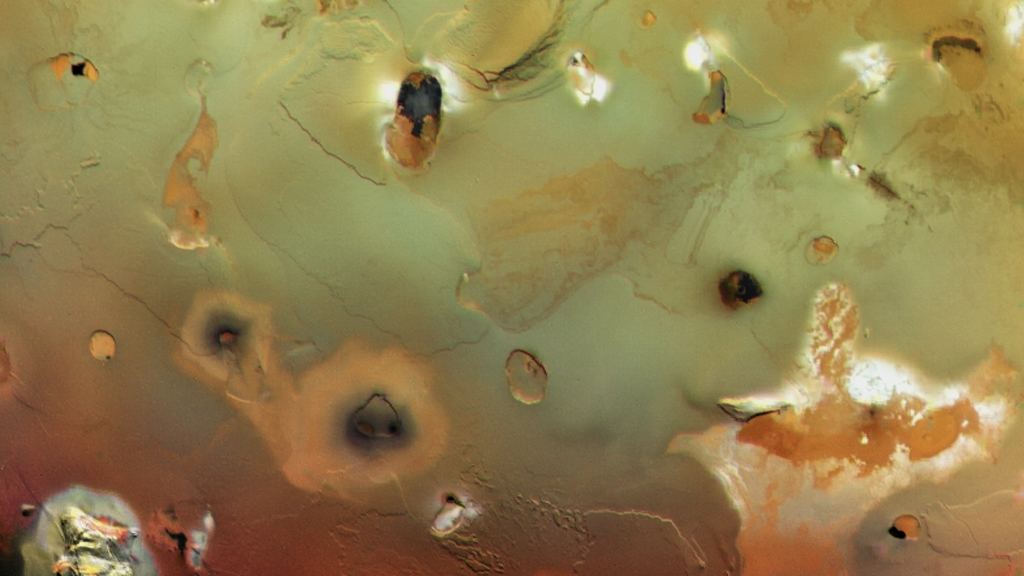
Where is This? April 15, 2022 Quiz

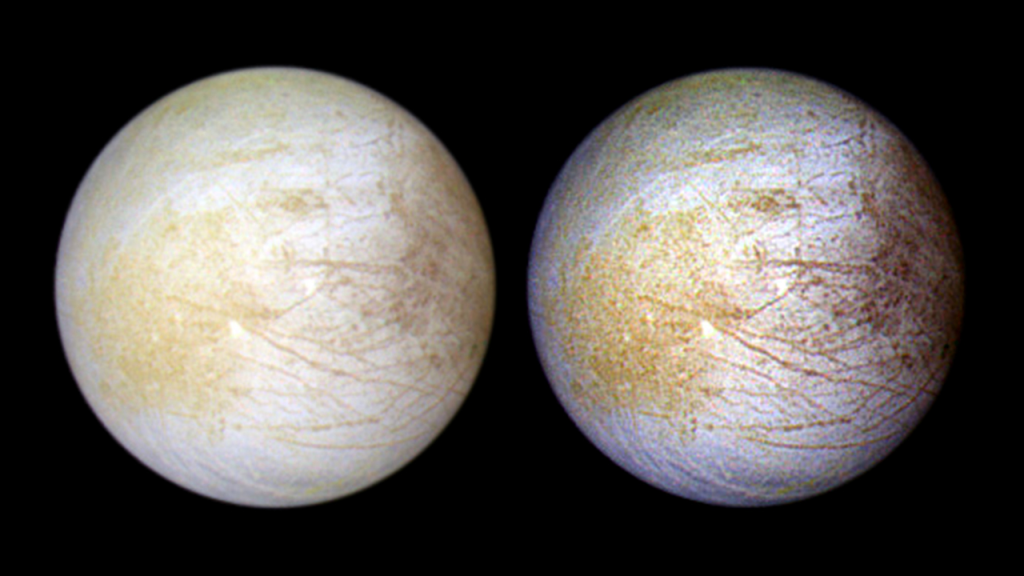
This week’s photo of Jupiter’s moon Europa was taken by the Hubble Space Telescope in June 1997 (and released by NASA on October 14, 2021). Here is the story about these two images (the left one in natural color and the right one enhanced) from the Hubble site:
This photograph of the Jovian moon Europa was taken in June 1997 at a range of 776,700 miles by NASA’s Galileo spacecraft.
Slightly smaller than Earth’s moon, Europa has a very smooth surface and the solid ice crust has the appearance of a cracked eggshell. The interior has a global ocean with more water than found on Earth. It could possibly harbor life as we know it.
Hubble Space Telescope observations of Europa have revealed the presence of persistent water vapor in its very tenuous atmosphere. Hubble observations, spanning 1999 to 2015, find that water vapor is constantly being replenished throughout one hemisphere of the moon. This is a different finding from Hubble’s 2013 observations that found localized water vapor from geysers venting from its subsurface ocean. This water vapor comes from a different process entirely. Sunlight causes the surface ice to sublimate, transitioning directly into gas.
This color composite Galileo view combines violet, green, and infrared images. The view of the moon is shown in natural color (left) and in enhanced color designed to bring out subtle color differences in the surface (right). The bright white and bluish part of Europa’s surface is composed mostly of water ice, with very few non-ice materials. Long, dark lines are fractures in the crust, some of which are more than 1,850 miles long.
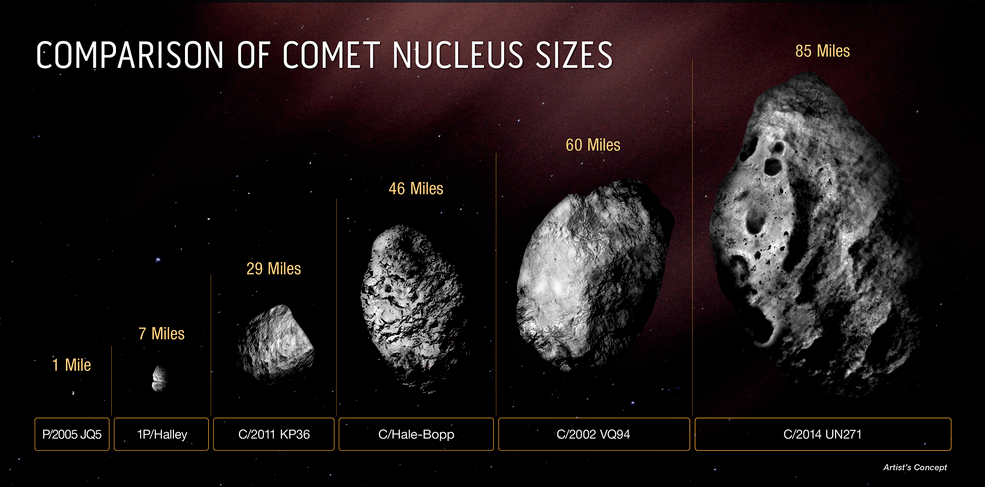
A monster comet that takes 3 million years to circle the Sun is being closely analyzed by astronomers. The comet, C/2014 UN271 (Bernardinelli-Bernstein), will come closest to the Sun in 2031, but even then it will be about 1 billion miles away. At the most distant point in its orbit, the comet is about half a light year away from the Sun.
As shown in the graphic above, this is a large comet that could fully cover the state of Rhode Island. It was first detected by astronomers back in November 2010, when it was still 3 billion miles from the Sun. With the help of the Hubble Space Telescope, the astronomers were able to learn more about it this year.
The comet is believed to be a product of the Oort Cloud circling far outside our solar system. Of course, the Oort Cloud itself is a theory that has never been directly observed. But what about the Voyager spacecraft that left our solar system? Well, if you are willing to wait another 300 years, and the spacecraft are still working, you may have an answer.
You can read more about the comet at this NASA site.

On this day in 1961, Russian cosmonaut Yuri Gagarin became the first human to go into outer space. He was launched into orbit aboard the Soviet Vostok 1 spacecraft. He orbited the Earth for 108 minutes before landing in Kazakstan. He did not come down in the capsule, but instead landed separately using a parachute.
Yuri Gagarin was later quoted as saying:
When I orbited the Earth in a spaceship, I saw for the first time how beautiful our planet is. Mankind, let us preserve and increase this beauty, and not destroy it!
It was his only flight into space. He died in 1968 in a training flight accident.
The following month, on May 5, 1961, Alan B. Shepard became the first American in space. He was aboard a Mercury capsule named Freedom 7.

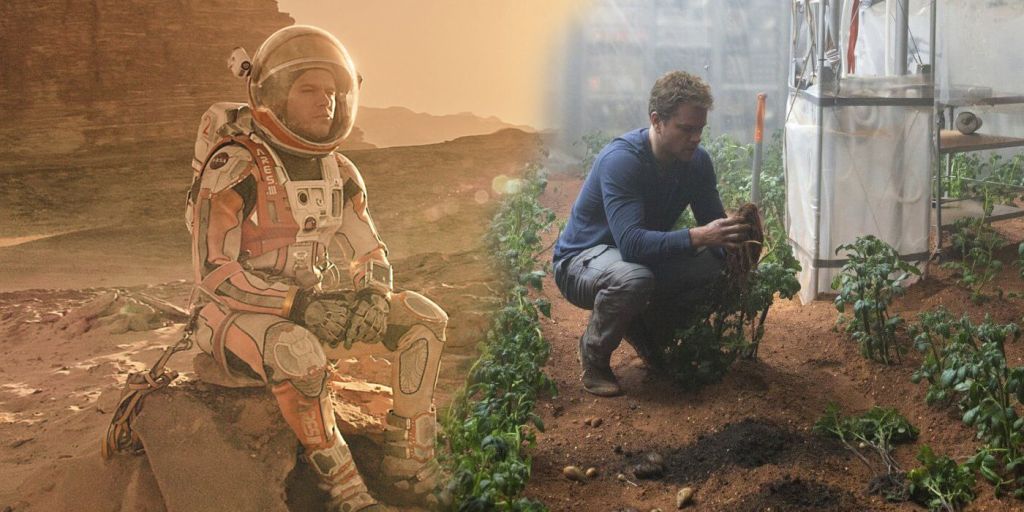
Back in a November 2020 article, Science News discussed the difficulties of farming on Mars, noting it was not as easy as Matt Damon’s character made it seem in the film The Martian. In fact, toxins discovered in the Martian soil has proven that growing potatoes with a bit of man-made manure is not possible.
In the article, “Farming on Mars will be a Lot Harder Than ‘The Martian’ Made it Seem,” the author noted that researchers put together a variety of soil samples to match the surface of Mars and determined that the soil that most closely matched the Martian soil was unable to grow vegetation for any length of time. Once that soil was modified to include calcium perchlorate, which makes up about 2 percent of Martian soil, nothing could grow at all. In other words, Matt Damon would have starved if he only had a latrine to support him.
The researchers are testing other possible soil types using materials that can be found on Mars, so Martian potatoes (or at least legumes) may be possible. We will just need to send Mr. Damon back to Mars to test these new approaches.
Extra: The BBC’s Science Focus website posted a more hopeful article around the same time highlighting what can be grown on Mars, but it also outlined a number of problems that will impact Martian farming, including less sunlight, lower temperatures, thinner atmosphere, radiation, and extreme seasonal variations. We don’t always realize how good we have it back here on our home planet.
 Our Awesome Universe