Image (Credit): SpaceX AX-1 mission to the International Space Station. (SpaceX)
“We are not space tourists.”
– Statement by Michael López-Alegría who traveled as a private citizen (and former NASA astronaut) to the International Space Station (ISS) on Friday as part of SpaceX’s AX-1 mission.
Why does this remind me of the statement “I am not a crook”? Mr. López-Alegría leads the mission carrying three wealthy passengers who spent about $55 million apiece to stay on the ISS for eight days and basically get in the way of working astronauts. I thought Bigelow was working on inflatable space hotels. Wouldn’t that be more appropriate? And maybe that $55 million could go towards STEM classes for students who want to go to space as a career rather than a joyride. Just an idea.
Image (Credit): Artist’s rendering of a Bigelow inflatable space station. (Bigelow Space Ops)
Image (Credit): This timeline illustrates the earliest galaxy candidates as well as the history of the universe.(Harikane et al., NASA, EST and P. Oesch/Yale)
Just recently I posted about the discovery of the farthest star. Well, now astronomers have spotted the farthest galaxy. The Harvard Gazette reports that a galaxy named HD1 appears to be about 13.5 billion light-years away and may contain the universe’s first stars or even the earliest black hole discovered to date. The contents of this galaxy is still being studied (and theorized).
The story quotes Fabio Pacucci, an astronomer at the Center for Astrophysics who was involved in the discovery, who stated:
Answering questions about the nature of a source so far away can be challenging… It’s like guessing the nationality of a ship from the flag it flies, while being faraway ashore, with the vessel in the middle of a gale and dense fog. One can maybe see some colors and shapes of the flag, but not in their entirety. It’s ultimately a long game of analysis and exclusion of implausible scenarios.
More review of the data as well as updated data from the James Webb Space Telescope at some point in the future should help to answer questions related to this galaxy.
Image (Credit): Launch vehicles for Amazon’s Project Kuiper. (Amazon)
Watch out SpaceX, Amazon is getting into the Internet satellite business as well. More importantly, beware astronomers and orbiting spacecraft, because the skies are going to be really crazy, and China has not even started with its massive program.
This week, Amazon announced plans to more forward with Project Kuiper, which will involve about 83 rocket launches involving Arianespace, Blue Origin, and United Launch Alliance. The Project will place 3,236 satellites into low Earth orbit (LEO) over a five-year period.
This is how Amazon describes Project Kuiper:
Project Kuiper aims to provide high-speed, low-latency broadband to a wide range of customers, including individual households, schools, hospitals, businesses, government agencies, disaster relief operations, mobile operators, and other organizations working in places without reliable internet connectivity. Amazon is designing and developing the entire system in-house, combining a constellation of advanced LEO satellites with small, affordable customer terminals and a secure, resilient ground-based communications network.
Of course, this is what SpaceX’s Starlink is already doing as it aims for 42,000 such satellites. In addition, Oneweb aims for about 600 such satellites (to be launched by SpaceX of all firms). And China is considering a similar system of 10,000 LEO satellites. This is just the list to date, which is quite a cluster of problems already.
So let me get this straight. We can get Dish TV cable services to every spot in the US using only 9 satellites, but we will need thousands and thousands of competing satellites crowding LEO and jeopardizing our space stations, weather and intelligence satellites, and astronomy efforts all for Internet services?
Why does it appear we are going backwards. I understand that the Dish satellites are about 22,000 miles away in geosynchronous orbits, but why can’t that be the model going forward rather than the billions of satellites that Mr. Musk thinks is possible? It strikes me as crazy to go down this path. All we need is one bad collision, and the cascading impact of that collision, to doom all of LEO.
Image (Credit): The nebula surrounding the star AG Carinae (ESA/Hubble and NASA, A. Nota, C. Britt)
This week’s photo is from the Hubble Space Telescope. It shows the “puffing dust bubbles and an erupting gas shell,” or nebula, surrounding the monster star AG Carinae. Here is the rest of the story from the European Space Agency (ESA) Hubble site:
This giant star is waging a tug-of-war between gravity and radiation to avoid self-destruction. The star is surrounded by an expanding shell of gas and dust — a nebula — that is shaped by the powerful winds emanating from the star. The nebula is about five light-years wide, equal to the distance from here to our nearest star, Alpha Centauri.
AG Carinae is formally classified as a Luminous Blue Variable because it is hot (blue), very luminous, and variable. Such stars are quite rare because there are not many stars that are so massive. Luminous Blue Variable stars continuously lose mass in the final stages of their life, during which a significant amount of stellar material is ejected into the surrounding interstellar space, until enough mass has been lost that the star has reached a stable state.
AG Carinae is surrounded by a spectacular nebula, formed by material ejected by the star during several of its past outbursts. The nebula is approximately 10 000 years old, and the observed velocity of the gas is approximately 70 kilometres per second. While this nebula looks like a ring, it is in fact a hollow shell rich in gas and dust, the centre of which has been cleared by the powerful stellar wind travelling at roughly 200 kilometres per second. The gas (composed mostly of ionised hydrogen and nitrogen) is visible to us in these images as a thick bright red ring, which appears doubled in places — possibly the result of several outbursts colliding into each other. The dust, here visible in blue, has formed in clumps, bubbles and filaments that are shaped by the stellar wind.
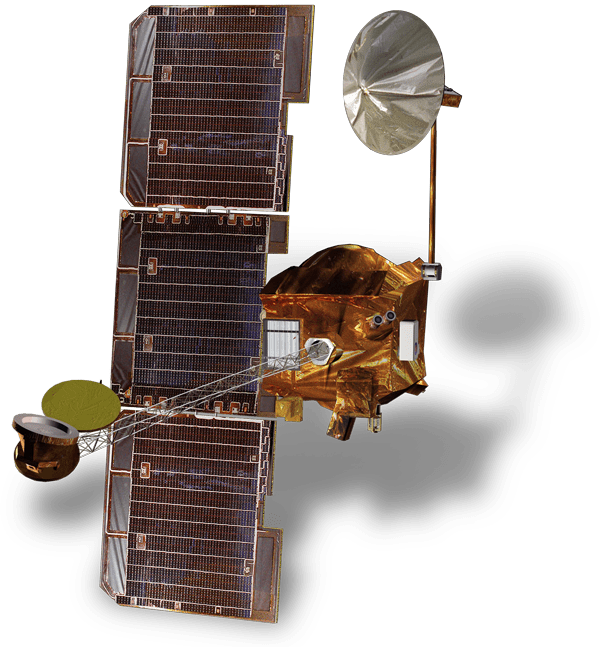
On this day in 2001, NASA’s Mars Odyssey orbiter was launched towards Mars to map and search the Red Planet for water. The mission itself took its name from Arthur C. Clarke’s novel 2001: A Space Odyssey.
The Mars Odyssey successfully discovered Martian water. Project Scientist Jeffrey Plaut of NASA’s Jet Propulsion Laboratory in Southern California, which leads the Odyssey mission, stated that “Before Odyssey, we didn’t know where this water was stored on the planet…We detected it for the first time from orbit and later confirmed it was there using the Phoenix lander.”
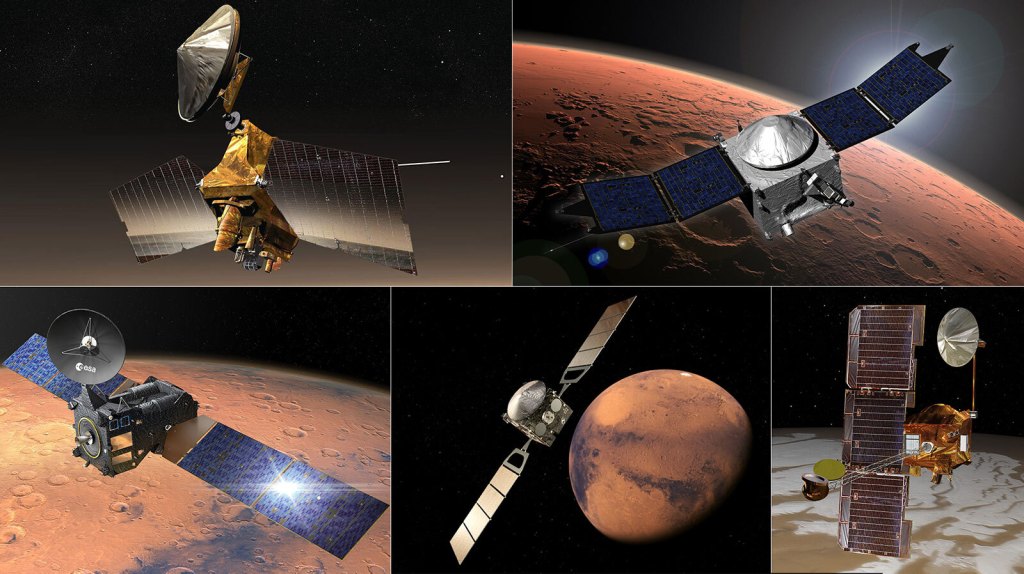
In addition to conducting its own studies, the Mars Odyssey was also used as a space satellite relaying data between Earth and Mars from other scientific missions, such as NASA’s Spirit and Opportunity rovers. The orbiter is part of what is called the Mars Relay Network, currently consisting of five orbiters (see below).
The Mars Odyssey is now the oldest oldest spacecraft still working at the Red Planet. It should be able to continue its work through 2025. You can find more information about the mission from this NASA site.
Image (Credit): Five spacecraft currently in orbit about the Red Planet make up the Mars Relay Network to transmit commands from Earth to surface missions and receive science data back from them. Clockwise from top left: NASA’s Mars Reconnaissance Orbiter (MRO), Mars Atmospheric and Volatile EvolutioN (MAVEN), Mars Odyssey, and the European Space Agency’s (ESA’s) Mars Express and Trace Gas Orbiter (TGO). (NASA/JPL-Caltech, ESA)


 Our Awesome Universe