Image (Credit): NASA Astronaut Mark Vande Hei aboard the International Space Station. (NASA)
“They were, are and will continue to be very dear friends of mine. We support each other throughout everything. And I never had any concerns about my ability to continue working with them – very good professionals and technically competent and wonderful human beings.”
-NASA astronaut Mark Vande Hei, who returned to Earth from the International Space Station (ISS) last week, regarding his US and Russian crew mates, as quoted in the Washington Post. As a result of his latest ISS mission, Mr. Vande Hei has now spent more time in space on a single mission than any other US astronaut.
Image (Credit): The International Space Station. (NASA)
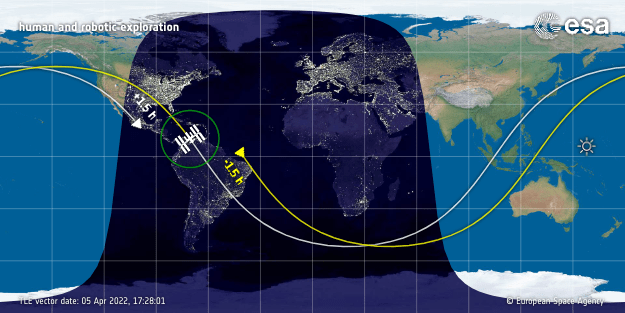
If you are standing outside in your yard looking for the International Space Station (ISS) at dawn or dusk (which is necessary to see the sun’s reflection on the station), this NASA site called Spot the Station may help. The site provides a global tracking map created by the European Space Agency (ESA) showing the current location of the ISS as well as its spot 90 minutes ago and 90 into the future.
NASA notes that the ISS circles the Earth every 90 minutes, traveling at about 17,500 miles per hour. While you experience one sunrise per day, an astronaut on the ISS will experience 16 sunrises each day.
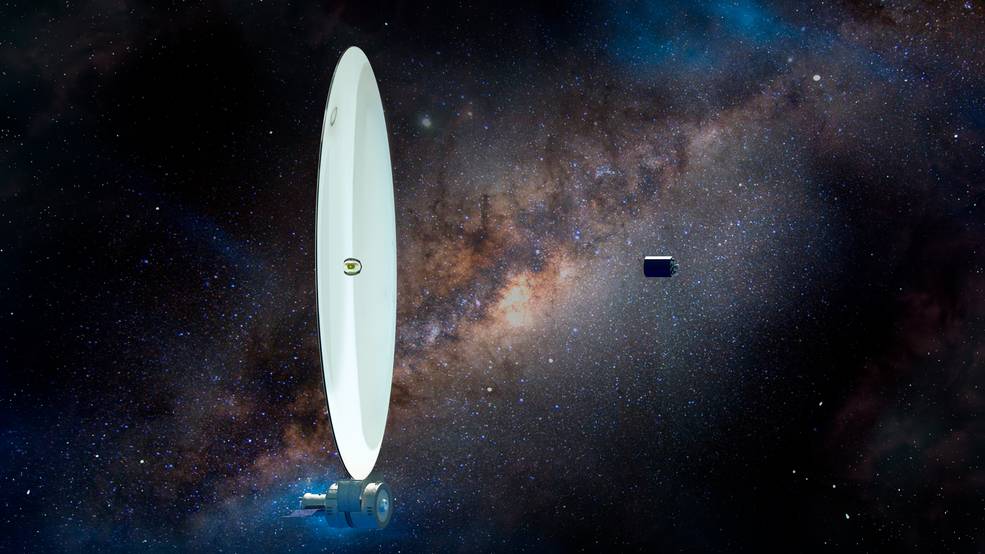
Image (Credit): Artist’s drawing of a possible future giant telescope being created in space using fluids. (NASA & Studio Ella Maru)
NASA has an interesting storyabout the development of liquid lenses for space telescopes. It’s a fascinating idea as we watch the slow assembly of the James Webb Space Telescope’s (JWST) 18-part mirror. This new approach, which could increase a telescope’s size 100 fold, will be tested aboard the International Space Station (ISS).
Edward Balaban, principal investigator of the Fluidic Telescope Experiment, or FLUTE, at NASA’s Ames Research Center in California’s Silicon Valley stated:
We thought, why not take advantage of the way liquids naturally behave in microgravity and apply it to the construction of large-scale telescopes or space-manufactured optical components that can have all kinds of uses. In microgravity, liquids take on shapes that are useful for making lenses and mirrors, so if we make them in space, they could be used to build telescopes that are dramatically bigger than was previously thought possible.
We are already expecting great things from the JWSP, but what could we learn with a telescope that is 100 times larger? I look forward to the results from the experiment aboard the ISS.
Alan Alda recently interviewed Canadian astronaut Chris Hadfield to discuss his space work, singing career, and recent book. You can catch all of it on Mr. Alda’s podcast Clear+Vivid. For instance, Mr. Hadfield notes that he used duct tape on the International Space Station (ISS) to cover over bullet-sized holes in the station’s exterior handrails torn up by space debris. This is not exactly a high-tech solution, but it works and prevents the rough edges of the damaged rails from tearing into this space suit.
Mr. Hadfield also shares his story about the time he was blinded during an ISS space walk. Amazingly, he continued with the eight-hour space walk after a quick fix bled air from his suit and restored his vision.
You can also learn about the work that went into his now famous space-based version of David Bowie’s “Space Oddity” (see below). He notes that he had plenty of time on the ISS to write his own songs as well.
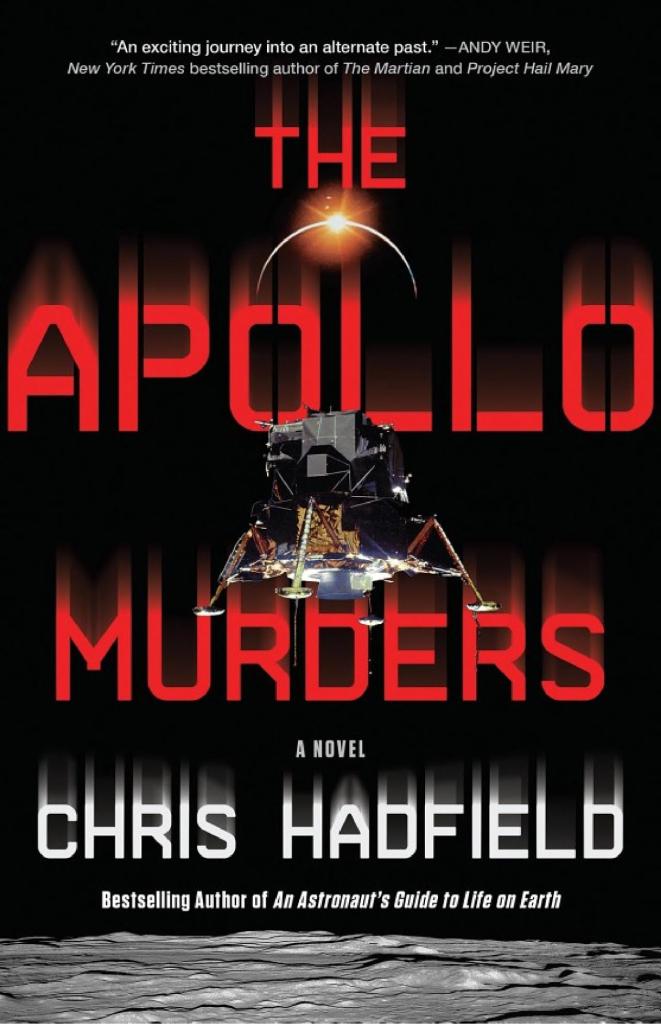
And should you be looking for a good adventure book, Mr. Hadfield book The Apollo Murdersmay solve that craving. It has enough real space stories intertwined within this thriller to keep it interesting. Here is the blurb for the book:
1973: a final, top-secret mission to the Moon. Three astronauts in a tiny spaceship, a quarter million miles from home. A quarter million miles from help.
NASA is about to launch Apollo 18. While the mission has been billed as a scientific one, flight controller Kazimieras “Kaz” Zemeckis knows there is a darker objective. Intelligence has discovered a secret Soviet space station spying on America, and Apollo 18 may be the only chance to stop it.
But even as Kaz races to keep the NASA crew one step ahead of their Russian rivals, a deadly accident reveals that not everyone involved is quite who they were thought to be. With political stakes stretched to the breaking point, the White House and the Kremlin can only watch as their astronauts collide on the lunar surface, far beyond the reach of law or rescue.
Full of the fascinating technical detail that fans of The Martian loved, and reminiscent of the thrilling claustrophobia, twists, and tension of The Hunt for Red October, The Apollo Murders is a high-stakes thriller unlike any other. Chris Hadfield captures the fierce G-forces of launch, the frozen loneliness of space, and the fear of holding on to the outside of a spacecraft orbiting the Earth at 17,000 miles per hour as only someone who has experienced all of these things in real life can.
Strap in and count down for the ride of a lifetime.
Alan Alda calls Mr. Hadfield a great communicator for space programs. Given all of his efforts and talents, it is hard to disagree.
Image (Credit): Chris Hadfield’s video singing “Space Oddity” on the ISS. (Canadian Space Agency)
Image (Credit): Chris Hadfield’s latest book. (Mulholland Books)
Image (Credit): Scene from Netflix’s film Apollo 10 1/2. (Netflix)
Last week’s film was about young adults in space, but now we are hitting elementary school for the right stuff. This Nextflix film, Apollo 10 1/2: A Space Age Childhood, is a good weekend movie for the whole family if you are looking for something light. The basic story is that NASA flubbed its Apollo program and created a lunar spaceship that is too small for adult astronauts. Hence, instead of sending a dog into space like the Russians, NASA goes to elementary school for what it needs. Here is a clip of the film narrated by Stan, the astroboy, and directed by Richard Linklater (from other films such as Boyhood and Before Sunrise).
Rogerebert.com, which notes that the films does a pretty good job providing context on American life in the late 60s, gives the movie three stars (out of a possible four), stating:
…Stan is a thoroughly likable storyteller, and there’s something to be said, in an era when Hollywood couldn’t care less about any idea not based on an pre-existing property, for intimate, personal films that don’t take you where you think you want to go.
It may be a silly plot, but given the state of the world at the moment it might also be a nice diversion. And don’t worry – it is my understanding that the Artemis lunar mission is being planned for full-sized adults.



 Our Awesome Universe