Space Quote: The White House’s View of the Moon

Image (Credit): View of the Earth from the Apollo 11 Command and Service Module. (NASA)

“Lunar orbit would be filled with many more satellites, including a lunar GPS network and a human space station capable of housing human astronauts that serves as a rest stop before they land on the moon’s surface. While there are no plans for a lunar city, there are proposals for a permanent outpost on the south pole of the moon, where crews might one day spend six-month rotations (China and Russia have announced plans for a lunar outpost, too). If NASA has its way, the lunar surface might eventually include a series of nuclear power plants, a resource extraction operation, and even something akin to moon internet. Given these plans, the US government estimates that the level of human activity in cislunar space over the next decade could exceed everything that’s happened there between 1957 and today, combined.”

-Quote from a November 22 Vox article, “The White House’s Plan to Colonize the Moon, Briefly Explained.” The article comments on the recently released report by the White House’s National Science & Technology Council, National Cislunar Science & Technology Strategy. By the way, the term “Cislunar space” in the report refers to “…the three-dimensional volume of space beyond Earth’s geosynchronous orbit that is mainly under the gravitational influence of the Earth and/or the Moon. Cislunar space includes the Earth-Moon Lagrange point regions…, trajectories utilizing those regions, and the Lunar surface.”

Pic of the Week: Distant Stellar Nursery

Image (Credit): CB 130-3 as captured by the Hubble Space Telescope. (ESA/Hubble, NASA & STScI, C. Britt, T. Huard, A. Pagan)

This week’s image comes from the Hubble Space Telescope. It shows a distant cloud of gas and dust known as CB 130-3. Such clouds can create new stars, as explained by the European Space Agency:

CB 130-3 is an object known as a dense core, a compact agglomeration of gas and dust. This particular dense core is in the constellation Serpens and seems to billow across a field of background stars.

Dense cores like CB 130-3 are the birthplaces of stars and are of particular interest to astronomers. During the collapse of these cores enough mass can accumulate in one place to reach the temperatures and densities required to ignite hydrogen fusion, marking the birth of a new star. While it may not be obvious from this image, a compact object teetering on the brink of becoming a star is embedded deep within CB 130-3.

Astronomers used Hubble’s Wide Field Camera 3 to better understand the environment surrounding this fledgling star. As this image shows, the density of CB 130-3 isn’t constant; the outer edges of the cloud consist of only tenuous wisps, whereas at its core CB 130-3 blots out background light entirely. The gas and dust making up CB 130-3 affect not only the brightness but also the apparent color of background stars, with stars toward the cloud’s center appearing redder than their counterparts at the outskirts of this image. Astronomers used Hubble to measure this reddening effect and chart out the density of CB 130-3, providing insights into the inner structure of this stellar nursery.

Space Stories: Chinese Lunar Nuclear Station, Helium Exoplanets, and the UAE Lunar Rover

Image (Credit): Artist’s rendering of a lunar exploration base. (NASA/Dennis Davidson)

Here are some recent stories of interest.

Republic World: “China Plans Development Of New Nuclear System To Power Its Bases On Moon By 2028

China is developing a nuclear system that will be used to power its lunar station planned to be developed on the Moon’s South Pole. Wu Weiren, chief designer of the Chinese lunar exploration programme, told Chinese broadcaster CCTV that this new system will fulfill the ‘high-power energy demands’ of the station, the South China Morning Post (SCMP) reported. Notably, the station is being developed by the China National Space Administration (CNSA) and the Russian space agency Roscosmos and is expected to complete by 2028.

University of Chicago: “Many Planets Could Have Atmospheres Rich in Helium, Study Finds

For centuries, no one knew if we were alone in the universe—or if there were even other planets like ours. But thanks to new telescopes and methods in the past decades, we now know there are thousands and thousands of planets out there circling faraway stars, and they come in all sorts of shapes and sizes—large and small, rocky and gaseous, cloudy or icy or wet. A study by scientists with the University of Chicago, the University of Michigan and the University of Maryland suggests another for the list: planets with helium atmospheres. Moreover, the discovery may suggest a new step in our understanding of planet evolution. Their simulations found that it’s likely that helium would build up in the atmospheres of certain types of exoplanets over time. If confirmed, this would explain a decades-long puzzle about the sizes of these exoplanets.

Astronomy.com: “China and United Arab Emirates Plan Lunar Rover Mission

The United Arab Emirates’ fledgling space program took another step forward last month, securing an agreement to collaborate on China’s planned Chang’e 7 lunar mission, set to land near the Moon’s south pole in 2026. The Mohammed bin Rashid Space Center (MBRSC) in Dubai will build a small robotic rover, which will hitch a ride on the Chang’e 7 lander, according to the agreement signed Sept. 16 between MBRSC and the China National Space Administration (CNSA).

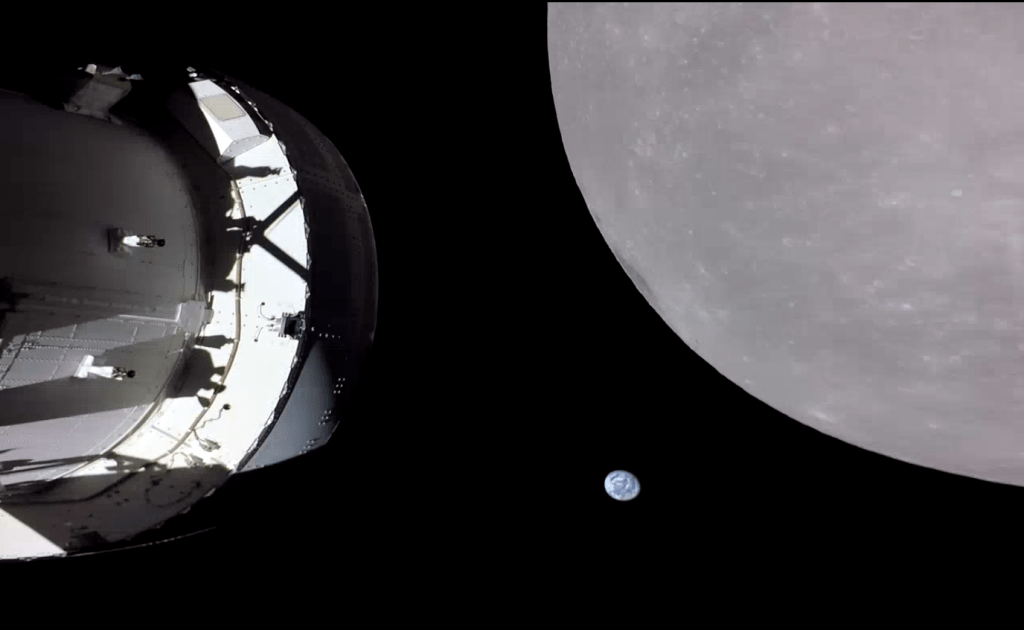
Orion Spacecraft: Successful Flyby of the Moon

Image (Credit): The Earth is seen setting from the far side of the Moon just beyond the Orion spacecraft in this video taken on the sixth day of the Artemis I mission by a camera on the tip of one of Orion’s solar arrays. (NASA)

The Artemis I mission is going well. On day six (November 21), the Orion capsule had a successful flyby of the moon and traveled to within 81 miles of the lunar surface. After a slow start to the launch, NASA engineers must be somewhat relieved.

NASA provided an update on the mission yesterday. You can find many more details on the mission in that one hour briefing.

Stay tuned for some space records later this week, as noted by NASA:

Orion will travel about 57,287 miles beyond the Moon at its farthest point from the Moon on Nov. 25, pass the record set by Apollo 13 for the farthest distance traveled by a spacecraft designed for humans at 248,655 miles from Earth on Saturday, Nov. 26, and reach its maximum distance from Earth of 268,552 miles Monday, Nov. 28.  

And be sure to stay abreast of the mission via the Artemis blog.

Television: The Origin of All Life via Netflix

Tomorrow, Netflix will premiere a new science program that ties together life on Earth and the origin of the universe. The six-part program, Our Universe, is a BBC project narrated by Morgan Freeman. You can see a trailer of new show here.

We have already had a Blue Planet, a Green Planet, and even an Our Planet to highlight life here on Earth, so maybe this is more “Big Bang Planet” going back a little earlier than these other series.

You can expect similar BBC science series to follow, according to Variety. They include:

  • Life on Our Planet – Coming 2023: 8 episodes narrated by Morgan Freeman
  • Our Oceans – Coming 2024: 5 episodes narrated by Jonathan Smith
  • Our Living World – Coming 2024: 4 episodes narrated by Ben Roy
  • Our Water World – Coming 2025: 5 episodes narrated by Jackie Garbutt

But let’s not get ahead of ourselves. Just tune into tomorrow night’s series and enjoy the show.

Posted in TV