Japan Supports the ISS Through 2030 and Expands Support for the Lunar Gateway

Image (Credit): Graphic showing Lunar Gateway elements from commercial and international partners. (NASA)

Late last week, the White House announced that Japan plans to support the operations of the International Space Station (ISS) through 2030 as well as further collaborate with the United States on the Artemis Lunar Gateway platform that will orbit the Moon.

On November 17, Vice President Kamala Harris stated:

The United States welcomes Japan’s intention to extend its support of International Space Station (ISS) operations through 2030, following the United States’ announcement of our ISS extension one year ago. In addition, our two countries are taking a step forward by reaching an agreement on collaboration on the Lunar Gateway orbiting platform, which will pave the way for the return of humanity to the Moon.

Under a previous agreement that has been expanded further, Japan’s JAXA has promised a number of contributions to the Lunar Gateway, including:

  • Critical components of the International Habitation (I-HAB) module that will provide the heart of the Gateway space station’s life support capabilities, as well as space for crew to live, conduct research, and prepare for lunar surface activities during Artemis missions. Japan will provide I-HAB’s Environmental Control and Life Support System (ECLSS), thermal control system functions, and cameras.
  • Batteries for I-HAB, the Habitation and Logistics Outpost (HALO) module, the initial crew cabin for astronauts visiting the Gateway, and the European System Providing Refueling Infrastructure and Telecommunication (ESPRIT) refueling module.
  • The JAXA HTV-XG spacecraft for launch and delivery of a logistics resupply mission for Gateway, scheduled for no later than 2030.

With the successful start of Artemis I lunar mission, it is good to hear that partner nations are increasing their support for a return to the Moon as well as plans to travel to Mars. While the United States went to the Moon alone last century, the Artemis partnership ensures this century’s return to the Moon is an international project.
Space Quote: The James Webb Space Telescope Keeps its Name

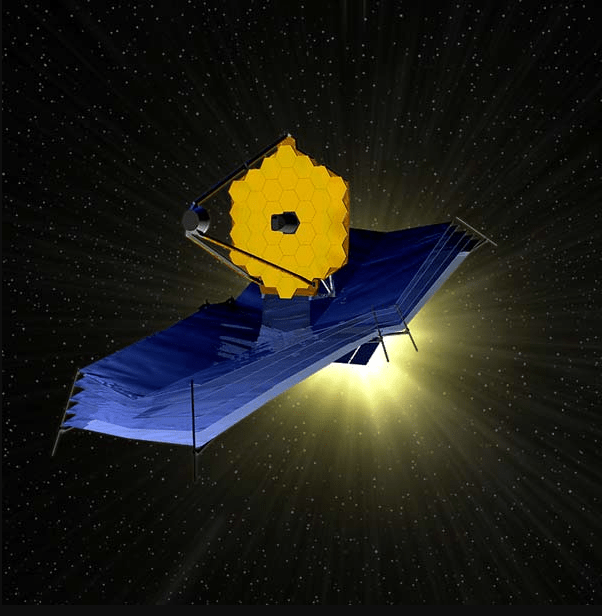
Image (Credits): Artist’s impression of the James Webb Space Telescope. (Northrop Grumman)

“In conclusion, to date, no available evidence directly links Webb to any actions or follow-up related to the firing of individuals for their sexual orientation. However, the research and this report make clear that the Lavender Scare was a painful chapter in our national history. Every effort was made to be as thorough in research and objective in analysis as possible. We must make great efforts to learn from the experience to guarantee that the core values of diversity, equity, accessibility, and inclusion are advanced, not only at NASA, but across the federal government. Only then can we ensure that dark episodes such as the Lavender Scare remain our history and not our future.”

-Concluding statement from the NASA Chief Historian’s report on James Webb, titled NASA Historical Investigation into James E. Webb’s Relationship to the Lavender Scare. As the reports notes, “The central purpose of this investigation was to locate any evidence that could indicate whether James Webb acted as a leader of or proponent for firing LGBTQ+ employees from the federal workforce.” It is sad summary of the federal government’s treatment of its gay employees following World War II, which represents a dark chapter in American history that we only recently left behind.

Space Stories: Early Galaxies, Early Life on Mars, and Gold-Rich Stars

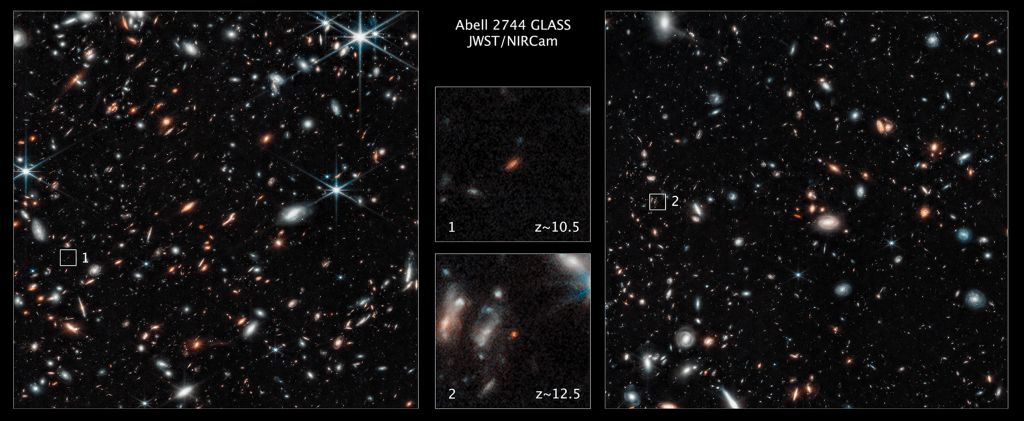
Image (Credit): Two of the farthest galaxies seen to date are captured in these Webb Space Telescope pictures of the outer regions of the giant galaxy cluster Abell 2744. The galaxies are not inside the cluster, but many billions of light-years farther behind it. The galaxy labeled (1) existed only 450 million years after the big bang. The galaxy labeled (2) existed 350 million years after the big bang. Both are seen really close in time to the big bang which occurred 13.8 billion years ago. These galaxies are tiny compared to our Milky Way, being just a few percent of its size, even the unexpectedly elongated galaxy labeled (1). (NASA, ESA, CSA, Tommaso Treu (UCLA), Zolt G. Levay (STScI))

Here are some recent stories of interest.

NASA: “NASA’s Webb Draws Back Curtain on Universe’s Early Galaxies

With just four days of analysis, researchers found two exceptionally bright galaxies in the GLASS-JWST images. These galaxies existed approximately 450 and 350 million years after the big bang (with a redshift of approximately 10.5 and 12.5, respectively), though future spectroscopic measurements with Webb will help confirm…“These observations just make your head explode. This is a whole new chapter in astronomy. It’s like an archaeological dig, and suddenly you find a lost city or something you didn’t know about. It’s just staggering,” added Paola Santini, fourth author of the Castellano et al. GLASS-JWST paper.

University of Copenhagen: “The First Life in Our Solar System May Have Been on Mars

When Mars was a young planet, it was bombarded by ice asteroids delivering water and organic molecules necessary for life to emerge. According to the professor behind a new study, this means that the first life in our solar system may have been on Mars.

National Astronomical Observatory of Japan: “Gold-rich Stars Came from Ancient Galaxies

Recently, hundreds of gold-rich stars have been detected by state-of-the-art telescopes worldwide. New simulations of galaxy formation, with the highest resolution in both time and mass, show that these gold-rich stars formed in progenitor galaxies, small galaxies which merged to create the Milky Way…According to the research, most gold-rich stars formed over 10 billion years ago in small, building-block galaxies―known as progenitor galaxies. Some but not all progenitor galaxies experience a neutron star merger, where large amounts of heavy r-process elements are produced and released, enriching that particular small galaxy. The predicted abundance of gold-enriched stars in the final Milky-Way-sized galaxy matches what is actually observed.

Pic of the Week: Hickson Compact Group 40

Image (Credit): The NASA/ESA Hubble Space Telescope view of five galaxies, called the Hickson Compact Group 40. (NASA/ESA Hubble)

This week’s image is from the NASA/ESA Hubble Space Telescope. It shows an amazing collection of five galaxies in close proximity to one another in what is known as the Hickson Compact Group 40. In about one billion years they are expected to coalesce into one large galaxy.

Here is the summary from the Hubble site:

This menagerie includes three spiral-shaped galaxies, an elliptical galaxy and a lenticular (lens-like) galaxy. Somehow, these different galaxies have crossed paths to create an exceptionally crowded and eclectic galaxy sampler.

Caught in a leisurely gravitational dance, the whole group is so crowded that it could fit within a region of space that is less than twice the diameter of our Milky Way’s stellar disc.

Though such galaxy groupings can be found in the heart of huge galaxy clusters, these galaxies are notably isolated in their own small patch of the Universe, in the direction of the constellation Hydra.

One possibility is that there’s a lot of dark matter (a poorly understood and invisible form of matter) associated with these galaxies. If they come close together the dark matter can form a big cloud within which the galaxies orbit. As the galaxies plough through the dark matter they feel a frictional force that results from its gravitational effects. This slows their motion and makes the galaxies lose energy, so they fall together. Therefore, this snapshot catches the galaxies at a very special moment in their lifetimes. In about 1 billion years they will eventually collide and merge to form a single giant elliptical galaxy.

Astronomers have studied this compact galaxy group not only in visible light, but in radio, infrared, and at X-ray wavelengths. Almost every one of the galaxies has a compact radio source at its core, which could be evidence for the presence of a supermassive black hole. X-ray observations show that the galaxies have been gravitationally interacting as witnessed by the presence of a lot of hot gas amongst them. Infrared observations reveal clues to the rate of formation of new stars.

Though over 100 such compact galaxy groups have been catalogued in sky surveys going back several decades, Hickson Compact Group 40 is one of the most densely packed. Observations suggest that such tight groups may have been more abundant in the early Universe and provided fuel for powering black holes, known as quasars, whose light from superheated inflating material blazed across space. Studying the details of galaxies in nearby groups like this helps astronomers sort out when and where galaxies assembled themselves, and what they are assembled from.

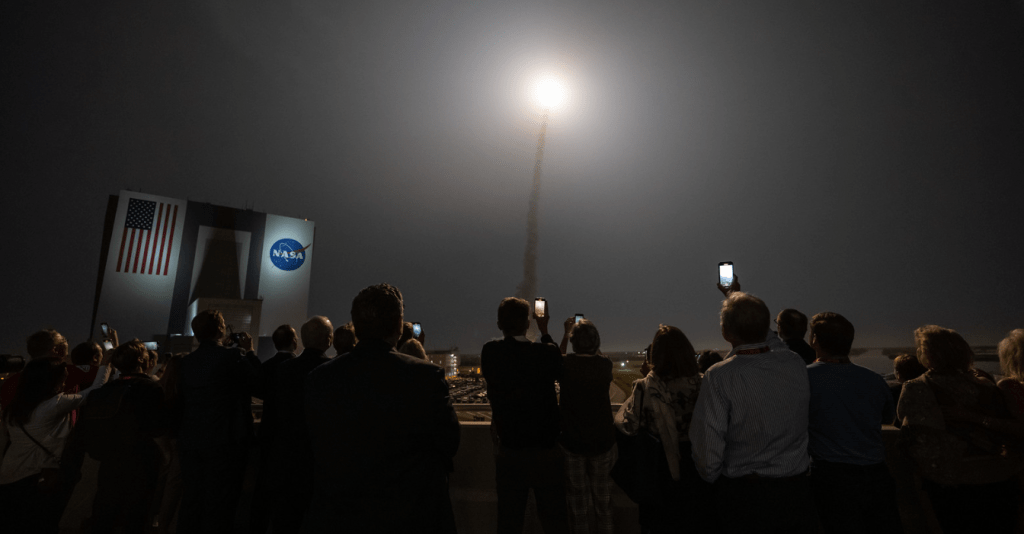
Artemis I Has Launched

Image (Credit): NASA’s Space Launch System rocket carrying the Orion spacecraft launches on the Artemis I flight test, Wednesday, Nov. 16, 2022, from Launch Complex 39B at NASA’s Kennedy Space Center in Florida. (NASA/Bill Ingalls)

After multiple attempts, NASA’s Artemis I mission started earlier today when the Space Launch System took off from the Kennedy Space Center carrying the uncrewed Orion spacecraft. It was a successful start to 25 day mission.

For a third time now, I am providing the mission facts, which are more meaningful given that we have a true launch:

  • Launch date: Nov. 16, 2022
  • Mission duration: 25 days, 11 hours, 36 minutes
  • Total distance traveled: 1.3 miIlion miles
  • Re-entry speed: 24,500 mph (Mach 32)
  • Splashdown: Dec. 11, 2022

This first test of the rocket and capsule will get us to the Artemis II mission, which includes a crewed Orion capsule.

Apollo II Astronaut Michael Collins said “I think a future flight should include a poet, a priest and a philosopher . . . we might get a much better idea of what we saw.” At the moment we are sending dummies around the Moon, but let hopes the others follow shortly.