Image (Credit): Night sky over Sacramento, CA on March 17, 2023. (Associated Press)
UFOs came up again last week pertaining to lights over Sacramento, California. As fireballs streaked across the night sky, a few citizens thought they might be watching fireworks or even the arrival of distant visitors to celebrate St. Patrick’s Day.
The explanation for the lights was interesting, but not because it was a UFO. It turns out the International Space Station (ISS) dumped a 683 pounds of Japanese communications equipment back in 2020. It took that long for the equipment to return towards Earth as a molten mass. The US Space Force later confirmed this explanation.
As noted in an earlier post, this ISS debris is not unusual, and can contain huge objects such as a cargo capsule.
The BBC recently noted that your chance of being struck by space debris is one in a trillion. So you can look up, but don’t worry about covering your head.
We’ve been waiting for nearly two years to see Elon Musk’s big rocket blast off again, and now the SpaceX founder is starting to narrow the targeted time frame for Starship’s first orbital attempt. The controversial entrepreneur said on Twitter last week that the next generation vehicle destined to take astronauts to the moon and perhaps start a civilization on Mars “will be ready to launch… in a few weeks, then launch timing depends on FAA license approval.”
South Korean rocket startup Innospace successfully launched a suborbital rocket from Brazil over the weekend, demonstrating a hybrid motor it plans to scale up into a small orbital launch vehicle. The launch of Innospace’s HANBIT-TLV suborbital rocket took place March 19 from the Alcântara Space Center, and the company called the flight a success, although it did not disclose the rocket’s peak altitude.
The first stars in the cosmos may have topped out at over 10,000 times the mass of the sun, roughly 1,000 times bigger than the biggest stars alive today, a new study has found. Nowadays, the biggest stars are 100 solar masses. But the early universe was a far more exotic place, filled with mega-giant stars that lived fast and died very, very young, the researchers found.
“We look forward to Firefly providing this [Commercial Lunar Payload Services] delivery… This lunar landing should enable new scientific discoveries from the far side of the Moon during the lunar night. This particular group of payloads should not only generate new science but should be a pathfinder for future investigations exploiting this unique vantage point in our solar system.”
–Statement by Joel Kearns, Deputy Associate Administrator for exploration in NASA’s Science Mission Directorate, regarding the $112 million contract award to Firefly for a commercial lunar delivery targeted to launch in 2026 through NASA’s CLPS initiative that support the Agency’s Artemis program. NASA noted that the three payloads are (1) the Lunar Surface Electromagnetics Experiment-Night (LuSEE-Night), (2) Lunar Pathfinder, and (3) User Terminal. You can read more about the Firefly mission here. Firefly also issued its own press release.
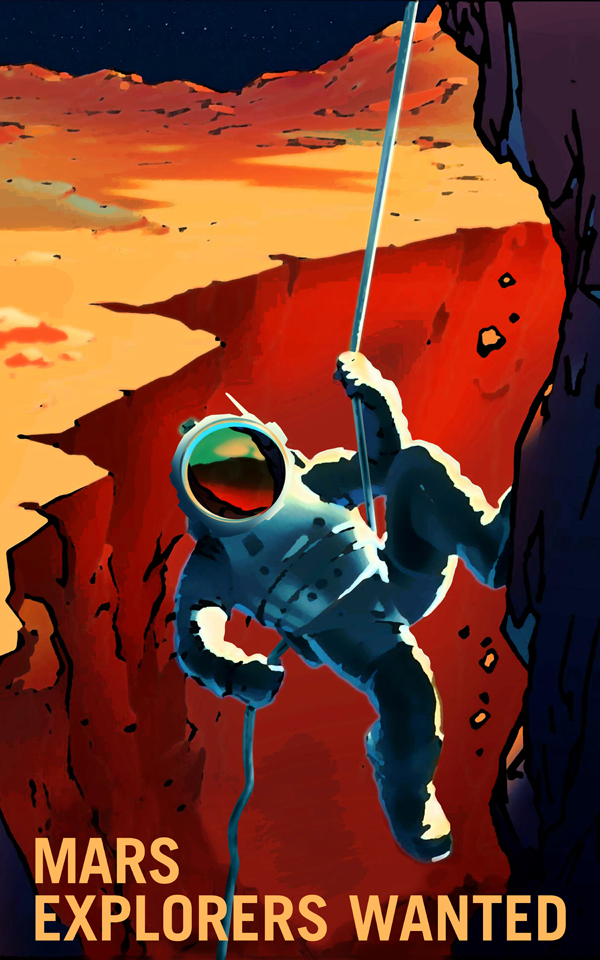
Back in 2016, NASA put a few fun posters online advertising opportunities on Mars. The posters were originally originally commissioned by NASA to be part of an exhibit at the Kennedy Space Center Visitor’s Complex in 2009.
Visit the NASA poster site if you want the files for these images and others. They are great for framing, note cards, or post cards.
I was playing with ChatGPT recently and asked it to create a NASA press release that would be issued if we ever found life on the dwarf planet Ceres. I wanted to see what it would create. Here it is:
NASA Press Release: NASA Discovers Possible Signs of Life on Ceres
NASA scientists studying data from the Dawn spacecraft have discovered evidence of possible life on Ceres, one of the largest objects in the asteroid belt between Mars and Jupiter. The discovery was made possible through the use of sophisticated instruments on the spacecraft, which has been orbiting Ceres since 2015.
The data collected by Dawn suggests the presence of complex organic molecules on the surface of Ceres, which are often associated with the presence of life. In addition, scientists have detected the presence of hydrothermal vents on the ocean floor of Ceres, providing further evidence of the potential for life on this small world.
“We are excited to announce that we have discovered evidence of possible life on Ceres,” said NASA Administrator Bill Nelson. “This discovery is a testament to the ingenuity and hard work of the scientists and engineers involved in the Dawn mission, and it opens up a whole new world of possibilities for astrobiology.”
The discovery of possible life on Ceres is significant because it suggests that life may be more common in the universe than previously thought. It also has important implications for future exploration of our solar system and beyond.
“We have always been fascinated by the possibility of finding life beyond Earth,” said Dr. Thomas Zurbuchen, Associate Administrator for the Science Mission Directorate at NASA Headquarters in Washington. “This discovery gives us new hope that we may not be alone in the universe, and it underscores the importance of continuing to explore our solar system and beyond.”
The Dawn spacecraft is currently in its final orbit around Ceres and will continue to collect data for as long as its instruments remain operational. NASA scientists are also planning future missions to Ceres to further study the potential for life on this small world.
For more information on this exciting discovery, visit the NASA website at www.nasa.gov.
Contact: NASA Headquarters 202-358-0001 hq-press@nasa.gov
It’s a fun fictional piece that builds on some real information, though it has its weak points. Here are some of my observations:
Spacecraft Information – Outdated: NASA lost contact with the Dawn spacecraft in November 2018, so a recent finding like this is unlikely unless it was buried in earlier data still being studied. The press release later states that the Dawn spacecraft is in its final orbit and still collecting data. While the spacecraft might remain in orbit for decades to some, its mission is over, as NASA noted when it stated: “Dawn spent every last drop of hydrazine making science observations of Ceres and radioing them back so we could learn more about the solar system we call home.”
Scientific Information – Good Speculation: Ceres does have hydrothermal vents that some have speculated could harbor life.
Overall, it is a good demonstration of what these chat bots can do – piece together a credible enough summary to keep you guessing. Just don’t post this anywhere without full context. I do not want to start any rumors.





 Our Awesome Universe