Space Mission: ESA’s Juice Mission

Image (Credit): Upper stage of the Ariane 5 rocket that will launch ESA’s Juice mission. (ESA)

On April 13th, the European Space Agency (ESA) will launch its Jupiter Icy Moons Explorer (Juice) mission from French Guiana. The purpose of the mission is to conduct a detailed study of Jupiter as well as three of its moons (and their oceans) – Ganymede, Callisto and Europa. The spacecraft will eventually go into orbit around Ganymede, which will be the first orbit of a moon in our solar system other than Earth’s Moon.

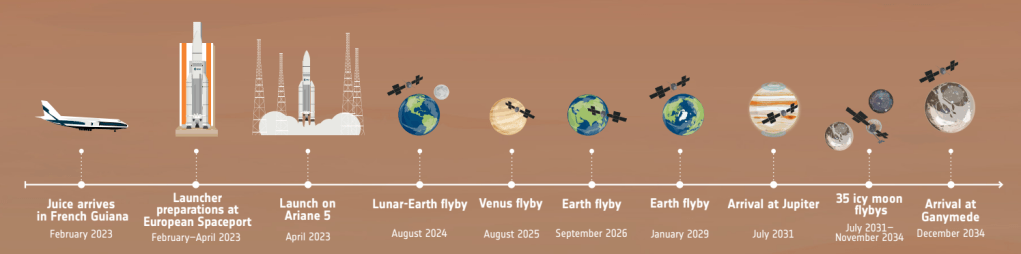
The key milestones for the mission are listed below and shown in greater detail within the graphic as well:

February 2023: Juice arrives in French Guiana

April 13, 2023: Launch on Ariane-5 rocket

July 2031: Arrival at Jupiter

-July 2031 – November 2034: 35 icy moon flybys

December 2034: Arrival at Ganymede

Image (Credit): Juice mission milestones. (ESA JUICE Launch Kit)

In addition to ESA/European scientific instruments and equipment, the spacecraft will also carry items from NASA, the Japan Aerospace Exploration Agency, and the Israel Space Agency.

The delayed arrival at Jupiter relates to the need for multiple flybys cover this great distance. In The Financial Times, Justin Byrne, head of science for lead contractor Airbus, stated, “Ariane-5 is a very powerful rocket but it can only give us about half the energy we need to get to Jupiter…We get the rest by doing planetary fly-bys, each one giving us a gravitational assist through a slingshot manoeuvre.”

The ESA put together a useful Launch Kit that answers any question you may have about the Juice mission, as well as related missions.

Pic of the Week: Blooming Stars in the Irregular Spiral Galaxy NGC 5486

Image (Credit): Irregular Spiral Galaxy NGC 5486. (ESA/Hubble & NASA, C. Kilpatrick)

This week’s image is from the Hubble Space Telescope. It shows the irregular spiral galaxy NGC 5486 with pink areas indicating the formation of new stars.

Here is a little more from the European Space Agency (ESA):

NGC 5486 hangs against a background of dim, distant galaxies in this image from the NASA/ESA Hubble Space Telescope. The tenuous disc of the galaxy is threaded through with pink wisps of star formation, which stand out from the diffuse glow of the galaxy’s bright core. While this particular galaxy has indistinct, meandering spiral arms it lies close to the much larger Pinwheel Galaxy, one of the best known examples of ‘grand design’ spiral galaxies with prominent and well-defined spiral arms. In 2006 Hubble captured an image of the Pinwheel Galaxy which was — at the time — the largest and most detailed photo of a spiral galaxy ever taken with Hubble.

NGC 5486 lies 110 million light-years from Earth in the constellation Ursa Major. This observation comes from a selection of Hubble images exploring debris left behind by Type II supernovae. As massive stars reach the end of their lives, they cast off huge amounts of gas and dust before ending their lives in titanic supernova explosions. NGC 5486 hosted a supernova in 2004, and astronomers used the keen vision of Hubble’s Advanced Camera for Surveys to explore the aftermath in the hopes of learning more about these explosive events.

Prototype of the New NASA Space Suits

Image (Credit): New Axiom Extravehicular Mobility Unit spacesuit. (NASA)

It is called the Axiom Extravehicular Mobility Unit, or AxEMU, but you can call it a lunar spacesuit. The newly designed spacesuit was on display today at the Space Center Houston’s Moon 2 Mars Festival. While the final suit will be in white, you get the idea with the prototype on display.

Axiom Space, the maker of the spacesuit, noted:

Since a spacesuit worn on the Moon must be white to reflect heat and protect astronauts from extreme high temperatures, a cover layer is currently being used for display purposes only to conceal the suit’s proprietary design. Axiom Space collaborated with costume designer Esther Marquis from the Apple TV+ series, “For All Mankind” to create this custom cover layer using the Axiom Space logo and brand colors.

It makes it sound like something being designed for Hollywood fans rather than a NASA-procurement contract. Is Axiom Space competing with Elon Musk on his design (see below)? Or maybe the company is trying to match the spacesuits from Lost in Space (also below)?

Whatever the case, NASA hopes to use these new suits for the lunar exploration under Artemis III. Moreover, NASA states these suits can fit “…at least 90 percent of the US male and female population.” I think they mean 90 percent of the population qualifying for such a mission. We cannot even fit the average American into train seats made for Europeans, so either the qualifying population is limited or these suits have a LOT of stretch-room.

Image (Credit): SpaceX astronaut spacesuits for the Dragon capsule. (SpaceX)
Image (Credit): Spacesuits on Lost in Space. (Netflix)

Space Stories: Deorbiting the ISS, Impounded Russian Rockets, and a Telescope on the Dark Side of the Moon

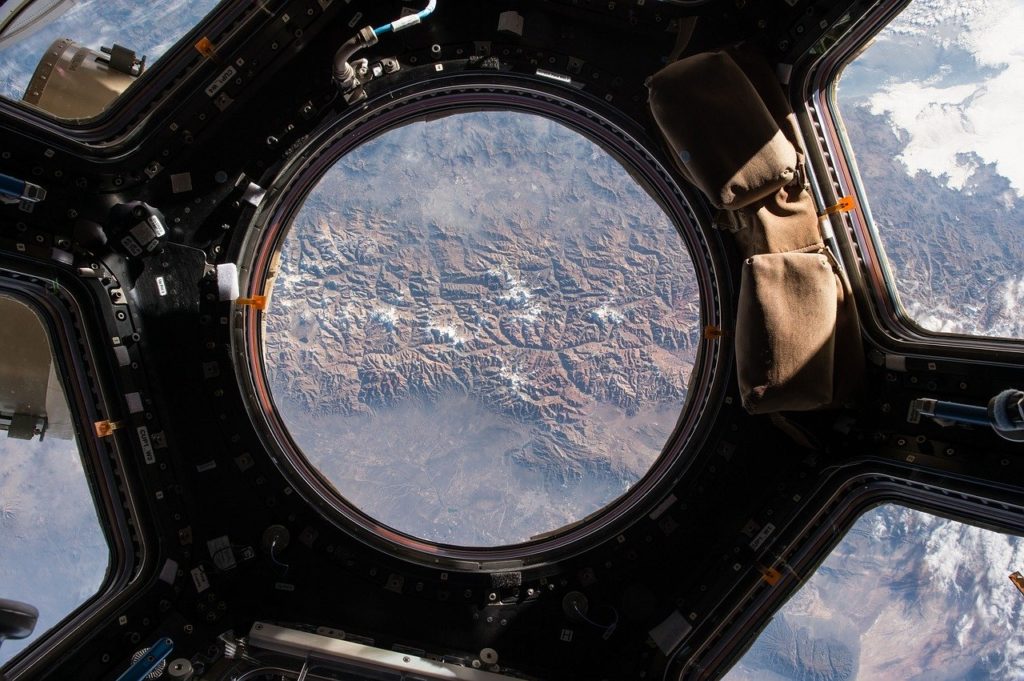
Image (Credit): View of Earth from the International Space Station (ISS). (NASA)

Here are some recent stories of interest.

Space News: “NASA Planning to Spend up to $1 Billion on Space Station Deorbit Module

NASA is projecting spending nearly $1 billion on a tug to deorbit the International Space Station at the end of the decade to provide redundancy for safely disposing of the station. NASA released additional details March 13 about its fiscal year 2024 budget proposal. An outline of the proposal, published by the White House March 9, requested $27.2 billion for the agency, a 7.1% increase from 2023 that roughly keeps pace with inflation.

Radio Free Europe: “Kazakhstan Impounds Property Of Russian Cosmodrome Operator In Baikonur

Kazakh authorities have impounded the property of Russia’s main operator of spacecraft launching sites in Baikonur (Baiqonyr) in the Central Asian nation’s southern region of Qyzylorda…According to the media outlet, the decision was made due to the Russian state company’s debt of 13.5 billion tenges ($29.7 million) to the Baiterek Kazakh-Russian joint venture for work related to estimating ecological damage caused by Souyz-5 rockets.

SciTechDaily: “NASA, DOE Telescope on Far Side of the Moon Will Reveal the Dark Ages of the Universe

NASA and the Department of Energy (DOE) are working together to develop a science instrument that will survive the harsh and unforgiving environment of the lunar surface at night on the far side of the Moon to attempt first-of-its-kind measurements of the Dark Ages of the Universe. The instrument, named the Lunar Surface Electromagnetics Experiment – Night (LuSEE-Night), is a collaboration between DOE’s Brookhaven National Laboratory, the DOE Office of Science, UC Berkeley’s Space Sciences Laboratory, and NASA’s Science Mission Directorate.

Space Quote: NASA’s Proposed Budget for FY 2024

“President Biden’s budget will help us explore new cosmic shores, continue to make strides in traveling to and working in space and on the Moon, increase the speed and safety of air travel with cutting-edge technologies, and help protect our planet and improve lives here on Earth.”

Statement by NASA Administrator Bill Nelson regarding the release of the The President’s Budget for Fiscal Year 2024. Under this budget, NASA proposes to:

  • Build on the successful Artemis I mission and pave the way for a long-term presence at the Moon. 
  • Further new scientific discovery in our solar system and beyond. 
  • Support a future in low-Earth orbit.
  • Advance U.S. leadership in technology innovation in aviation and space. 
  • Engage diverse learners in NASA’s mission to create our nation’s next generation of scientists, engineers, and explorers – the Artemis Generation.