Movie: 65 (Million Years Ago)

Credit: Sony Pictures

Adam Driver (from Star Wars fame) is starring in a new movie released this weekend that combines Planet of the Apes with Jurassic Park. Driver plays a space traveler who goes back in time and does not know the “uncharted” planet he landed on until the big-teeth neighbors come around to say “hi.”

Here is the set up from Sony Pictures:

After a catastrophic crash on an unknown planet, pilot Mills (Adam Driver) quickly discovers he’s actually stranded on Earth…65 million years ago. Now, with only one chance at rescue, Mills and the only other survivor, Koa (Ariana Greenblatt), must make their way across an unknown terrain riddled with dangerous prehistoric creatures in an epic fight to survive.

You can catch the trailer here as well.

So far, Rotten Tomatoes has give it a critic’s score of 36%. Here are a few of the comments:

  • There’s a reason such films have, in theatrical terms, been pushed to the brink of extinction, and 65 represents such an uninspired effort as to look like a fossil even before the credits roll.
  • Sometimes a short, simple premise with good leads is all you need. 65 is no Jurassic Park but it will entertain and get out before you want it to.
  • It’s not schlocky enough to be so-bad-it’s-good and nowhere near good enough to be taken even a tiny bit seriously.

I thought the movie was expected to be released on March 17th, but instead the movie 65 was in theaters this weekend.

Don’t let the critics deter you. If you are looking for a simple, fun film, I would check it out.

Television: The JWST on NOVA, Again

Credit: PBS

NOVA has a new episode this season on the James Webb Space Telescope (JWST). Unlike last season’s episode, Ultimate Space Telescope, which discussed the creation, launch, and early success of the space telescope, this episode, New Eye on the Universe, goes deeper into the goals of the space telescope as well as the findings since the first images appeared.

Here is a list of the topics covered in the latest episode (and their spot on the recording):

  • 00:00 Introduction
  • 04:11 The James Webb Space Telescope’s First Images
  • 05:47 Searching for Life on Exoplanets: Are We Alone in the Universe?
  • 14:40 Looking for Life in Our Own Solar System: Moons of Jupiter and Saturn
  • 18:52 Adjusting New Images from JWST: Science Meets Art
  • 23:55 Studying Supermassive Black Holes and Merging Galaxies
  • 30:25 Detecting the Oldest Galaxies with the JWST
  • 37:13 Troubleshooting the New Telescope’s Light Measurements
  • 42:12 Detecting the Atmosphere of a Rocky Exoplanet
  • 46:28 Results from the Team’s New Studies
  • 51:05 Conclusion

The section on adjusting the images is interesting in that we would not see these beautiful images as portrayed even if we could fly though space for an up-close look. Our eyes cannot see all of what the JWST can see in infrared. This is further explained in a Scientific American article, “Are the James Webb Space Telescope’s Pictures ‘Real’?

You can watch the latest episode on the PBS internet site, your local PBS station, or YouTube.

One More Rocket Mishap, This Time in Japan

Image (Credit): Japan’s Advanced Land Observing Satellite-3, which was lost in the latest rocket failure. (JAXA)

The string of rocket failures continues. I had earlier mentioned the UK and Alaskan mishaps, while an Arianespace Vega C rocket launch from French Guiana when awry last December, and now Japan has suffered its own failure this week. Tuesday’s failed launch of the Japan Aerospace Exploration Agency’s (JAXA) H3 rocket is a setback for this new rocket. When the second stage of the rocket failed to ignite, the rocket self-destructed. The destruction included the rocket’s payload – the Advanced Land Observing Satellite-3.

In additional to assisting with key Japanese defense and research satellite payloads, the H-3 rocket is part of Japan’s plan to assist with cargo to the International Space Station (ISS) as well as future Artemis missions. Japan will need to figure out what happened here and get back into the game as soon as possible.

Following the recent failure of two Russian capsules at the ISS, this latest mishap demonstrates that both new and well-tested government-run space missions are subject to failure and delays. Redundancy within the commercial space industry will be critical as a backstop to these government-run programs.

Pic of the Week: The Shining Nucleus of NGC 7496

Image (Credit): Barred spiral galaxy NGC 7496. (NASA, ESA, CSA, Janice Lee (NOIRLab), Joseph DePasquale (STScI))

This week’s image from the James Webb Space Telescope shows the barred spiral galaxy NGC 7496, which is over 24 million light-years away from Earth. The glowing center is a supermassive black hole.

Here is the full story about the image from the Webb Space Telescope site:

The spiral arms of NGC 7496, one of a total of 19 galaxies targeted for study by the Physics at High Angular resolution in Nearby Galaxies (PHANGS) collaboration, are filled with cavernous bubbles and shells overlapping one another in this image from Webb’s Mid-Infrared Instrument (MIRI). These filaments and hollow cavities are evidence of young stars releasing energy and, in some cases, blowing out the gas and dust of the interstellar medium surrounding them.

Until Webb’s high resolution at infrared wavelengths came along, stars at the earliest point of the lifecycle in nearby galaxies like NGC 7496 remained obscured by gas and dust. Webb’s specific wavelength coverage allows for the detection of complex organic molecules called polycyclic aromatic hydrocarbons, which play a critical role in the formation of stars and planets. In Webb’s MIRI image, these are mostly found within the main dust lanes in the spiral arms. 

In their analysis of the new data from Webb, scientists were able to identify nearly 60 new, embedded cluster candidates in NGC 7496. These newly identified clusters could be among the youngest stars in the entire galaxy. 

At the center of NGC 7496, a barred spiral galaxy, is an active galactic nucleus (AGN). AGN is another way to refer to an active supermassive black hole that is emitting jets and winds. This glows quite brightly at the center of the Webb image. Additionally, Webb’s extreme sensitivity also picks up various background galaxies, which appear green or red in some instances.

Space Stories: Ancient Water, Nearby Black Hole, and a Lunar Time Zone

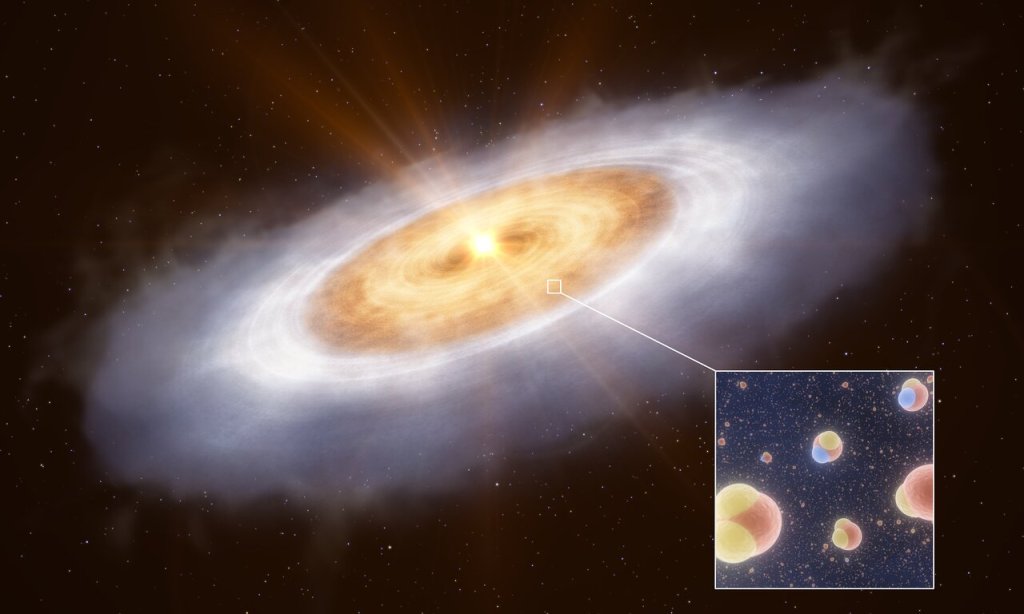
Image (Credit): Illustration showing gaseous water in the planet-forming disc around the star V883 Orionis. (European Southern Observatory)

Here are some recent stories of interest.

European Southern Observatory: “Astronomers Find Missing Link for Water in the Solar System

Using the Atacama Large Millimeter/submillimeter Array (ALMA), astronomers have detected gaseous water in the planet-forming disc around the star V883 Orionis. This water carries a chemical signature that explains the journey of water from star-forming gas clouds to planets, and supports the idea that water on Earth is even older than our Sun.

“We can now trace the origins of water in our Solar System to before the formation of the Sun,” says John J. Tobin, an astronomer at the National Radio Astronomy Observatory, USA and lead author of the study published today in Nature. 

SciTech Daily: “Astronomers Uncover Black Hole Closer to Earth Than Ever Before

Astronomers have discovered the closest black hole to Earth, the first unambiguous detection of a dormant stellar-mass black hole in the Milky Way. Its close proximity to Earth, a mere 1,600 light-years away, offers an intriguing target of study to advance understanding of the evolution of binary systems.

New York Times: “The Moon May Get Its Own Time Zone

What time is it on the moon? Since the dawn of the space age, the answer has been: It depends. For decades, lunar missions have operated on the time of the country that launched them. But with several lunar explorations heading for the launchpad, the European Space Agency has deemed the current system unsustainable. The solution, the agency said last week, is a lunar time zone.