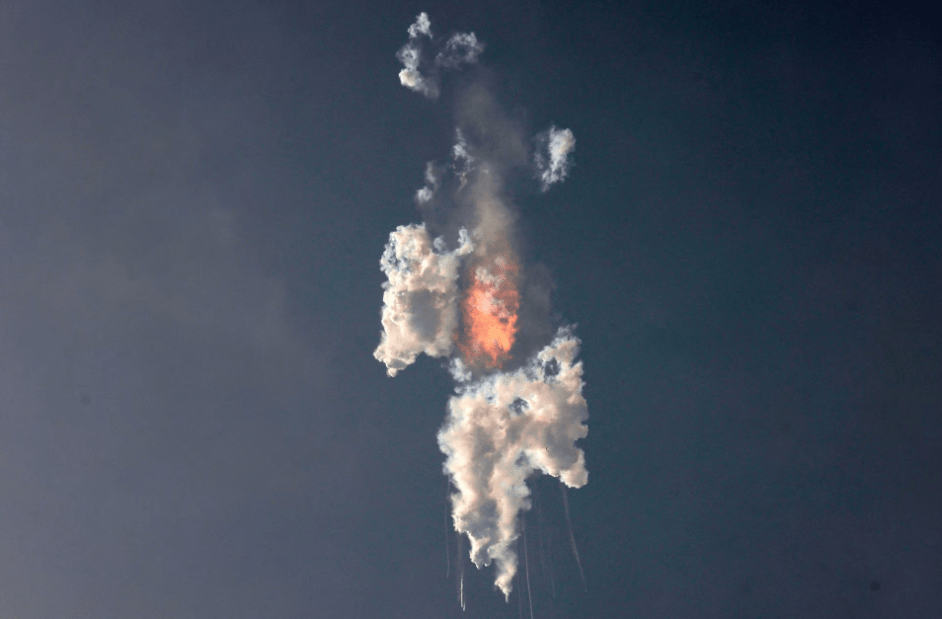
Pic of the Week: Starship Explodes Mid-Air

Image (Credit): Starship explosion after launch on April 20, 2023. (Rueters)

This week’s image is from today’s launch of the SpaceX Starship. The rocket experienced engine troubles and exploded about four minutes following the launch after reaching a height of 25 miles. The goal of this mission was to reach at least 90 miles.

SpaceX had this to say about the launch:

At 8:33 a.m. CT, Starship successfully lifted off from the orbital launch pad for the first time. The vehicle cleared the pad and beach as Starship climbed to an apogee of ~39 km over the Gulf of Mexico – the highest of any Starship to-date. The vehicle experienced multiple engines out during the flight test, lost altitude, and began to tumble. The flight termination system was commanded on both the booster and ship. As is standard procedure, the pad and surrounding area was cleared well in advance of the test, and we expect the road and beach near the pad to remain closed until tomorrow.

With a test like this, success comes from what we learn, and we learned a tremendous amount about the vehicle and ground systems today that will help us improve on future flights of Starship.


One More Try: Starship Set to Launch Tomorrow

Image (Credit): SpaceX’s Starbase in Boca Chica, Texas, where tomorrow’s Starship launch will take place. (SpaceX)

The launch of SpaceX’s Starship, delayed on Monday, could take place as early as tomorrow morning at 9:28 am ET.

Should everything go according to plan, you can watch tomorrow’s launch here.

I am just hoping that the delay was not another weed-related game to mark 4/20 in a unique way. The joke is getting old and costly for Mr. Musk.

Let’s just get the Starship in the air.

Space Stories: Merging Galaxies, Anniversary for TESS, and Helicopter Flights on Mars

Image (Credit): Arp 220 as captured by NASA’s James Webb Space Telescope. (NASA, ESA, CSA, STScI, Alyssa Pagan)

Here are some recent stories of interest.

PetaPixel:Webb Captures Star-Forming Galactic Merger Brighter Than 1 Trillion Suns’”

NASA’s James Webb Space Telescope has captured a stunning “smash-up” of two spiral galaxies. Collectively called Arp 220, the collision of the pair of galaxies has facilitated massive star formation. Arp 220 is located within the constellation Serpens, about 250 million light-years from Earth. Arp 220 gets its namesake because it is the 220th object in Hallton Art’s Atlas of Peculiar Galaxies. Arp 220 is “peculiar” because it’s an ultra-luminous infrared galaxy (ULIRG), and the nearest ULIRG to Earth.

Phys.org:NASA’s TESS Celebrates Fifth Year Scanning the Sky for New Worlds’”

Now in its fifth year in space, NASA’s TESS (Transiting Exoplanet Survey Satellite) remains a rousing success. TESS’s cameras have mapped more than 93% of the entire sky, discovered 329 new worlds and thousands more candidates, and provided new insights into a wide array of cosmic phenomena, from stellar pulsations and exploding stars to supermassive black holes.

NASA:NASA’s Ingenuity Mars Helicopter Completes 50th Flight’”

NASA’s Ingenuity Mars Helicopter has completed its 50th flight on Mars. The first aircraft on another world reached the half-century mark on April 13, traveling over 1,057.09 feet (322.2 meters) in 145.7 seconds. The helicopter also achieved a new altitude record of 59 feet (18 meters) before alighting near the half-mile-wide (800-meter-wide) “Belva Crater.”

Delay in the Launch of the Starship

Image (Credit): The SpaceX Starship at the launch pad. (SpaceX)

Today was supposed to be the day SpaceX flight tested the Starship from its facility in Texas, but less than 10 minutes before the launch a problem with the Super Heavy booster put everything on hold.

The Starship is a key part of NASA’s Artemis III mission to place astronauts on the Moon, so the tests are crucial to move that project forward.

SpaceX will need to wait at least 48 hours before attempting another launch.

Credit: SpaceX

More on those Chinese Balloons

Image (Credit): Chinese balloon details from the leaked Pentagon documents. (The Daily Mail)

The Chinese balloons that causes so much trouble a few months back appear to be nothing new, according to recently leaked Pentagon documents. The Chinese have been using them for years to spy on American military positions. And on closer inspection, the contraption being carried by these balloons looks a lot like a normal satellite, with solar panels, antenna, sensors, and more (see the image above).

So why use balloons and not normal satellites? As noted in earlier press stories, the balloons are cheaper, easier to launch, more difficult for US intelligence to detect when launched, fly closer to targets, and linger longer over those targets. These are many of the same reason the US and many other countries continue to use balloons for scientific reasons as well.

The leaked documents are simply confirming what we already know. UFOs are all over and as far as we know to date man-made. I know it is still hard for many to believe that the crashed object in Roswell, New Mexico back in the 1947 was just a US military surveillance balloon. Real life can be boring at times.