Study Findings: Regression to the Mean Can Explain Saturation of Geomagnetic Storms

Image (Credit): A May 2024 image of a solar flare captured by NASA’s Solar Dynamics Observatory (SDO). (NASA SDO)

Nature abstract of study findings:

Extreme space weather events on Earth occur during intervals of strong solar wind driving. The solar wind drives plasma convection and currents in the near-Earth space environment. For low values of the driver, the Earth’s response is linear, estimated by parameters such as the polar cap index based on ground magnetometer activity. Curiously, for extreme solar wind driving, the Earth’s response appears not to increase beyond a saturation limit. Theorists have advanced a host of explanations for this saturation effect, but there is no consensus. Here we demonstrate that this saturation is a manifestation of the regression to the mean effect arising from random uncertainty in the timing and magnitude of solar wind measurements. Our results reveal that data analysis underpinning the saturation theories is nonlinearly biased, thereby challenging the validity of the theories. Correcting for the uncertainties reveals that the Earth’s response to solar wind driving is linear throughout, and that the impact of extreme geomagnetic storms can be twice as large as previously thought. We show that regression to the mean is a fundamental property of the relationship between measurement and the truth, where the truth corresponding to the measurement is closer to the mean. This effect is particularly pronounced for uncertain measurements of extreme values and is likely to manifest across various fields, from extreme climate studies to chronic medical pain.

Citation: Sivadas, N., Sibeck, D., Subramanyan, V. et al. Regression to the mean can explain saturation of geomagnetic storms. Nature 655, 1143–1147 (2026).

DOI: https://doi.org/10.1038/s41586-026-10757-4

Study-related stories:

Wired – “An Extreme Solar Storm May Be Even More Devastating Than Previously Imagined”

SciTechDaily – “Earth May Be Twice As Vulnerable to Extreme Solar Storms As Scientists Thought”

NASA – “New NASA Study Says Possibly No Limit to Solar Storm Effects”

Pic of the Week: Preparing the Nancy Grace Roman Space Telescope

Image (Credit): Members of NASA’s Nancy Grace Roman Space Telescope propellant, safety, and quality assurance team. (NASA/Sydney Rohde (Rocz))

The image above, taken on July 20th, shows one of the many teams working on the Nancy Grace Roman Space Telescope as it gets ready for its launch on August 30th. The pictured individuals are part of the propellant, safety, and quality assurance team.

NASA’s latest update on the mission stated:

Technicians completed fueling NASA’s Nancy Grace Roman Space Telescope, bringing it an important step closer to launch. On July 25, the team completed operations that carefully loaded 290 gallons of hydrazine fuel into the observatory at the Payload Hazardous Servicing Facility at NASA’s Kennedy Space Center in Florida.

After launch and separation from the rocket, Roman will use this onboard propellant to perform maneuvers as it travels to Sun-Earth Lagrange point 2, or L2, located about one million miles from Earth. There, about four times the distance to the Moon, it will have an ideal home for astronomy.

Podcast: AI Data Centers in Space

If you are following the debate about whether data centers belong in orbit, this Freakonomics Radio podcast titled “Should A.I. Move to Space?” may be for you.

Guest host Steve Levitt talks to a number of experts about the role of AI in our economy. I recommend listing to all of the podcast since much of it touches on the logistics of data centers in orbit, but it is the later part of the podcast involving a discussion with Will Marshall, co-founder and C.E.O. of Planet Labs, that peaked my attention. He discusses both the role of Planet Labs as its satellites monitors every corner of the Earth’s surface as well as the need for AI data centers in space.

In terms of the Planet Lab satellites, I found his most intriguing statements were related to the reduced costs of satellites. While most of the stories in the press seem to be about the decrease in rocket costs, Mr. Marshall said the real transformation is the miniaturization of satellites. Even under the earlier rocket system (pre-SpaceX), the drop in satellite costs due to smaller satellites would have been incredible.

In the quote below, Mr. Marshall is referring initially to the lower rocket costs, but then he expands into the real cost saving:

But remember even a four or five x reduction in cost, which really helps the whole space industry and has helped spawn it, is less significant, purely from an economic standpoint, than the 100 to a 1,000x improvement in cost performance of satellites that are going in. So, in each kilogram that you put up into space, if you can get a hundred times more data, because you’ve made the satellite way smaller, then you have won big time, even if the launch cost didn’t change one iota.

In his discussion about AI data centers, Mr. Marshall also has a unique view about the role of the Earth’s surface versus space:

I think it’s inevitable that, within a 10-ish year timeframe, most computers being built on the Earth will be going to space. I actually think not only is it going to be economically cheaper, but it’s going to be more sustainable. Earth’s life is so precious, it’s incredible, but yet we’re whittling away a lot of it. We’re doing deforestation for lithium, for cows, for whatever, we’re doing it. And we need to put our energy-intensive infrastructure into orbit, if we can, to not have a collision course with the biodiversity on the planet,

The podcast episode is in two parts, so be sure to listen to the second part when it comes out.

Space Quote: Two Spacecraft Are Now Imperiled

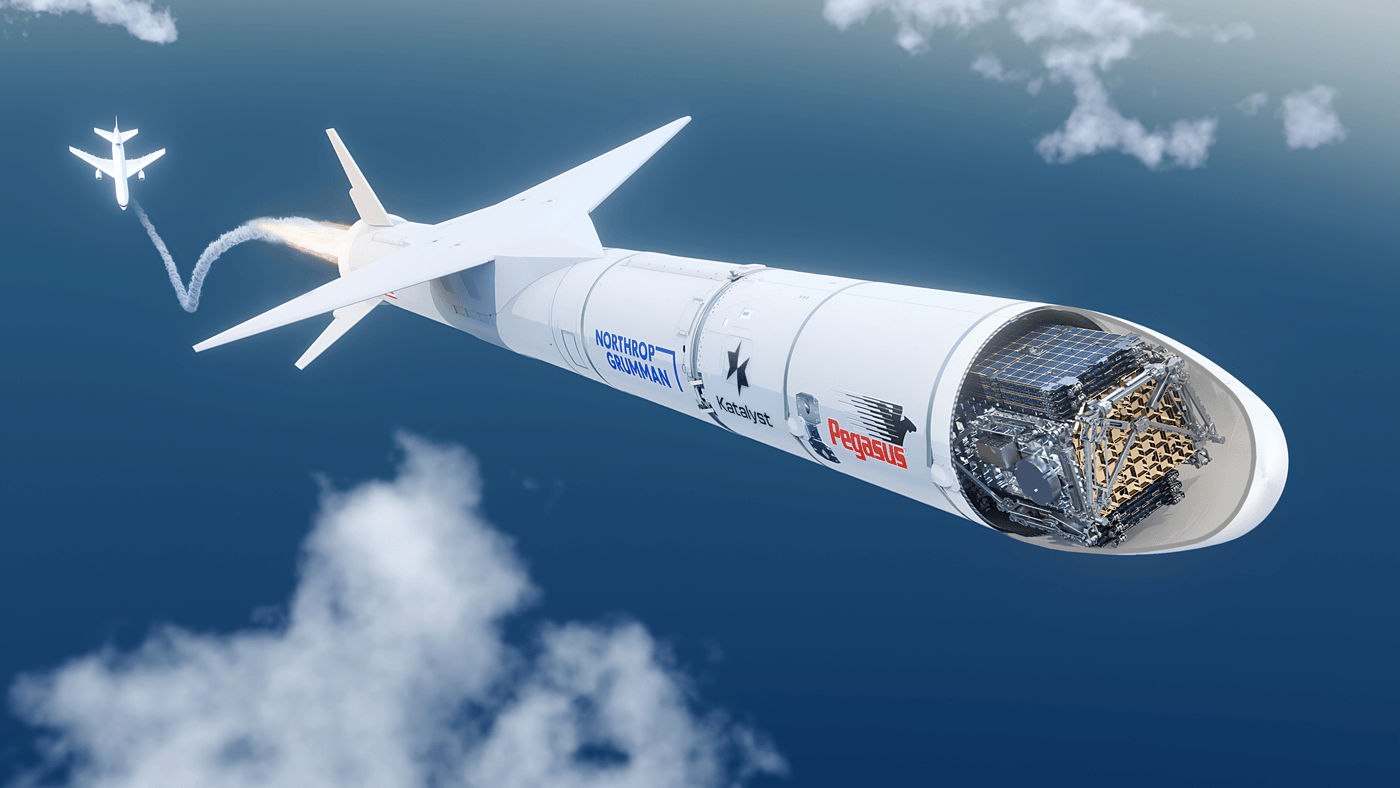
Image (Credit): Artist’s rendering of the LINK spacecraft in the Pegasus XL Rocket after launch. (Northrop Grumman)

“Over the weekend, Katalyst’s LINK servicing spacecraft experienced issues with attitude control, causing the spacecraft to spin and resulting in sporadic communications. Preliminary investigation shows that two of LINK’s three reaction wheels currently are not operable, and there is some loss of functionality in its cold gas thruster system. LINK is designed to approach, capture, and boost NASA’s Neil Gehrels Swift Observatory to a higher orbital altitude.”

-Statement by NASA regarding the private sector LINK mission to save the Neil Gehrels Swift Observatory, which is slowly losing altitude and is expected to burn up in the atmosphere by year’s end if nothing is done. The LINK mission was launched from the Marshall Islands on July 3rd aboard a Pegasus rocket.

Space Stories: English Observatory Closing, an Early Warning System for Astronomers, and Accessing Europa’s Ocean

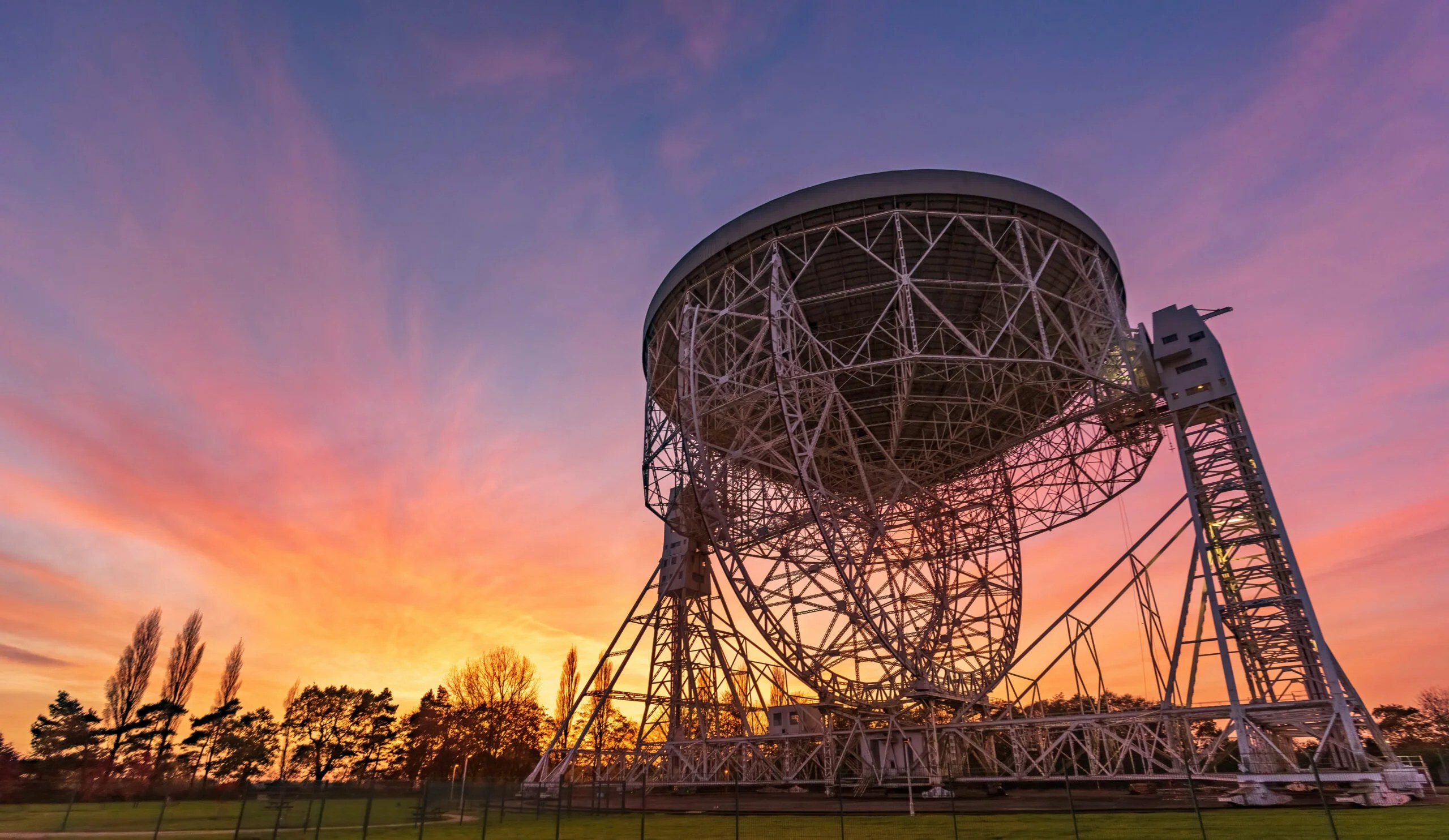
Image (Credit): The Jodrell Bank Observatory in Cheshire, England. (Jodrell Bank)

Here are some recent space-related stories of interest.

The Guardian: Jodrell Bank Observatory Facing Closure After Major Funder Cuts Support

Jodrell Bank Observatory, the hub of a world-leading network of radio telescopes, is facing closure after government funding for the facility was slashed. Scientists say decision is blow to UK astronomy as deep space observatory is home to world-leading facilities. The deep space observatory includes the Grade I-listed Lovell telescope and is prized by astronomers who study galaxies, black holes, star formation, planets beyond the solar system and the afterglow of the big bang.

ZME Science: “Astronomers Are Building an ‘Artificial Retina’ to Protect Telescope Images From Satellites

A telescope can spend hours collecting the faint light of a distant galaxy. A fast-moving satellite needs only a few seconds to cross its field of view, leaving a bright streak that contaminates (and sometimes ruins) the long exposure. As the number of satellites around Earth grows, astronomers increasingly need ways to predict and avoid these crossings. Researchers at the University of Warwick are now developing an early-warning system that could spot an approaching satellite and alert a telescope before it enters the image.

Rutgers: Why Europa’s Hidden Ocean May Be More Difficult to Reach Than Scientists Thought

Europa, one of Jupiter’s icy moons, long has fascinated scientists because of what may lie beneath its frozen shell: a global ocean of liquid water. That hidden ocean has made Europa one of the most compelling places in the solar system to study the conditions that might support life. But new research led by Rutgers scientist Lujendra Ojha suggests one of the most promising shortcuts to Europa’s ocean may be far more complicated than previously thought.

Note: Here is the podcast version of this post.