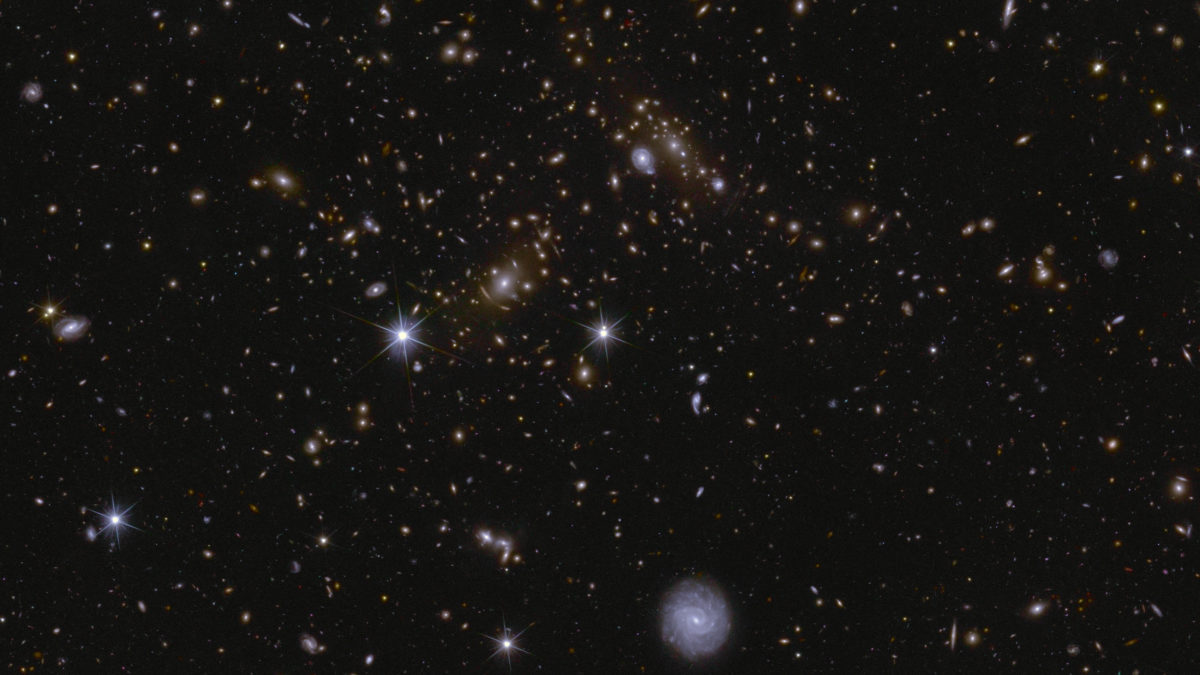
Multiple Choice: How long will it take Voyager 1 to travel one light year at its current speed?
A. 5,000 years
B. 18,000 years
C. 23,000 years
Take a guess and then check your answer by going to the “Astronomy Question Answer Sheet” page.

Multiple Choice: How long will it take Voyager 1 to travel one light year at its current speed?
A. 5,000 years
B. 18,000 years
C. 23,000 years
Take a guess and then check your answer by going to the “Astronomy Question Answer Sheet” page.

Here are some recent stories of interest.
—ARSTechnica: “For Some Reason, NASA is Treating Orion’s Heat Shield Problems as a Secret“
For those who follow NASA’s human spaceflight program, when the Orion spacecraft’s heat shield cracked and chipped away during atmospheric reentry on the unpiloted Artemis I test flight in late 2022, what caused it became a burning question. Multiple NASA officials said Monday they now know the answer, but they’re not telling. Instead, agency officials want to wait until more reviews are done to determine what this means for Artemis II, the Orion spacecraft’s first crew mission around the Moon, officially scheduled for launch in September 2025.
—NASA: “New Report Shows NASA’s $75.6 Billion Boost to US Economy“
In its third agencywide economic impact report, NASA highlighted how its Moon to Mars activities, climate change research and technology development, and other projects generated more than $75.6 billion in economic output across all 50 states and Washington, D.C., in fiscal year 2023…Combined, NASA’s missions supported 304,803 jobs nationwide, and generated an estimated $9.5 billion in federal, state, and local taxes throughout the United States.
—ABC News: “China Launches New Crew to its Space Station as it Seeks to Expand Exploration“
China declared a “complete success” after it launched a new three-person crew to its orbiting space station early Wednesday as the country seeks to expand its exploration of outer space with missions to the moon and beyond. The Shenzhou-19 spaceship carrying the trio blasted off from the Jiuquan Satellite Launch Center in northwest China at 4:27 a.m. local time atop a Long March-2F rocket, the backbone of China’s crewed space missions.

If you have yet to see the latest trailer for the upcoming HBO Max series Dune: Prophesy, I recommend you take a look. It provides plenty of information on the battle to come starting November 17th.
The initial images are impressive, though it does not appear we will have the out-of-this-world music we experienced with the first two Dune movies.
Maybe I have seen too many of these series now, but this latest story seems to be a cross between HBO’s Game of Thrones and Apple TV+’s Foundation. Not that I am complaining.
See for yourself, and stay tuned for what looks to be another success from the world called Dune.
Note: For a breakdown of the trailer, visit Secrets of Dune on Youtube. The narrator does a nice job tying the the new series into the two earlier movies.

Earlier today, a new Cool Worlds video was posted to Youtube titled “The Odds of Life – THIS CHANGED MY MIND.” Its an interesting piece narrated by Professor David Kipping regarding whether life is common in the universe. You will see that Professor Kipping is excited to share his results as he walks you through various papers before concluding that simple life may be more common than he believed earlier, making the chance of an advanced civilization a little more likely.
As always, it’s a fun story to follow as it answers one questions and stirs up other questions. For example, as part of his talk he notes an earlier paper that hypothesized the existence of an earlier technological civilization here on Earth about 350 million years ago. The paper is titled The Silurian Hypothesis: Would it be Possible to Detect an Industrial Civilization in the Geological Record.
Here is the abstract of this paper:
If an industrial civilization had existed on Earth many millions of years prior to our own era, what traces would it have left and would they be detectable today? We summarize the likely geological fingerprint of the Anthropocene, and demonstrate that while clear, it will not differ greatly in many respects from other known events in the geological record. We then propose tests that could plausibly distinguish an industrial cause from an otherwise naturally occurring climate event.
Professor Kipping said he hoped to create another video to discuss this idea about earlier civilizations. In the meantime, you may want to take a look at the paper.

It was not a good week for the US space industry. One major US space company is looking to exit the business while the head of another US space company is holding secret talks with Putin.
In the first case, Boeing’s bleak finances may be pushing it to consider the sale of its space business, which includes the troubled Starliner capsule most recently stuck at the International Space Station.
Fortune magazine highlighted comments by Boeing’s new CEO, Kelly Ortber, at his first earnings conference call on Wednesday, where he stated:
We’re better off doing less and doing it better than doing more and not doing it well…What do we want this company to look like five and 10 years from now? And do these things add value to the company or distract us?
This follows rumors that Boeing has been talking with Blue Origin about handing off some of its NASA-related portfolio.
It would appear that Boeing, which has been with NASA since the Apollo program, is having some second thoughts about its role in the space program as it deals with Starliner troubles, airplane manufacturing issues, and an ongoing worker strike.
And then we read about Elon Musk having help secret talks with Russia’s Vladimir Putin since at least 2022. You may remember Mr. Musk raised concerns in Washington when it was learned that he turned off his Starlink system when the Ukranians were planning an attack against invading Russian.
Some in Congress are already calling for an investigation into these discussions, given the role of SpaceX in critical Department of Defense contracts. Rep. Adam Smith (D-WA), the House Armed Services Committee’s top Democrat, stated:
We should investigate what Elon Musk is up to to make sure that it is not to the detriment of the national security of the United States.
NASA Administrator Bill Nelson also has some questions, stating:
I don’t know that that story is true. I think it should be investigated…If the story is true that there have been multiple conversations between Elon Musk and the president of Russia, then I think that would be concerning, particularly for NASA, for the Department of Defense, for some of the intelligence agencies.
It has become increasingly apparent that Mr. Musk’s excellence in creating companies will always be trumped by his bone-headed ego. He cannot help but be the center of attention rather than the competent engineer. He should really stay away from social media and social relationships until he can get his ego under control.
As I said, it was not a good week for the US space industry.