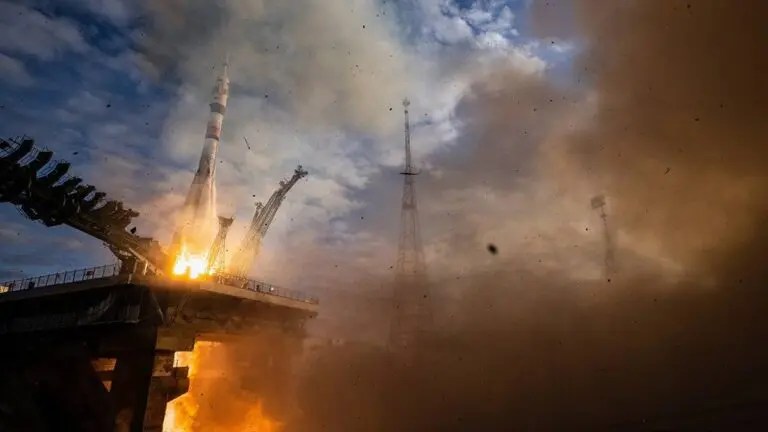
Image (Credit): The launch earlier today of the Progress MS-28 cargo spacecraft to the ISS. (TASS Russian News Agency)
This week’s image is from earlier today when the Russian’s successfully launched its Progress MS-28 cargo spacecraft via a Soyuz rocket to the International Space Station (ISS). The resupply mission was launched from the Baikonur Cosmodrome located in Kazakhstan. The spacecraft will rendezvous with the ISS on Saturday.
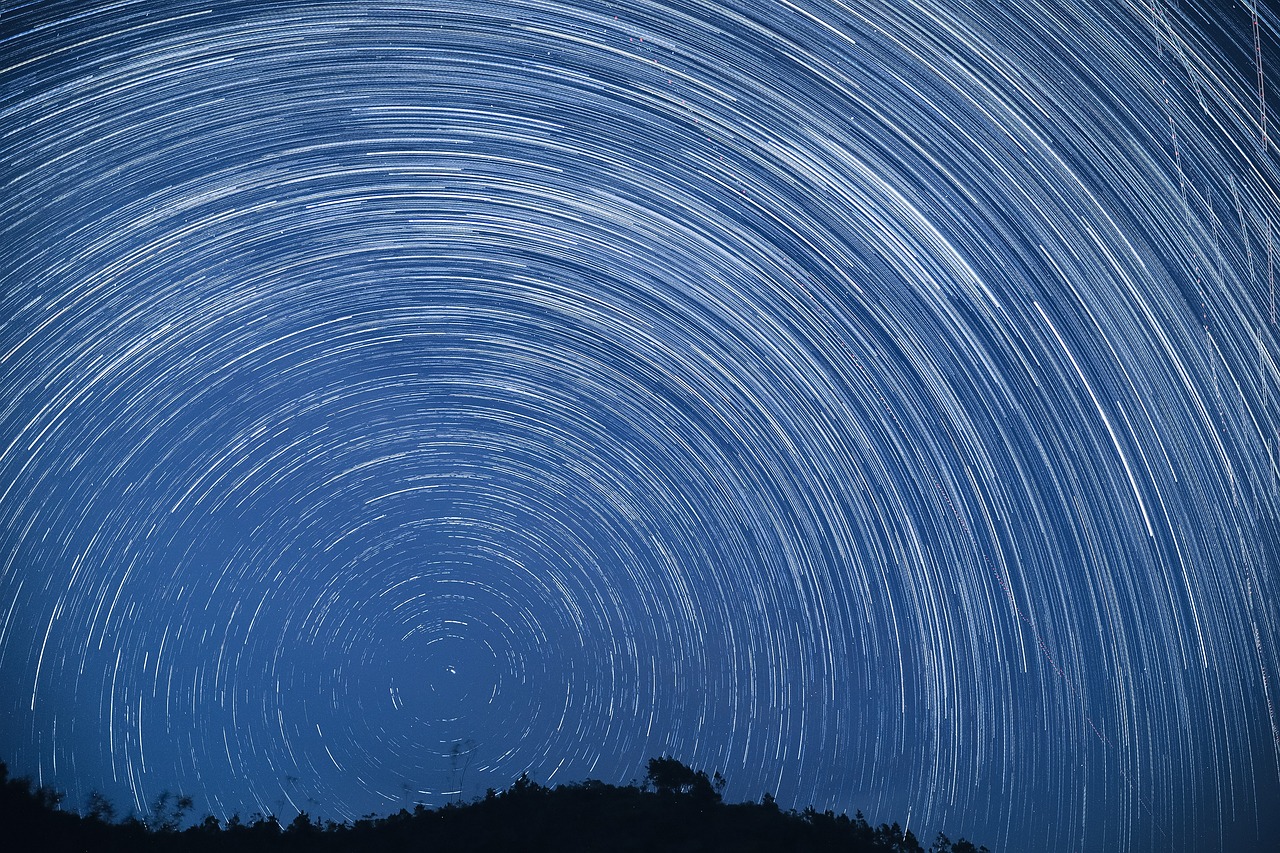
On August 1, Senators John W. Hickenlooper (D-CO) and Mike Crapo (R-ID) introduced a bill called The Dark and Quiet Skies Act (S.495) to assist astronomers with the night sky.
In a press release from Senator Hickenlooper’s office, we learn the Act would
…create a Center of Excellence overseen by National Institute of Standards and Technology (NIST) to develop best practices to reduce light and noise interference. The Center would boost collaboration between the astronomical community, industry, and Federal agencies to protect federally-funded scientific research that observes the sky and celestial bodies.
Specifically, this center would:
Establish and circulate best practices to reduce unintentional optical and radio interference;
Conduct research and development on tracking, identifying, modeling, and characterizing satellite interference; and
Develop mitigation technology that includes satellite paint, film, orientation adjustments, cooling techniques, or fuselage design.
The bill may be a little late to the game, particularly if the press release is correct and the sky is really getting 10 percent brighter each year, but it is certainly welcome. We already know SpaceX, Amazon, and China have grand plans to fill up the sky with satellites, so this is the time to set some rules for the U.S. companies at least.
Let’s hope any and all such efforts in this area can be coordinated to bring the greatest pressure to bear on these satellite companies. The goal should be more than protecting the night sky for telescopes. If it is true that we will see hundreds of thousands of new satellites in orbit in the years to come, we need to make some sense of this booming industry before a few massive collisions make the space over our heads full of litter and unusable.
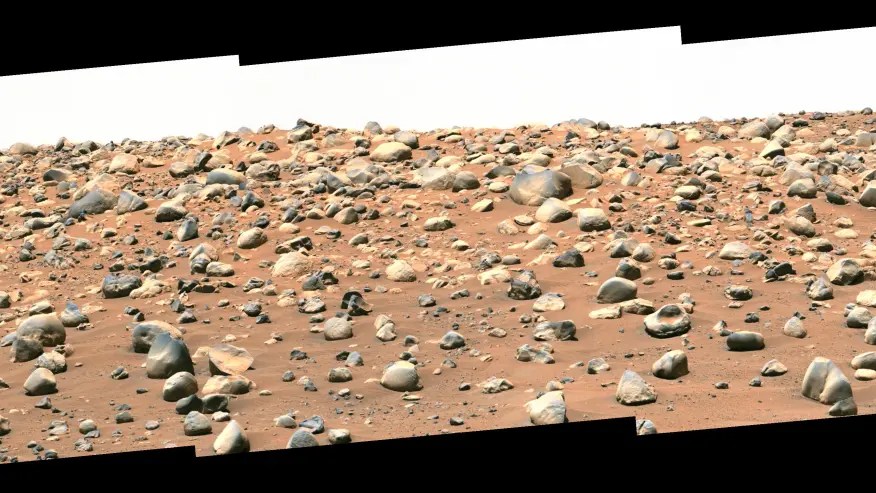
Image (Credit): Martian surface as captured by NASA’s Perseverance Mars rover (NASA/JPL-Caltech/ASU/MSSS)
“These new results demonstrate that liquid water does exist in the Martian subsurface today, not in the form of discrete and isolated lakes, but as liquid water-saturated sediments, or aquifers…On Earth, the subsurface biosphere is truly vast, containing most of the prokaryotic diversity and biomass on our planet. Some investigations even point to an origin of life on Earth precisely deep in the subsurface. Therefore, the astrobiological implications of finally confirming the existence of liquid water habitats kilometers beneath the surface of Mars are truly exciting.”
–Statement by Alberto Fairén, a visiting interdisciplinary planetary scientist and astrobiologist within the department of astronomy at Cornell University, regarding a recent study reporting vast quantities of water may reside between 7 and 12 miles beneath the Martian surface. The study utilized data from NASA’s InSight lander.
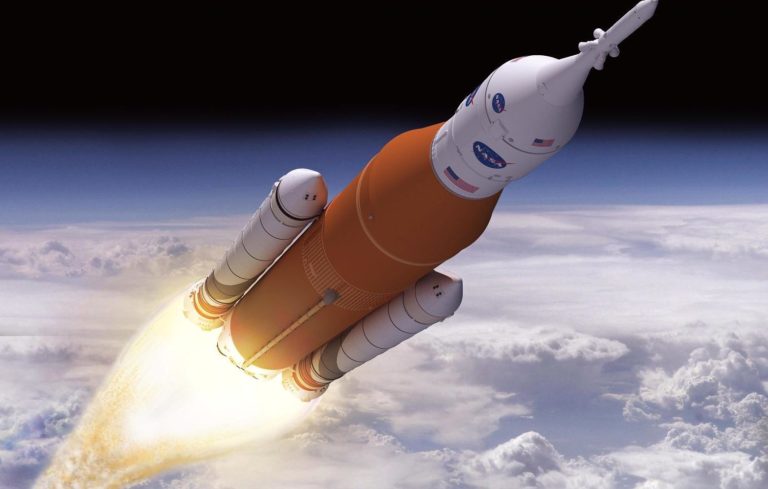
The report, released Thursday by NASA’s Office of Inspector General, calls into question Boeing’s standards and quality control for its part in NASA’s efforts to return astronauts to the moon. In NASA’s development of its next-generation megarocket, known as the Space Launch System, it gave Boeing the contract to build the rocket system’s powerful upper stage. But according to the report, Boeing’s quality control systems fall short of NASA’s requirements, and some known deficiencies have gone unaddressed. What’s more, the workers on the project are not, as a whole, sufficiently experienced or well trained, according to the inspector general.
A NASA payload will hitch a ride to the moon on Blue Origin’s first lunar lander mission, scheduled to launch as soon as next March. In an Aug. 6 procurement filing, NASA revealed it selected Blue Origin to fly a camera system to study how engine plumes interact with regolith at south polar regions of the moon, collecting data to support future crewed landing missions. The payload, called Stereo Cameras for Lunar Plume Surface Studies (SCALPSS), will fly through NASA’s Commercial Lunar Payload Services (CLPS) program.
NASA’s upcoming flagship astrophysics missions, the Nancy Grace Roman Space Telescope and the Habitable Worlds Observatory, will study planets outside our solar system, known as exoplanets. Over 5,000 exoplanets have been confirmed to date — and given that scientists estimate at least one exoplanet exists for every star in the sky, the hunt has just begun. Exoplanet discoveries from Roman and the Habitable Worlds Observatory may not be made only by professional researchers, but also by interested members of the public, known as citizen scientists.
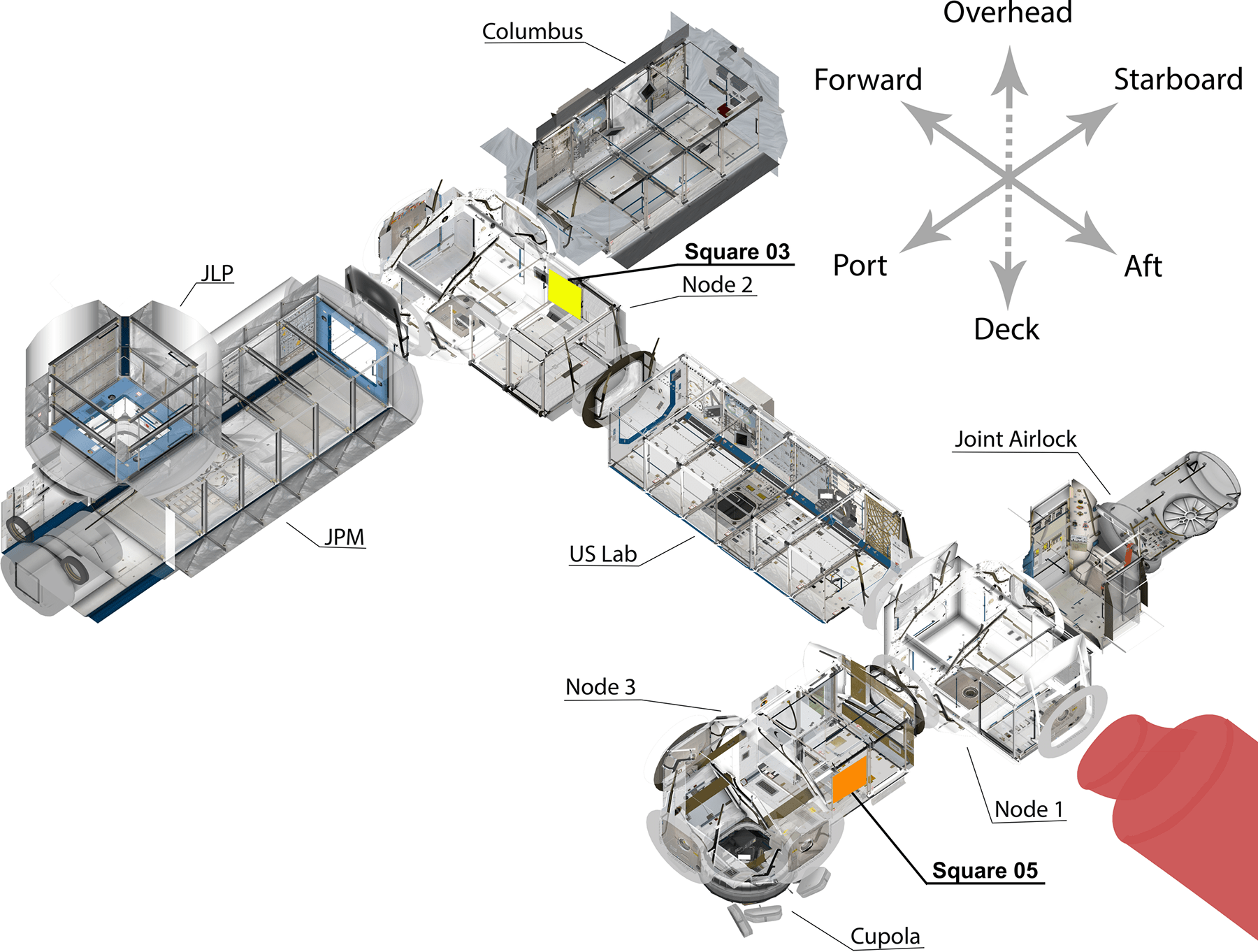
Image (Credit): A cutaway image of the International Space Station’s US Orbital Segment, showing the locations of Square 03 (at upper center, in yellow) and 05 (at lower right, in orange). (Tor Finseth, by permission, modified by Justin Walsh)
Between January and March 2022, crew aboard the International Space Station (ISS) performed the first archaeological fieldwork in space, the Sampling Quadrangle Assemblages Research Experiment (SQuARE). The experiment aimed to: (1) develop a new understanding of how humans adapt to life in an environmental context for which we are not evolutionarily adapted, using evidence from the observation of material culture; (2) identify disjunctions between planned and actual usage of facilities on a space station; (3) develop and test techniques that enable archaeological research at a distance; and (4) demonstrate the relevance of social science methods and perspectives for improving life in space. In this article, we describe our methodology, which involves a creative re-imagining of a long-standing sampling practice for the characterization of a site, the shovel test pit. The ISS crew marked out six sample locations (“squares”) around the ISS and documented them through daily photography over a 60-day period. Here we present the results from two of the six squares: an equipment maintenance area, and an area near exercise equipment and the latrine. Using the photographs and an innovative webtool, we identified 5,438 instances of items, labeling them by type and function. We then performed chronological analyses to determine how the documented areas were actually used. Our results show differences between intended and actual use, with storage the most common function of the maintenance area, and personal hygiene activities most common in an undesignated area near locations for exercise and waste.
Citation: Walsh JSP, Graham S, Gorman AC, Brousseau C, Abdullah S, Archaeology in space: The Sampling Quadrangle Assemblages Research Experiment (SQuARE) on the International Space Station. Report 1: Squares 03 and 05. PLoS ONE 19(8): e0304229 (2024). https://doi.org/10.1371/journal.pone.0304229