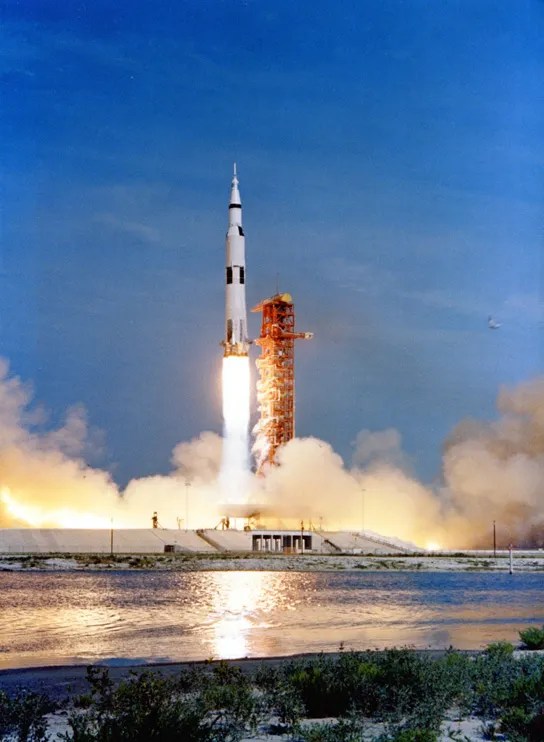
Image (Credit): The launch of the Apollo 11 space vehicle from the launch pad on July 16, 1969. (NASA/ Kipp Teague)
On this day in 1969, NASA launched the Saturn V rocket that carried astronauts Armstrong, Edwin “Buzz” Aldrin, and Michael Collins on the first manned lunar landing. The 363-feet tall Saturn V rocket was launched from Pad A, Launch Complex 39, Kennedy Space Center, at 9:32 a.m. EDT.
While this was the most significant use of the Saturn V at that point in time, it was the backbone of the Apollo program. The first crewed Saturn V to launch was Apollo 8, which orbited the Moon without landing.
You can listen in on the control room chatter surrounding the launch at this NASA launch history site.
NASA has a number of events planned for this month to celebrate the 55th anniversary of the Moon landing. You can read about the planned activities at this NASA anniversary site.
Three astronomers last week proposed expanding the official definition of a planet to encompass worlds orbiting stars other than our own, a nuance not currently included in the formal definition of the term established in 2006 by the International Astronomical Union, or IAU. If the trio’s new definition pans out, thousands of celestial bodies across the universe could be confirmed as formal planets.
An American plan to destroy the International Space Station by propelling it to burn through the atmosphere, and then crashing it into the Pacific Ocean, would rob citizens of the future of one of civilization’s greatest technological masterworks, and should be halted, say one-time leaders of NASA and of the European Space Agency. NASA’s draft blueprints to send the ISS on a peacetime kamikaze mission, to explode on impact with Antarctic waters, would obliterate a pole star of human ingenuity, says Jean-Jacques Dordain, Director General of the European Space Agency when the ISS was being built and expanded.
Team members are installing pedestals aboard NASA’s Pegasus barge to hold and secure the massive core stage of NASA’s SLS (Space Launch System) rocket, indicating NASA barge crews are nearly ready for its first delivery to support the Artemis II test flight around the Moon. The barge will ferry the core stage on a 900-mile journey from the agency’s Michoud Assembly Facility in New Orleans to its Kennedy Space Center in Florida…Measuring 212 feet in length and 27.6 feet in diameter, the core stage is the largest rocket stage NASA has ever built and the longest item ever shipped by a NASA barge.
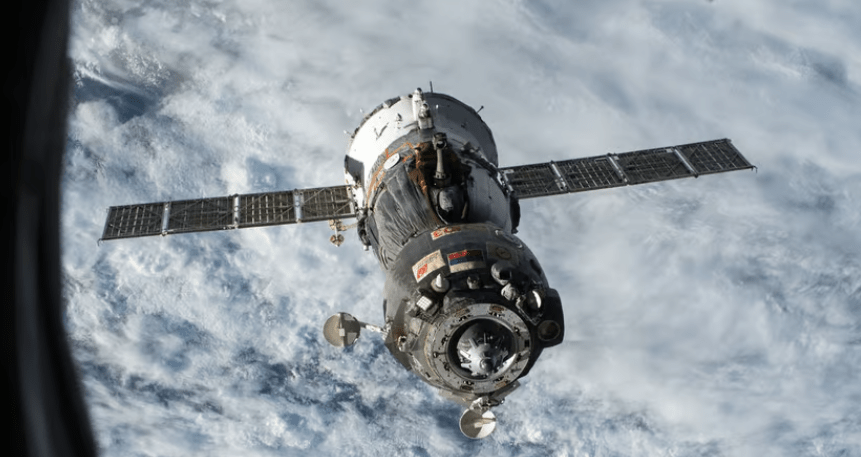
Image (Credit): A Russian Soyuz spacecraft outside the ISS. (NASA)
Well, the U.S. now has one space company with its manned spacecraft stranded at the International Space Station (ISS) while a second space company responsible for manned flights to the ISS has been grounded following a rocket mishap.
So where does this leave the ISS? Dependent on the Russians for manned flights to the ISS until the SpaceX problem can be investigated. Of course, SpaceX was also one solution for returning the Boeing crew to Earth if the Starliner problem could not be timely resolved. So much for that at the moment.
Both the Boeing and SpaceX issues could be resolved in the next few weeks, but this shows how quickly the situation can change on the ground and in space. While the Russians have certainly had their own issues with the Soyuz spacecraft as well, at least the men and women on the station have one option available to them.
Let’s hope Boeing gets its act together and the SpaceX mishap can be resolved quickly.
This weekend you can see a space-related movie, but it is light fare that probably should have been released on Apple TV+.
Fly Me to the Moon is a romantic comedy centered on an Apollo 11 Moon mission starring Scarlett Johansson and Channing Tatum. All you need to know is shown in this trailer.
Dramatizing the Apollo 11 mission is fine, but the part of the story about trying to fake the Moon landing does not seem necessary, particularly nowadays when conspiracy kooks are around every corner.
The movie Capricorn One about a fake landing on Mars had a time and a place in a troubled America, but the use of a fake landing here is just a cheap stunt adding little value to the film.
Luckily, real life drama can be so much better than Hollywood drama. I think I will skip this movie and watch Apollo 13again.
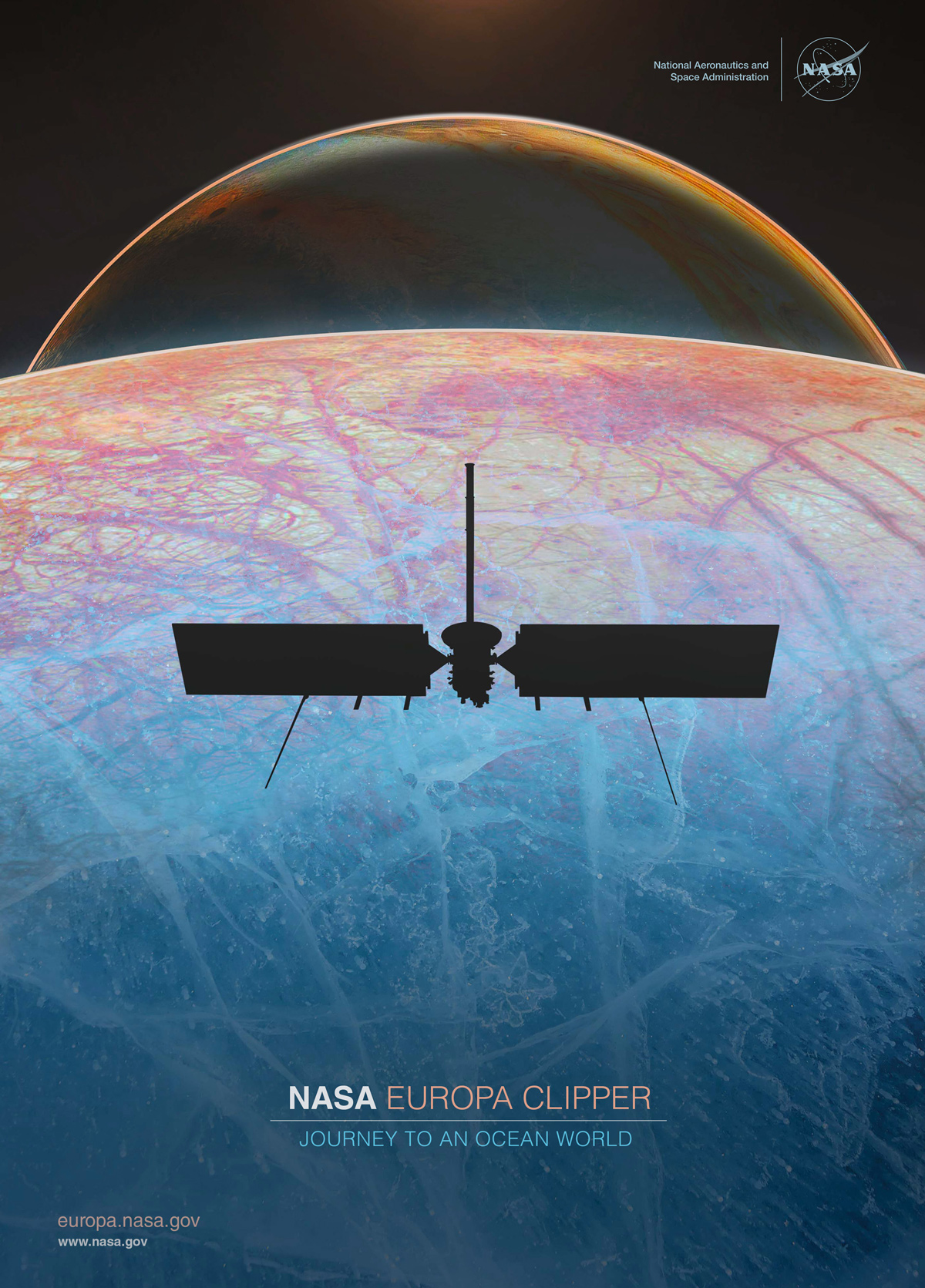
Image (Credit): NASA’s Europa Clipper poster. (NASA/ Jet Propulsion Laboratory-Caltech)
“Engineers with NASA’s Europa Clipper mission continue to conduct extensive testing of transistors that help control the flow of electricity on the spacecraft. NASA’s Jet Propulsion Laboratory in Southern California, which manages the mission, began the tests after learning that some of these parts may not withstand the radiation of the Jupiter system, which is the most intense radiation environment in the solar system.”
–NASA statement from yesterday regarding potential issues with electrical switches on the Europa Clipper spacecraft that is set to launch in October. Whether this leads to a delayed launch of the mission or a less nimble mission has yet to be determined. The preliminary findings from the current testing are expected to be released later this month.