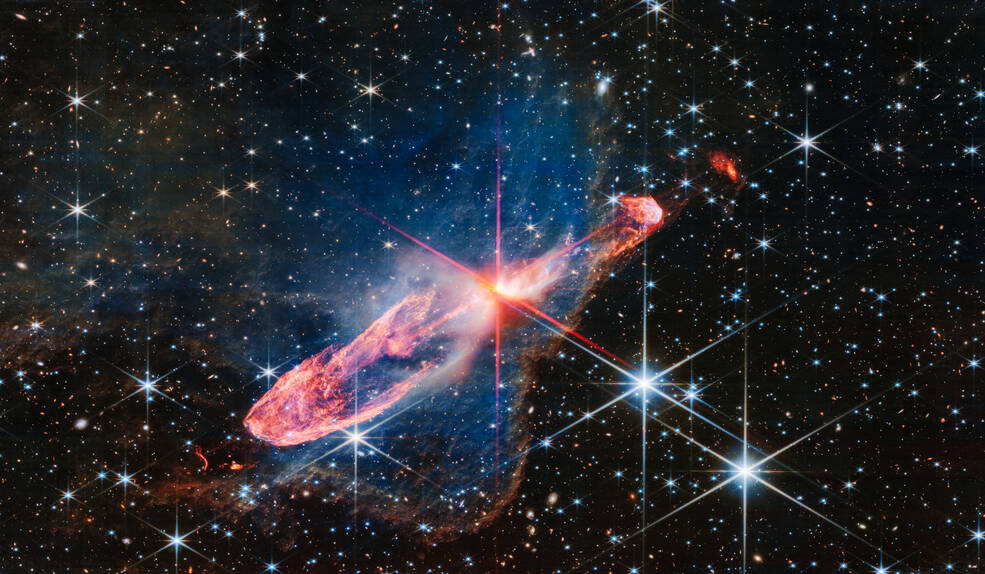
Image (Credit): JWST image showing the formation of a pair of new stars. (NASA, ESA, CSA. Image Processing: Joseph DePasquale (STScI))
This week’s image is from the James Webb Space Telescope (JWST). It shows the formation of new stars 1,470 light-years away that will take millions of years to form.
Here is a partial description of what you are seeing from NASA (visit the link for the full desciption):
NASA’s James Webb Space Telescope has captured the “antics” of a pair of actively forming young stars, known as Herbig-Haro 46/47, in high-resolution near-infrared light. To find them, trace the bright pink and red diffraction spikes until you hit the center: The stars are within the orange-white splotch. They are buried deeply in a disk of gas and dust that feeds their growth as they continue to gain mass. The disk is not visible, but its shadow can be seen in the two dark, conical regions surrounding the central stars.
The most striking details are the two-sided lobes that fan out from the actively forming central stars, represented in fiery orange. Much of this material was shot out from those stars as they repeatedly ingest and eject the gas and dust that immediately surround them over thousands of years.
When material from more recent ejections runs into older material, it changes the shape of these lobes. This activity is like a large fountain being turned on and off in rapid, but random succession, leading to billowing patterns in the pool below it. Some jets send out more material and others launch at faster speeds. Why? It’s likely related to how much material fell onto the stars at a particular point in time.
After going through Amazon’s list of top science fiction books, I pulled the top five involving interplanetary travel that may be of interest to readers. I am not endorsing these (nor would I in some clear cases), but rather pointing them out if you left for the beach and forgot to bring a book or two. It’s a good idea to have a backup book, and I also recommend you start at the beginning of each series just to make life easier.
The Three-Body Problem by Cixin Liu (1 of 4 in the series)
Set against the backdrop of China’s Cultural Revolution, a secret military project sends signals into space to establish contact with aliens. An alien civilization on the brink of destruction captures the signal and plans to invade Earth. Meanwhile, on Earth, different camps start forming, planning to either welcome the superior beings and help them take over a world seen as corrupt, or to fight against the invasion. The result is a science fiction masterpiece of enormous scope and vision.
Light Bringer: A Red Rising Novel by Pierce Brown (6 of 7 in the series)
The Reaper is a legend, more myth than man: the savior of worlds, the leader of the Rising, the breaker of chains.
But the Reaper is also Darrow, born of the red soil of Mars: a husband, a father, a friend.
Marooned far from home after a devastating defeat on the battlefields of Mercury, Darrow longs to return to his wife and sovereign, Virginia, to defend Mars from its bloodthirsty would-be conqueror Lysander.
Lysander longs to destroy the Rising and restore the supremacy of Gold, and will raze the worlds to realize his ambitions.
The worlds once needed the Reaper. But now they need Darrow, and Darrow needs the people he loves—Virginia, Cassius, Sevro—in order to defend the Republic.
So begins Darrow’s long voyage home, an interplanetary adventure where old friends will reunite, new alliances will be forged, and rivals will clash on the battlefield.
Because Eo’s dream is still alive—and after the dark age will come a new age: of light, of victory, of hope.
Ice Planet Barbarians by Ruby Dixon ( 1 of 21 in the series)
You’d think being abducted by aliens would be the worst thing that could happen to me. And you’d be wrong. Because now, the aliens are having ship trouble, and they’ve left their cargo of human women – including me – on an ice planet. And the only native inhabitant I’ve met? He’s big, horned, blue, and really, really has a thing for me…
Backyard Starship: Constant Sorrowby J.N. Chaney and Terry Maggert (15 of 16 in the series)
Humans have been in the stars far longer than Van originally thought, and they’ve been busy.
But not every visitor to or from Earth has good intentions, and the Peacemakers are faced with an uncomfortable reality. The Earth is about to meet aliens. Some of the aliens are bringing goods to trade. And among those items—are weapons.
When a secret cabal of humans who want to exploit the Earth is revealed, Van has to decide how and where to fight this threat. Along the way, he reveals a secret history that began in the Great War—and ends with mass chaos on his home planet.
Van won’t let that happen—at least not without a fight, and to hold back the gears of war, he’s going to need a lot of help. With Torina at his side, the crew faces a decision that will change the future of the stars themselves, and challenge the Guild, the Earth, and the Equal Grasp as the universe gets smaller with each contact between humans and aliens.
How can Van manage the clash, save earth, and deliver peace?
If he can, what will it cost him?
Defiance of the Fall 10: A LitRPG Adventure by TheFirstDefier and JF Brink (10 of 11 in the series)
A storm of fate is gathering, and Zac finds himself at its center.
Having escaped the Orom’s prison, Zac has finally returned to Earth. Much has changed during his years off-world, with war brewing in the Zecia Sector. Struggle is the System’s mandate, where the strong thrive, and the weak suffer.
Zac and the Atwood Empire are racing against time to accumulate the power needed to survive. With danger comes opportunity, and all clues point toward the chaotic Million Gates Territory. That’s where the invaders are hiding, and that’s where Ogras is trapped. But first, Zac needs a spaceship.
Meanwhile, ancient forces from the depths of the Multiverse stir, their gazes pointed toward the desolate frontier.
NASA’s Mars Ascent Vehicle (MAV) recently reached some major milestones in support of the Mars Sample Return program. The Mars Ascent Vehicle would be the first launch of a rocket from the surface of another planet. The team developing MAV conducted successful tests of the first and second stage solid rocket motors needed for the launch.Mars Sample Return will bring scientifically selected samples to Earth for study using the most sophisticated instrumentation around the world. This strategic partnership with ESA (European Space Agency) features the first mission to return samples from another planet. The samples currently being collected by NASA’s Perseverance Rover during its exploration of an ancient river delta have the potential to reveal the early evolution of Mars, including the potential for ancient life.
The James Webb Space Telescope has spotted objects in the early universe that might be a new kind of star — one powered by dark matter. These “dark stars” are still hypothetical. Their identification in JWST images is far from certain. But if any of the three candidates — reported in the July 25 Proceedings of the National Academy of Sciences — turn out to be this new type of star, they could offer a glimpse of star formation in the early universe, hint at the nature of dark matter and possibly explain the origins of supermassive black holes.
The head of Russia’s space agency has extended an offer to Moscow’s partners in the BRICS group – Brazil, India, China and South Africa – to participate in the construction of a joint module for its planned orbital space station, state media reported Monday. Construction of the planned space station follows Moscow’s decision last year to end its decades-long partnership with NASA and withdraw from the aging International Space Station – one of the last remaining channels of cooperation between Russia and the United States.
Image (Credit): Artist’s rendering of the DRACO spacecraft. (DARPA)
When you hear the word DRACO, you may think of the Harry Potter series or even severe Athenians, but NASA wants you to think of speedy travel to Mars. DRACO, or Demonstration for Rocket to Agile Cislunar Operations, is NASA’s plan to develop a nuclear thermal rocket engine with the Defense Advanced Research Projects Agency (DARPA). Defense contractor Lockheed Martin was recently tapped to lead this effort.
Such an engine would shorten the journey to Mars, thereby exposing astronauts to less risk from solar energetic particles and galactic cosmic rays as well as lessening the amount of supplies needed for the trip. The rocket engine could also be used initially for shorter trips to the Moon.
The space domain is critical to modern commerce, scientific discovery, and national security. The ability to accomplish leap-ahead advances in space technology through the DRACO nuclear thermal rocket program will be essential for more efficiently and quickly transporting material to the Moon and eventually, people to Mars.
You can read more about this new rocket approach and the parties involved at this NASA link.
Image (Credit): View of Jupiter’s moon Io. (NASA/JPL-Caltech/SwRI/MSSS)
Last week, NASA released this video showing the Juno spacecraft’s view of Jupiter and its moon Io as it flew by on May 16, 2023. The clip includes music by Vangelis. It is short but stunning video.
Juno was launched back in 2011 and first started orbiting Jupiter in 2016. Sent to study Jupiter, the current flyby is part of the spacecraft’s extended mission.
Juno’s closest approach to Io will occur today, so you can expect more images shortly.
If you want to read more about Io and the mission, visit this NASA site.