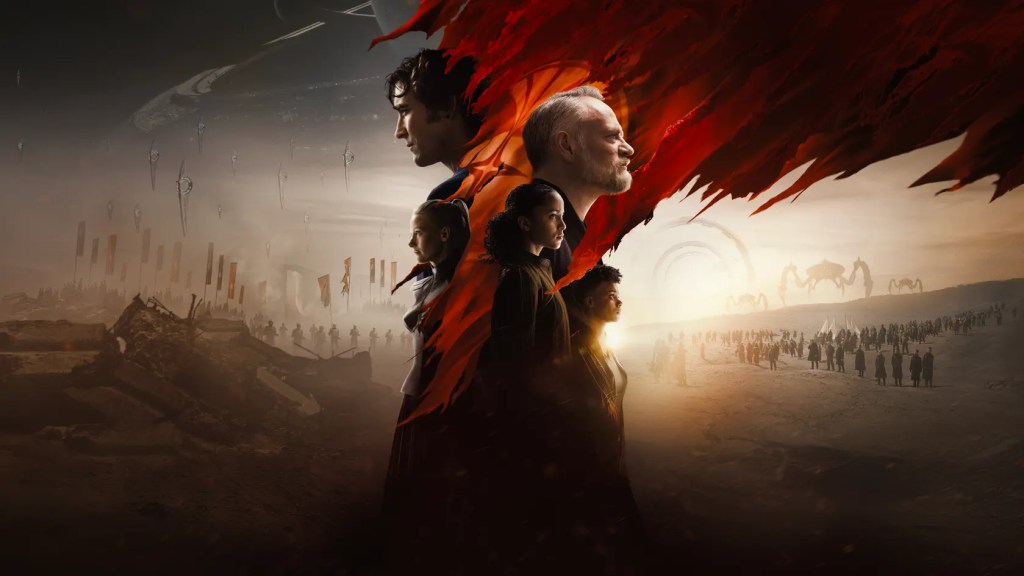
Image (Credit): Poster for season two of Foundation. (Apple TV+)
If you are not watching Foundationon Apple TV+, I recommend you give it a try. Season two begins today.
We need it during a summer with very few if any films touching on space fantasies (without Marvel or DC Comics superheros). The season two trailer will show you what is in store this season, but you need to start from the beginning with season one. You do not want to miss a minute of this series.
The Foundation television series is a cross between Dune and Game of Thrones, with plenty of corrupt dynasties, rebel alliances, and moral dilemmas. However, you should not expect it to closely track Issac Asimov’s books. It deviates from and expands on the themes from the books, but this television story is its own creature. You should enjoy the book and television series separately.
Back in 2021, Belen Edwards wrote a good piece for Mashable called “How Apple TV’s ‘Foundation’ is different from the books.” You will not need it if you are new to the overall story or willing to trust Apple TV+ to give you a good show, but if you are curious about the variations on a theme then this will satisfy that itch.
I am just happy that we have a summer space blockbuster to keep us satisfied. And it is a welcome addition to the constant renewal of Star Trek and Star Wars series. Don’t get me wrong. I want all of it. But Asimov’s universe is another great place to travel if only to better understand the world back here.
Image (Credit): The Rho Ophiuchi cloud complex as captured by JWST. (NASA, ESA, CSA, STScI, Klaus Pontoppidan (STScI))
This amazing image was released by NASA earlier this week in celebration of the James Webb Space Telescope’s (JWST) one year anniversary. It shows the Rho Ophiuchi cloud complex, which is the closest star-forming region to Earth.
Webb’s image shows a region containing approximately 50 young stars, all of them similar in mass to the Sun, or smaller. The darkest areas are the densest, where thick dust cocoons still-forming protostars. Huge bipolar jets of molecular hydrogen, represented in red, dominate the image, appearing horizontally across the upper third and vertically on the right. These occur when a star first bursts through its natal envelope of cosmic dust, shooting out a pair of opposing jets into space like a newborn first stretching her arms out into the world. In contrast, the star S1 has carved out a glowing cave of dust in the lower half of the image. It is the only star in the image that is significantly more massive than the Sun.
“Webb’s image of Rho Ophiuchi allows us to witness a very brief period in the stellar lifecycle with new clarity. Our own Sun experienced a phase like this, long ago, and now we have the technology to see the beginning of another’s star’s story,” said Klaus Pontoppidan, who served as Webb project scientist at the Space Telescope Science Institute in Baltimore, Maryland, since before the telescope’s launch and through the first year of operations.
Take a look at the image above. Can you determine where this image originated? Take a guess and then check your answer by going to the “Where is This? The Answer Sheet” page.
Tomorrow, July 12th, is the first anniversary of the James Webb Space Telescope (JWST). As a result, NASA has a few events planned that you may want to attend.
Webb mission experts will be available to conduct live, remote interviews with broadcast media, in both English and Spanish. Details about scheduling these interviews are available online. Webb experts also are available for interviews outside of this window upon request.
4 p.m.: NASA Science Live online
Two Webb experts will be featured on a NASA Science Live episode, discussing how Webb has made an impact in its first year on exploring the distant universe, characterizing exoplanet atmospheres, and understanding the solar system. The show will air live on the NASA Science Live website, as well as YouTube, Facebook, and Twitter. Viewers of this episode can submit questions on social media using the hashtag #UnfoldtheUniverse or by leaving a comment in the chat section of the Facebook or YouTube stream.
This past Sunday, 60 Minutes had a segment on Google and artificial intelligence (AI) called Exploring the human-like side of artificial intelligence at Google. Part of the discussion covered Google’s new AI chat bot Bard. And while the creative output of Bard was impressive, it was a little too creative when asked asked about economics. Bard recommended five books, but all five were nonexistent books. This is called “hallucination” in the AI realm.
I decided to try this myself, but ask for the five best books on black holes. This is what came back from Bard:
1. Black Holes: The BBC Guide by Andrew Hamilton. This book is a comprehensive introduction to black holes, covering their history, physics, and astrophysics. It is written in a clear and accessible style, and is perfect for anyone who wants to learn more about these fascinating objects. (link provided: https://www.goodreads.com/book/show/29537175-black-holes-the-reith-lectures)
3. A Brief History of Time by Stephen Hawking. This classic book is a must-read for anyone interested in black holes or cosmology. Hawking explains complex concepts in a clear and engaging way, and his book is full of insights into the nature of the universe. (link provided: https://www.amazon.com/Brief-History-Time-Stephen-Hawking/dp/0553380168)
4. Black Holes & Time Warps: Einstein’s Outrageous Legacy by Kip Thorne. This book is a more advanced treatment of black holes, but it is still written in a clear and accessible style. Thorne is one of the world’s leading experts on black holes, and his book provides a wealth of information about these fascinating objects. (link provided: https://www.amazon.com/Black-Holes-Time-Warps-Commonwealth/dp/0393312763)
5. The Little Book of Black Holes by Janna Levin. This book is a great introduction to black holes for people who are new to the subject. Levin writes in a clear and engaging style, and she uses humor and analogy to make the physics more accessible. (link provided: https://www.amazon.com/Little-Black-Holes-Science-Essentials/dp/0691163723)
Bard was even helpful enough to provide links to the books being cited.
After looking up these books, related authors, and links, here is what I found:
I could not find the first book by Andrew Hamilton, though he is a professor in the Department of Astrophysical and Planetary Sciences at Cornell University. Also, the link was to a different book.
The second, third, and fourth book references were accurate, as were the associated links.
The fifth book exists, but the authors are Steven S. Gubser and Frans Pretorius, not Janna Levin, who wrote other books on black holes.
So that gives you a 40 percent error rate on the 5 books listed. It does not inspire confidence. I am afraid to ask for the top 10 if only because it would take more time to correct this supposedly amazing chat bot.
And I do not really know if these are the top books in the field. Chat GPT gave me three of the five books listed, and also named the first book linked in Bard’s response, but attributed the lecture to Roger Penrose (the name of the lecture series) rather than Stephen Hawking.
Caution is highly recommended with these chat bots.