Take a look at the image above. Can you determine where this image originated? Take a guess and then check your answer by going to the “Where is This? The Answer Sheet” page.

Take a look at the image above. Can you determine where this image originated? Take a guess and then check your answer by going to the “Where is This? The Answer Sheet” page.

This week’s image comes from NASA’s Mars rover Perseverance as it explores the to Jezero Crater. The photo was posted last month. It has been a little while since we directly our attention at the Red Planet.
The image shows what may be the result of a fast-moving river some time in the past. In the NASA write-up accompanying the photo above, we read:
“Pinestand” is an isolated hill bearing sedimentary layers that curve skyward, some as high as 66 feet (20 meters). Scientists think these tall layers may also have been formed by a powerful river, although they’re exploring other explanations, as well.
“These layers are anomalously tall for rivers on Earth,” [postdoctoral researcher at NASA’s Jet Propulsion Laboratory in Southern California Libby] Ives said. “But at the same time, the most common way to create these kinds of landforms would be a river.”

“Mitigating the risk of extinction from AI should be a global priority alongside other societal-scale risks such as pandemics and nuclear war.”
-Statement by artificial intelligence (AI) experts and public figures in a “Statement on AI Risk” from the Center for AI Safety. This followed an earlier open letter back in March from other AI leaders that called “on all AI labs to immediately pause for at least 6 months the training of AI systems more powerful than GPT-4.” This could indicate we may be witnessing the “Great Filter” at work, which was one answer to Fermi’s paradox highlighting the lack detectable extraterrestrial life.

Here are some recent stories of interest.
—ScienceDaily: “One-third of Galaxy’s Most Common Planets Could be in Habitable Zone“
In a new analysis based on the latest telescope data, University of Florida astronomers have discovered that two-thirds of the planets around these ubiquitous small stars could be roasted by these tidal extremes, sterilizing them. But that leaves one-third of the planets — hundreds of millions across the galaxy — that could be in a goldilocks orbit close enough, and gentle enough, to hold onto liquid water and possibly harbor life.
—Space Telescope Science Institute: “Astronomers are Reducing Satellite Interference in Hubble Images“
When the Hubble Space Telescope was launched in 1990, there were about 470 artificial satellites orbiting Earth. By 2000, that number doubled. But by 2023, the rising number has grown almost exponentially to nearly 8,000 satellites. For Hubble this means that satellites photobomb about 10% of its exposures on celestial targets…Astronomers at the Space Telescope Science Institute in Baltimore, Maryland have developed tools for cleaning up this clutter. Hubble observations consist of more than just one exposure. And so, artifacts can be identified and subtracted between exposures because they are not in the same place on a detector.
—BGR: “Aliens Might be Trying to Contact Us from Within the Milky Way, Study Claims“
A new study seems to think alien signals could be emitting from the heart of the Milky Way, attempting to make contact with humankind. The study focuses on the use of data from a groundbreaking mission known as the Breakthrough Listen Investigation for Periodic Spectral Signals (BLIPSS), which looks for repeating patterns that could be key to unlocking connections with extraterrestrial intelligence in our galaxy.

WTF Podcast host Marc Maron interviewed William Shatner recently. Overall, it was a fun conversation with Mr. Shatner discussing his early acting career, his family, his flight into space on Blue Origin, his various ongoing projects, and more.
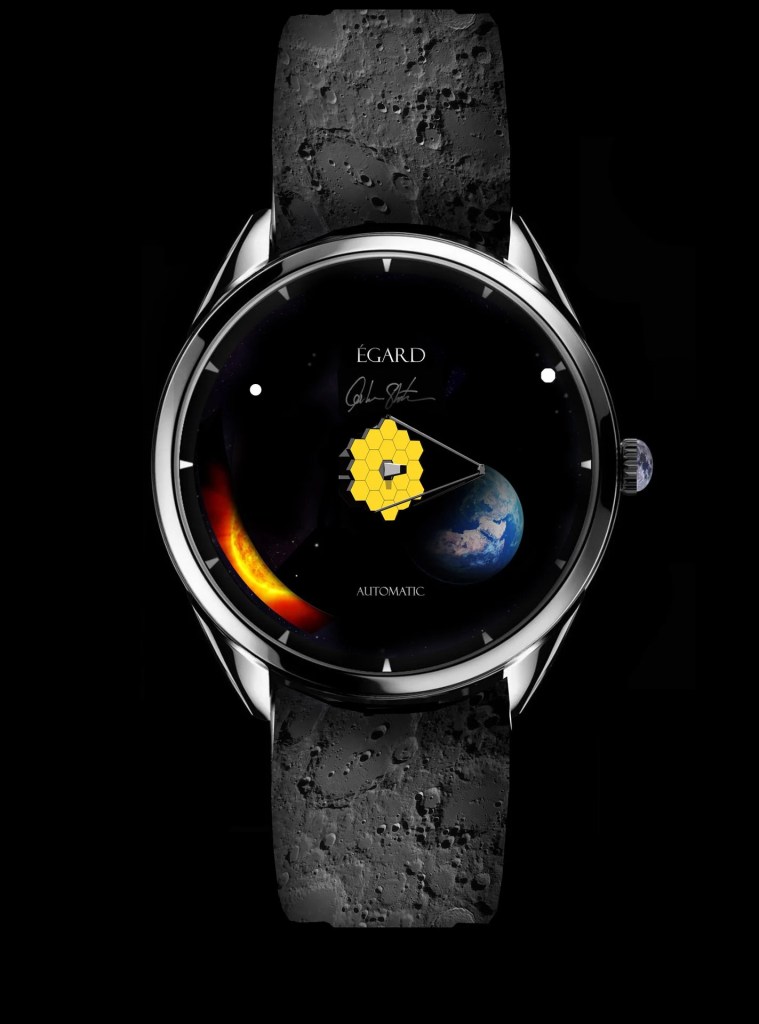
In terms of projects, Mr. Shatner mentioned a variety of interests, including horse shows, television series, and even designing his own watch (shown below). Yes, the man is still busy in his 90s.
I recommend you check it out (the interview starts at about the 11 minute mark).
Note: One of the television series discussed is Fox’s new series Stars on Mars, which premieres today.