Source/Credit: Astronaut Leroy Chiao (right) attending a Red Square Memorial Ceremon in September 2004. Image from CNN.
As we await peace or war between Russia and Ukraine, US astronaut Leroy Chiao shared his thoughts about his cooperation with Russians at the International Space Station (ISS). He served as the copilot of a Russian Soyuz spacecraft to the ISS as well as the commander during Expedition 10. In his CNN editorial, he emphasizes the importance of continued cooperation at the station even when partners are on opposing sides during ongoing conflicts:
In the early 2000s, a few years after the Kosovo war, I started training for my ISS mission in Star City, outside of Moscow. Not long after I started training in Russia there were conflicts in and around the Balkans and I remember times when we would hear heavy Russian transport aircraft taking off all night from the air base next to us, bringing troops and materiel to the conflict zones. We Americans discussed these issues with our Russian friends in the training program and I learned one of the wonderful things about living in other worlds is you develop perspective. You don’t necessarily agree, but you can appreciate the viewpoints of the other side.
Let’s hope the two-nation relationship is not tested further in the weeks to come. I like the idea of international cooperation as well as maintaining healthy competition in the realm of space endeavors.
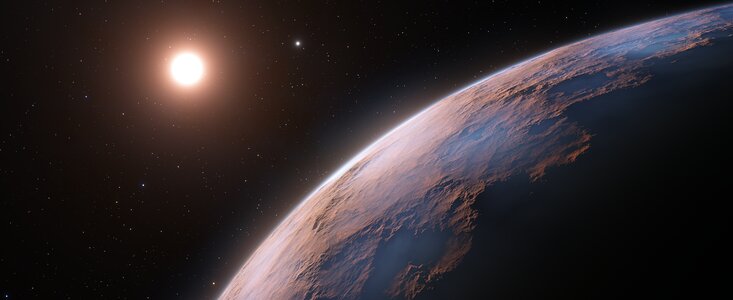
Source/Credit: Artist rendering of a candidate exoplanet orbiting Proxima Centauri from the ESO.
Earlier this month, astronomers utilizing the European Space Observatory’s (ESO) Very Large Telescope identified what appears to be a third exoplanet orbiting Proxima Centauri, the closest star to our solar system at about 4.2 light years away. The ESO press release shared the following details:
The newly discovered planet, named Proxima d, orbits Proxima Centauri at a distance of about four million kilometres, less than a tenth of Mercury’s distance from the Sun. It orbits between the star and the habitable zone — the area around a star where liquid water can exist at the surface of a planet — and takes just five days to complete one orbit around Proxima Centauri.
The star is already known to host two other planets: Proxima b, a planet with a mass comparable to that of Earth that orbits the star every 11 days and is within the habitable zone, and candidate Proxima c, which is on a longer five-year orbit around the star.
…At just a quarter of the mass of Earth, Proxima d is the lightest exoplanet ever measured using the radial velocity technique, surpassing a planet recently discovered in the L 98-59 planetary system. The technique works by picking up tiny wobbles in the motion of a star created by an orbiting planet’s gravitational pull. The effect of Proxima d’s gravity is so small that it only causes Proxima Centauri to move back and forth at around 40 centimetres per second (1.44 kilometres per hour).
It’s great to learn a little more about our nearest neighbor.
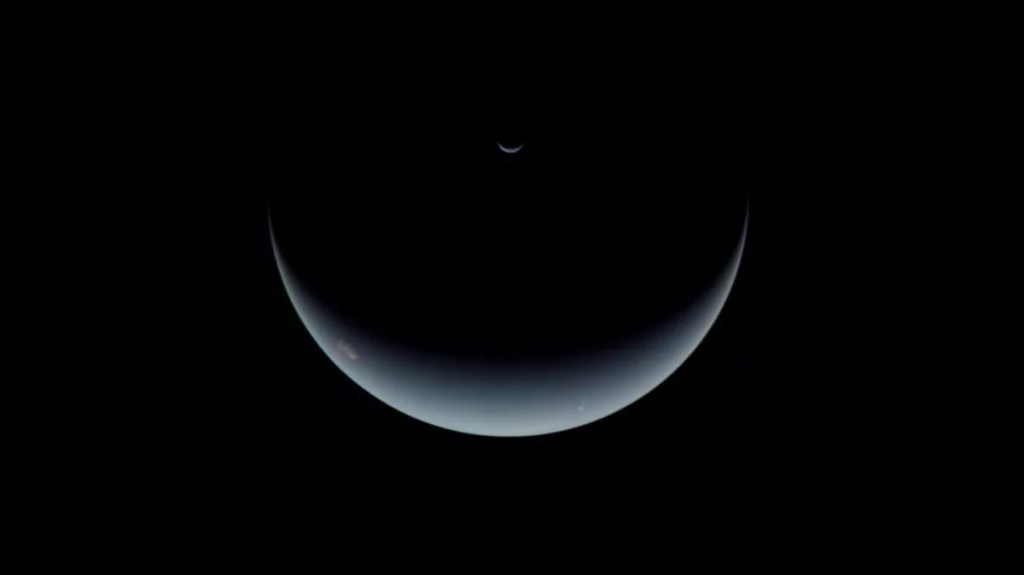
Source/Credit: Voyager 2 image of Neptune and Triton from NASA/JPL-Caltech/Björn Jónsson.
In a recent posting, the non-profit Planetary Society is recommending NASA consider a return to Neptune and its moon Triton, noting that such a mission was part of the plan in the last Decadal Survey in 2010 along with trips to Mars and Europa (both of which are underway). NASA was aiming for Uranus or Neptune, but the Planetary Society stated a preference for Neptune.
The last and only visit to Neptune back in 1989 with NASA’s Voyager 2 spacecraft providing our first close view of the planet. The Voyager 2 mission also led to the discovery of six new moons as well as four rings around the planet. Moreover, the mission detected what may be underground oceans on the moon Triton.
The Planetary Society believes Triton, most likely a captured object from the Kuiper Belt, should be the deciding factor for visiting Neptune rather than Uranus. A 2019 paper, “The NASA Roadmap to Ocean Worlds,” highlights the value of visiting Triton to learn more about its potential oceans:
Triton is deemed the highest priority target to address as part of an Ocean Worlds Program. This priority is given based on the extraordinary hints of activity shown by the Voyager spacecraft (e.g., plume activity; smooth, walled plains units; the cantaloupe terrain suggestive of convection)…and the potential for ocean-driven activity given by Cassini results at Enceladus. Although the source of energy for Triton’s activity remains unclear, all active bodies in the Solar System are driven by endogenic heat sources, and Triton’s activity coupled with the young surface age makes investigation of an endogenic source important. Further, many Triton mission architectures would simultaneously address Ice Giant goals on which high priority was placed in the Visions and Voyages Decadal Survey. Finally, as Triton likely represents a captured Kuiper Belt object (KBO), some types of comparative planetology with KBOs could also be addressed in a Triton mission. Before the next Decadal Survey, a mission study should be performed that would address Triton as a potential ocean world; such a study could be part of a larger Neptune orbiter mission. The Decadal Survey should place high priority on Triton as a target in the Ocean Worlds Program.
The next Decadal Survey is being prepared now and among the papers submitted for consideration is this one highlighted by the Planetary Society – “Neptune and Triton: A Flagship for Everyone.” This paper states that a large strategic mission, called a “Flagship Mission,” to Neptune and Triton would have may benefits:
A Flagship Mission to Neptune and Triton would provide many firsts, an orbiter and atmospheric probe would not only be feasible on a Flagship budget, but achievable given the current state of the technology required by such a venture. This bold mission of exploration would be the first to orbit an ice giant to study the planet, its rings, small satellites, space environment, and the planetsized moon, Triton, itself a captured dwarf planet from the Kuiper Belt and a geophysically reactivated twin of Pluto. Broadly, the mission would address the following questions: How do theinteriors and atmospheres of ice giant (exo)planets form and evolve? What causes Neptune’s strange magnetic field, and how do its magnetosphere and aurora work? What are the origins of and connections between Neptune’s rings, arcs, and small moons? Is Triton an ocean world? What causes its plumes? What is the nature of its atmosphere? and how can Triton’s geophysics and composition expand our knowledge of dwarf planets like Pluto?
It sounds like a strong argument to me. I imagine the other 500 or so papers submitted as part of the upcoming Decadal Survey have some other great scientific missions in mind as well. I look forward to seeing the final recommendations to NASA.
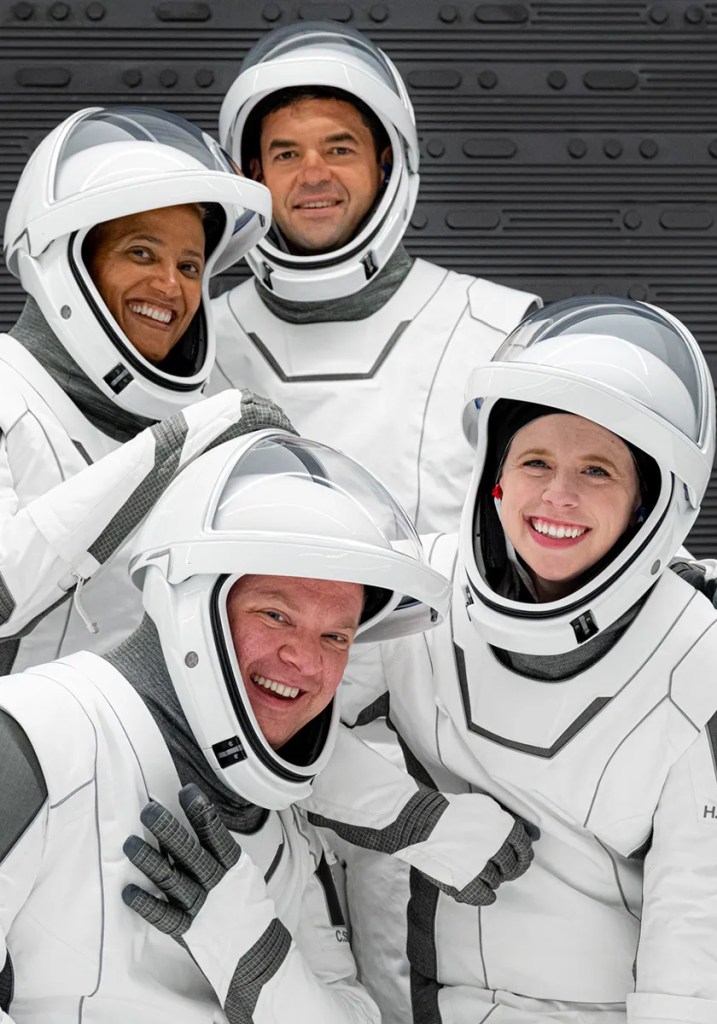
I guess once was not enough. Billionaire Jared Isaacman wants to spend even more money sending private citizens into space aboard SpaceX spacecraft. He funded his first private flight last September, called Inspiration 4, and now wants to do three more of these flights. The first one raised funds for St. Jude Children’s Research Hospital, whereas it is not clear whether these other voyages also relate to charitable causes.
Space tourism is all the rage these days, with Captain Kirk going up on Blue Origin’s capsule and Virgin Galactic sending Sir Richard Branson into space in preparation of paying customers in the near future. SpaceX always seemed to have more serious goals, but I suppose a buck is a buck.
The first of these three new flights is planned for later this year and will include a spacewalk and science experiments. The second will involve SpaceX’s Dragon, which is currently used for trips to the International Space Station (ISS). The third will involve SpaceX’s Starship created for lunar missions under NASA’s Artemis program.
Apparently, these new missions are expected to “…serve a bigger purpose of opening up space for everyone and making humankind a multiplanetary species, and ideally, have a benefit for the things we’re trying to accomplish back here on Earth.” Once might ask whether this bigger purpose, such as space walks and science experiments, can already be performed by professional astronauts aboard the ISS. It is hard to believe these new vanity missions are critical. And maybe dangerous stunts on such missions should only be performed by a professional team, but Mr. Isaacman wants to command the mission. I cannot see how having an accident on one of these flights will benefit SpaceX. I can still remember the blow-back after sending (and losing) the first teacher to space.
Space is still a dangerous place. Maybe money should not trump everything, including common sense. This seems more like a bored corporate executive spending $500,000 on a new fire truck, setting a few old buildings on fire, and then going in with an inexperienced crew to have fun putting out the blaze while claiming he is advancing the science of firefighting. I am not convinced.
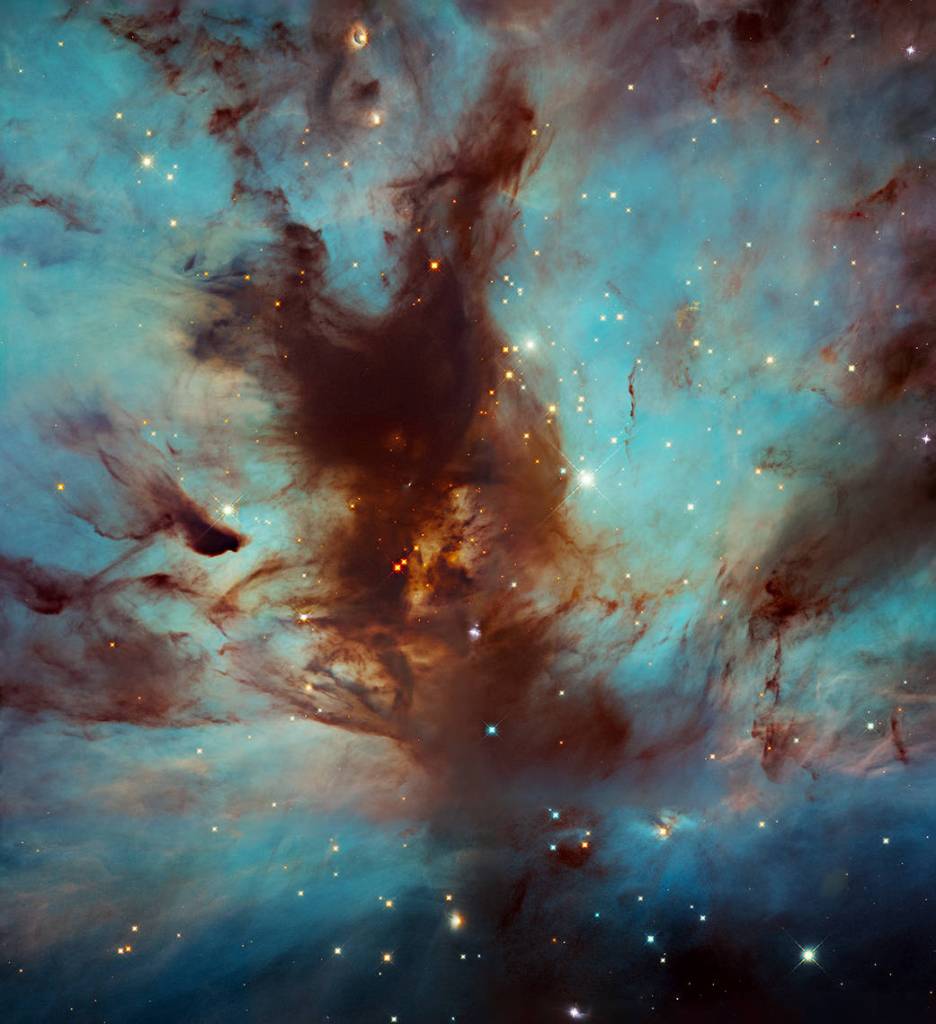
Source/Credit: NASA, ESA, and N. Da Rio (University of Virginia); Processing: Gladys Kober (NASA/Catholic University of America).
This week’s image from the Hubble Space Telescope shows the Flame Nebula in the constellation Orion, as explained by NASA:
The Flame Nebula, also called NGC 2024, is a large star-forming region in the constellation Orion that lies about 1,400 light-years from Earth. It’s a portion of the Orion Molecular Cloud Complex, which includes such famous nebulae as the Horsehead Nebula and Orion Nebula. This image focuses on the dark, dusty heart of the nebula, where a star cluster resides, mostly hidden from view. Nearby (but not visible in this image) is the bright star Alnitak, the easternmost star in the Belt of Orion. Radiation from Alnitak ionizes the Flame Nebula’s hydrogen gas. As the gas begins to cool from its higher-energy state to a lower-energy state, it emits energy in the form of light, causing the visible glow behind the swirled wisps of dust.