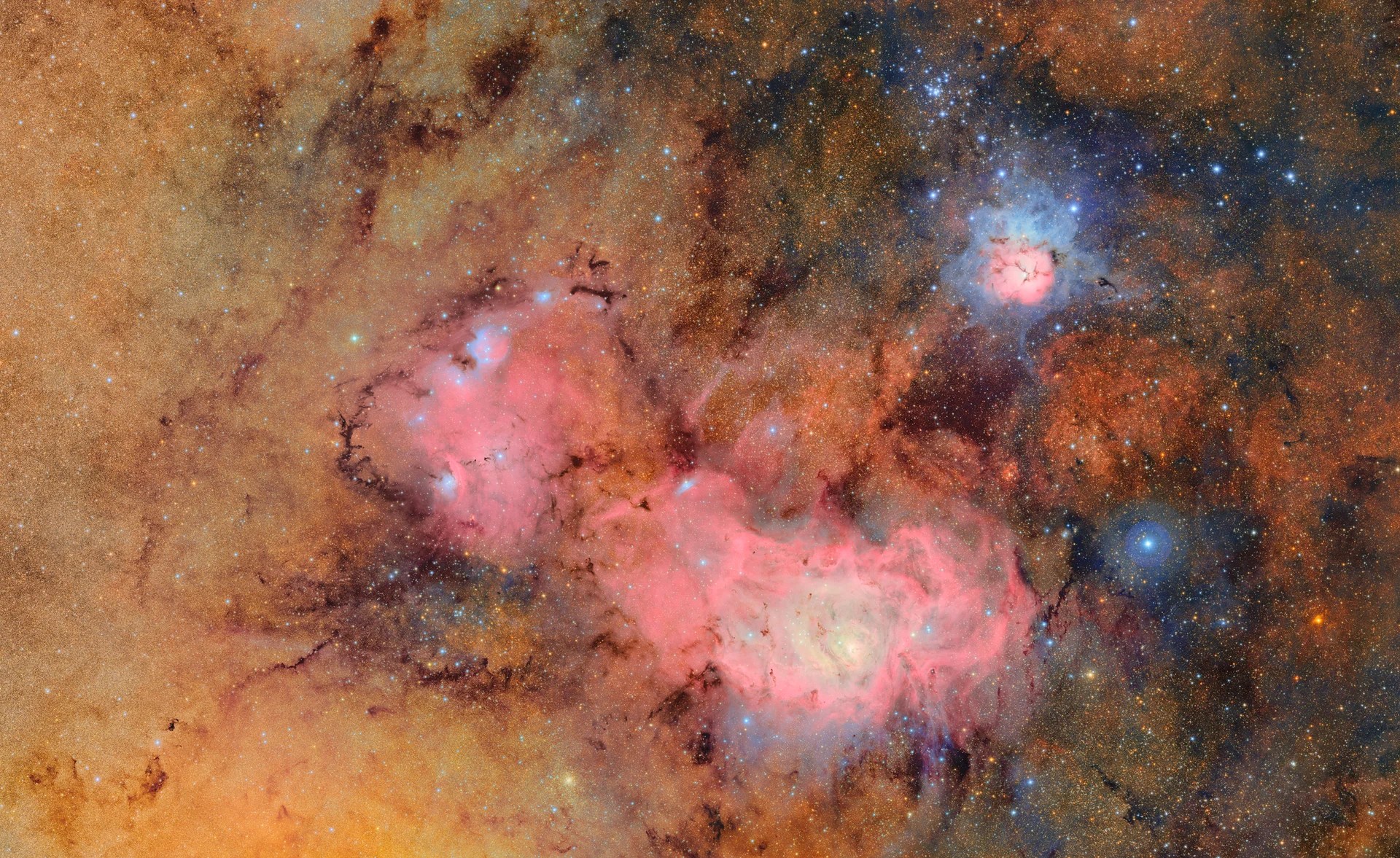
Image (Credit): The Trifid and Lagoon Nebulas as captured by the Vera C. Rubin Observatory. (NSF–DOE Vera C. Rubin Observatory)
This week’s colorful image is from the new Vera C. Rubin Observatory in Chile. It is part of the initial images being released as the observatory comes online. This particular image was created by combining 678 separate images. It shows clouds of gas and dust that comprise the Trifid nebula (top of image) and the Lagoon nebula (middle of image).
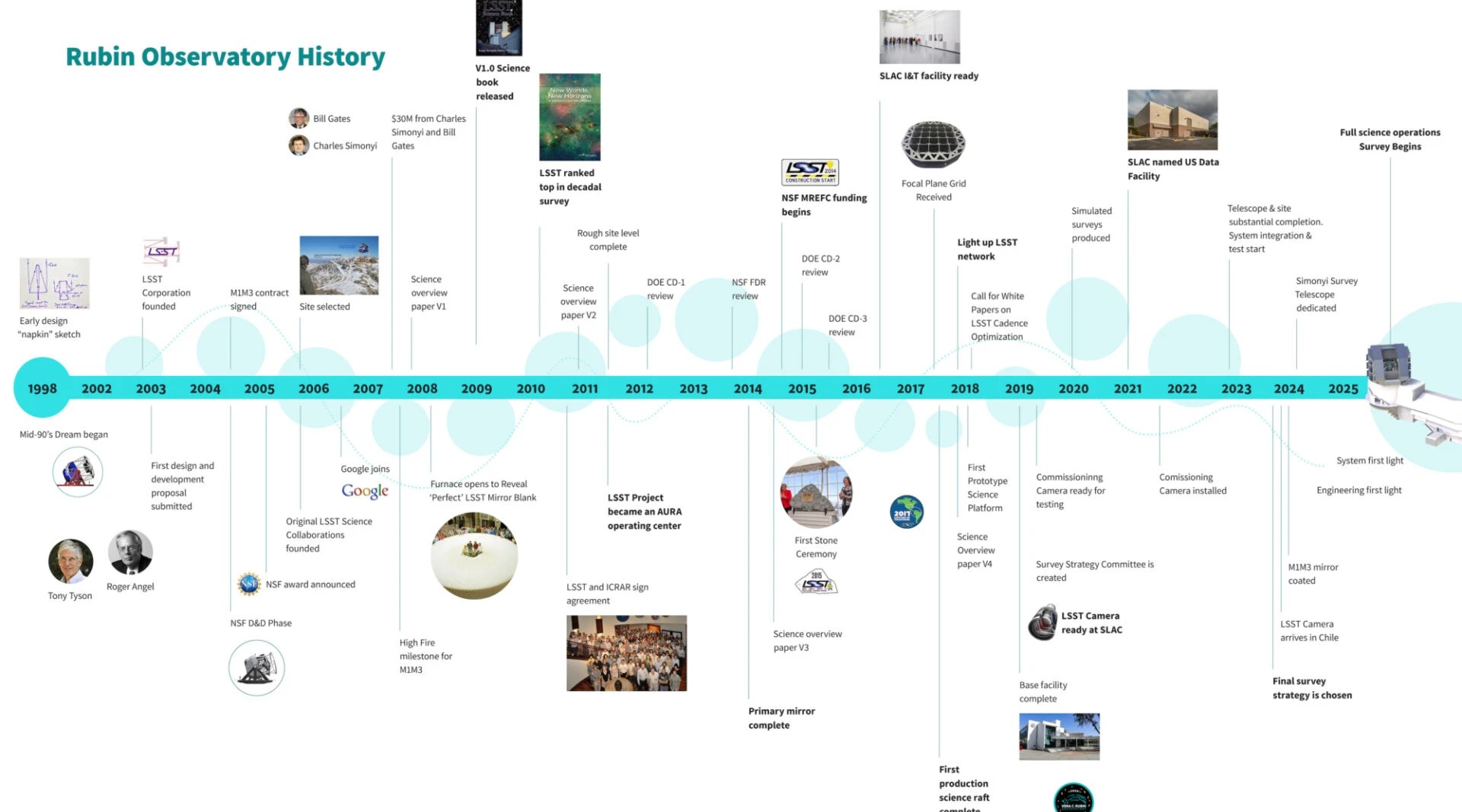
The new observatory is funded by the U.S. National Science Foundation and the U.S. Department of Energy’s Office of Science, and is expected to operate for at least 10 years so it can provide more amazing images and information for astronomers. The timeline related to the creation of the observatory is provided below as well as via this link.
Dr. Vera C. Rubin was an American astronomer known for her work proving the existence “dark matter” in the Universe.
Image (Credit): JWST image subtracting light from the star TWA 7 (marked with a circle and a star symbol) to highlight the exoplanet identified as TWA 7 b. (NASA, ESA, CSA, Anne-Marie Lagrange (CNRS, UGA), Mahdi Zamani (ESA/Webb))
The James Webb Space Telescope (JWST ) continues to amaze us with its discoveries. It has now captured the image of an exoplanet with the mass of Saturn orbiting star TWA 7, representing the first exoplanet captured by JWST in this way. TWA 7 is a young red dwarf star located about 34 light-years away.
JWST used its Mid-Infrared Instrument (MIRI) coronograph to mask the light of the star so that the light from orbiting exoplanets could be detected. Astronomers are pretty confident that what they are seeing is an orbiting planet rather than a star or galaxy in the background. For example, the smaller orange orb on the left represents a background star.
Anne-Marie Lagrange, CNRS researcher at the Observatoire de Paris-PSL and Université Grenoble Alpes in France as well as lead author of the Nature paper, stated.
Our observations reveal a strong candidate for a planet shaping the structure of the TWA 7 debris disk, and its position is exactly where we expected to find a planet of this mass.
NASA’s investments are paying off as we attempt to learn more about this strange universe of ours. Hopefully, members of Congress are paying attention.
A team of astronomers and astrophysicists affiliated with several institutions in Australia has found that a mysterious fast radio burst (FRB) detected last year originated not from a distant source, but from one circling the planet—a long-dead satellite. The team has posted a paper outlining their findings on the arXiv preprint server…The findings could lead to the development of new tools for studying signals coming from space, whether near or far, and possibly new ways to monitor the movement of dead satellites.
A team of astronomers say they’ve gleaned the mysterious traits of our galaxy’s black hole by probing it with an AI model. But a pretty big name on the field is throwing a little bit of cold water on their work. Just a little bit.Reinhard Genzel, a Nobel laureate and an astrophysicist at the Max Planck Institute, expressed some skepticism regarding the team’s use of AI, and the quality of the data they fed into the model.“I’m very sympathetic and interested in what they’re doing,” Genzel told Live Science. “But artificial intelligence is not a miracle cure.”
A space instrument, built by the Swedish Institute of Space Physics (IRF), has for the first time detected negative hydrogen ions on the surface of the Moon – a type of particle never seen there before. The discovery was recently published in the scientific journal Nature Communications Earth and Environment.
Image (Credit): Scene from The Mandalorian. (Disney+)
So, the long anticipated Andor is over. It was certainly worth the wait. But what is next?
Last I looked, this was the status of the many Star Wars live-action television series (chronologically):
The Mandalorian – three seasons and capped with a movie.
The Book of Boba Fett – one season and done.
Obi-Wan Kenobi – one season and done.
Andor – two seasons and done.
Ahsoka – one season and maybe a second season.
The Acolyte – one season and done.
Skeleton Crew – one season and done.
It seems the live-action television series have hit a wall. Ahsoka is said to be filming now, but you will be waiting until the summer of 2026 to see anything. I would have replaced Ahsoka with Skeleton Crew, which I thought was a better series with more energy that took itself a little less serious, but it appears the cast of Skeleton Crew is moving on to other projects.
So after all of this Disney hype, all we have left is a few crumbs and The Mandalorian and Grogu movie (maybe premiering in May 2026). While there is still some talk about a season four for The Mandaorian, the movie may be the last hurray.
There had also been talk about a Star Wars: Lando television series, but that then turned into a movie idea instead. I don’t have high hopes if it is a weak as the Star Wars: Solo movie.
Television may be dead for a while while a few other Star Wars movies are released, including Star Wars: Starfighter, starring Ryan Gosling.
Disney really dropped the ball with Andor by condensing it into only two seasons, and yet the delays between seasons was enough to frustrate fans. Given the current pace at Disney, it would have taken more than 10 years to see all five planned seasons.
We may need to look elsewhere for our inspiration in the future. Star Wars started back in the 1970s, and Star Trek back in the 1960s. I think we have plenty of talented writers and producers who can create that next television series to bring us into the next generation. And it is not Dune, first written in the 1960s, nor Foundation, based on stories starting in the 1940s (though both are terrific revivals and recreations).




 Our Awesome Universe