Space Stories: Strange Flashing Object, New Dwarf Planet in Our Solar System, and a Short-Lived Galaxy

Image (Credit): CSIRO’s ASKAP radio telescope in Western Australia. (https://www.csiro.au/)

Here are some recent space-related stories of interest.

Australian Broadcasting Corporation: Strange Flashing Object Discovered in Deep Space Puzzles Astronomers

Astronomers have detected a mystery stellar object that emitted pulses of light for two minutes every 44 minutes. A handful of objects like this have been found before, but this is the first to emit both radio waves and X-rays…An international team, led by Curtin University astronomer Ziteng Andy Wang, first detected a radio signal in data captured by CSIRO’s ASKAP radio telescope in Western Australia...By chance, the signal was also spotted by NASA’s Chandra X-ray Observatory on Valentine’s Day last year.

Newsweek: Astronomers Think They’ve Discovered a New Dwarf Planet in Our Solar System

A team of astronomers believe they may have discovered a new dwarf planet—just like Pluto—on the edge of our solar system. The object—which orbits out beyond Neptune—has been named “2017 OF201” by the team, which was led by Sihao Cheng of the Institute for Advanced Study in Princeton, New Jersey. Cheng and colleagues estimate that the body has a diameter of more than 430 miles, which means that it may be large enough to qualify as a dwarf planet.

Brighter Side of News: Astronomers Discover That Galaxies Die Much Earlier Than Expected

In a Universe that was only 700 million years old, long before Earth even formed, something unexpected happened. A massive galaxy stopped forming stars and went silent. This type of galaxy, called quiescent, typically needs billions of years to grow and then shut down star formation. But thanks to the powerful James Webb Space Telescope (JWST), astronomers have now confirmed that one such galaxy had already died young. This ancient galaxy, called RUBIES-UDS-QG-z7, is now the most distant quiescent galaxy ever confirmed. It challenges current ideas about how quickly galaxies form and evolve in the early Universe. This discovery pushes the boundaries of what scientists thought was possible during cosmic dawn.


The Ninth Starship Test Launch Had a Few Problems

Image (Credit): Side-by-side illustrations of the SpaceX Starship lunar lander and the Blue Origin Blue Moon lunar lander. (SpaceX/Blue Origin)

Elon Musk may be in a rush to get to Mars, if only to escape all of the chaos he is causing here on Earth, but he is going nowhere fast with his Starship. Today’s ninth test launch of the rocket ended with the explosion of its first-stage booster as well as the rocket itself during re-entry. While this is better than the last two launches, it still demonstrates that the rocket has a ways to go before it can be used for Moon missions, leaving aside any talk about Mars.

SpaceX loves to play with language (particularly when regulators are around), so it called this a “rapid unscheduled disassembly” once again. That said, the humor is getting thin.

Mr. Musk said he is back to his jobs at Tesla and SpaceX, so let’s hope he can get a handle on this rocket. I don’t really care about the cars – Tesla has already been superseded by other car companies – but SpaceX is important to the US space industry.

It is also time for Mr. Musk to stop over-promising on everything (though I am glad he was dead wrong about DOGE savings). The focus needs to be the Moon. Forget Mars for now.

By the way, DOGE has also done damage to future Mars missions by cutting funding and staffing at the Astrogeology Science Center in Flagstaff, Arizona. The Center would be critical to finding a safe landing site on Mars for one of Musk’s rockets.

You don’t poke out your eyes and then hope to make progress, but that is what is happening these days.

Note: It seems the term “rapid unscheduled disassembly” precedes Mr. Musk, as this link explains.

RIP: Ed Smylie, NASA Engineer

Image (Credit): Former NASA engineer Ed Smylie. (Bill Stafford/NASA)

Last month, former NASA engineer Ed Smylie passed away at the age of 95. He is best known for his efforts leading a NASA team that saved the Apollo 13 crew after the capsule experienced the onboard explosion of an oxygen canister. His quick efforts saved the crew, allowing them to return home safely. You can see it all in color by watching the film Apollo 13.

Mr. Smylie left Douglas Aircraft Company and joined NASA after President Kennedy made it clear that the nation would put a man on the Moon. Luckily, he was there at NASA when he was needed.

In a 1999 interview about his efforts to save the Apollo 13 mission, he was very self-effacing about his role in the entire effort:

It was pretty straightforward, even though we got a lot of publicity for it and [President Richard M.] Nixon even mentioned our names. I always argued that that was because that was one you could understand nobody really understood the hard things they were doing. Everybody could understand a filter. I said a mechanical engineering sophomore in college could have come up with it. It was pretty straightforward. But it was important.

You can also read more on Mr. Smylie’s life and career at these sites:

Rest in peace.

A Day in Astronomy: President Kennedy’s Call to Put a Man on the Moon

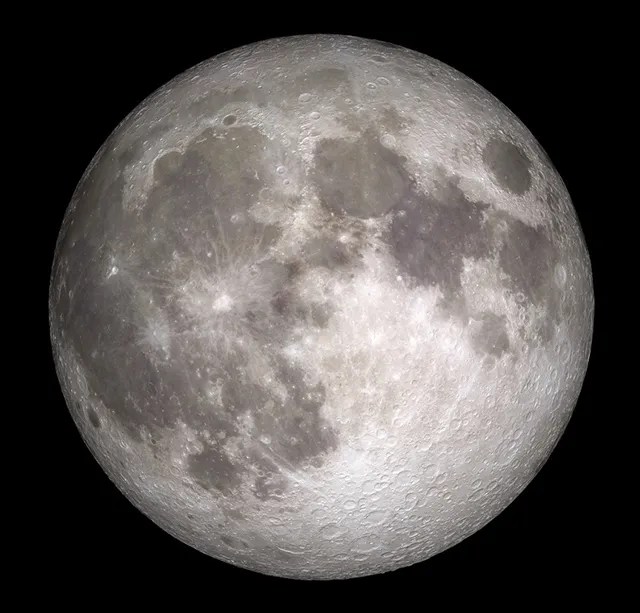
Image (Credit): The full Moon. (NASA)

On this day in 1961, President John F. Kennedy addressed a joint session of Congress and called for landing a man on the Moon. An excerpt from that address is provided below:

First, I believe that this nation should commit itself to achieving the goal, before this decade is out, of landing a man on the moon and returning him safely to the earth. No single space project in this period will be more impressive to mankind, or more important for the long-range exploration of space; and none will be so difficult or expensive to accomplish. We propose to accelerate the development of the appropriate lunar space craft. We propose to develop alternate liquid and solid fuel boosters, much larger than any now being developed, until certain which is superior. We propose additional funds for other engine development and for unmanned explorations–explorations which are particularly important for one purpose which this nation will never overlook: the survival of the man who first makes this daring flight. But in a very real sense, it will not be one man going to the moon–if we make this judgment affirmatively, it will be an entire nation. For all of us must work to put him there.

Space Quote: Oops – Sorry About All That Excitement About K2-18b

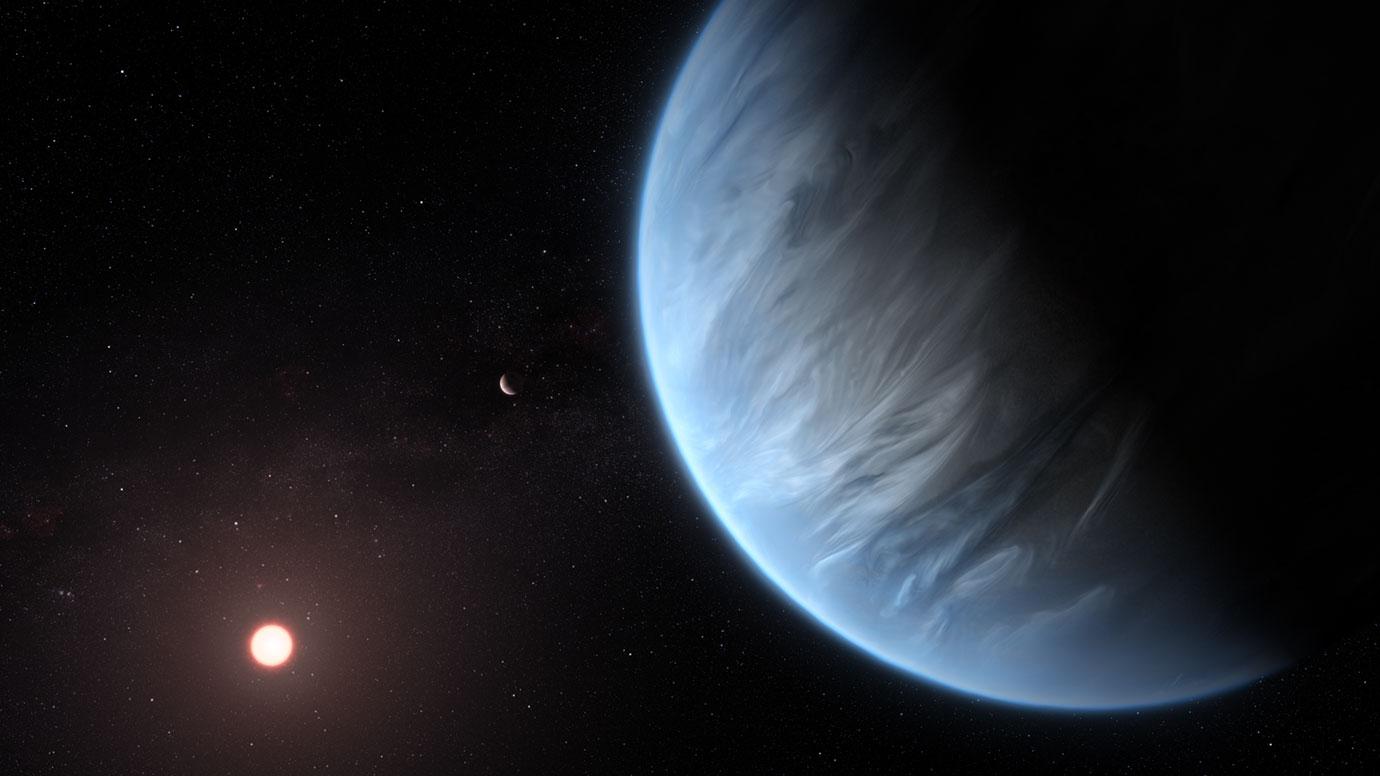
Image (Credit): An artist’s illustration showing a possible K2-18b. (ESA/Hubble, M. Kornmesser)

“We found the data we have so far is much too noisy for the proof that would be needed to make that claim…There’s just not enough certainty to say one way or the other.”

Statement by Rafael Luque, a postdoctoral researcher at the University of Chicago, regarding stories last month about the possible detection of life on exoplanet K2-18b. New analysis from the University of Chicago calls into question the interpretation of the scientific data, and also notes that other factors could account for what was initially detected. A lot of this debate is better explained in a recent video from Cool Worlds Lab titled “The K2-18b Video You’ve Been Waiting For.”