Upcoming International Space Development Conference

You may not like the idea of spending any part of the summer in hot and humid Florida, but the National Space Society has a good reason for you to go anyway. It is holding its 43rd annual International Space Development Conference from June 19 to 22 in Orlando, Florida.

Some of the guests during the week include Jared Isaacman, the future Administrator of NASA, as well as space experts and numerous current, former, and retired astronauts.

The various sessions, panels, and workshops will cover topics such as:

  • Moon and Mars exploration and settlement,
  • Deep space exploration,
  • Innovative technology,
  • Science fiction’s influence on the technology and commercialization of space,
  • Planetary defense,
  • Living in space,
  • Space solar power,
  • Space debris, and
  • Space law and policy.

For instance, on Thursday you can attend four related lectures in a session titled “Interplanetary Infrastructure“. Here is what the session will cover:

Infrastructure is the backbone of civilization. A multi-planetary civilization needs interplanetary infrastructure to support its expansion, facilitate trade, and keep its citizens and their societies connected. The Interplanetary Infrastructure session considers whether investments in infrastructure, especially two-way transportation infrastructure, can address some of the most pressing problems associated with humanity’s initial efforts to expand into the solar system. Historically, infrastructure has facilitated human expansion. It increased accessibility and reduced the personal sacrifices that adventurous settlers and their families had to make. Infrastructure projects tend to be somewhat conservative in nature. They generally use technologies and materials that have been applied in other industries and that are already well-understood and well-characterized by engineers. Successful infrastructure projects are economically viable because their long-term benefit to society exceeds their upfront cost, even when the upfront cost is significant. The speakers presenting concepts in this session adhere to these fundamental principles and can demonstrate that their proposals do indeed pencil out.

Take a look at the program and decide for yourself if you can handle the heat while learning more about future space adventures.
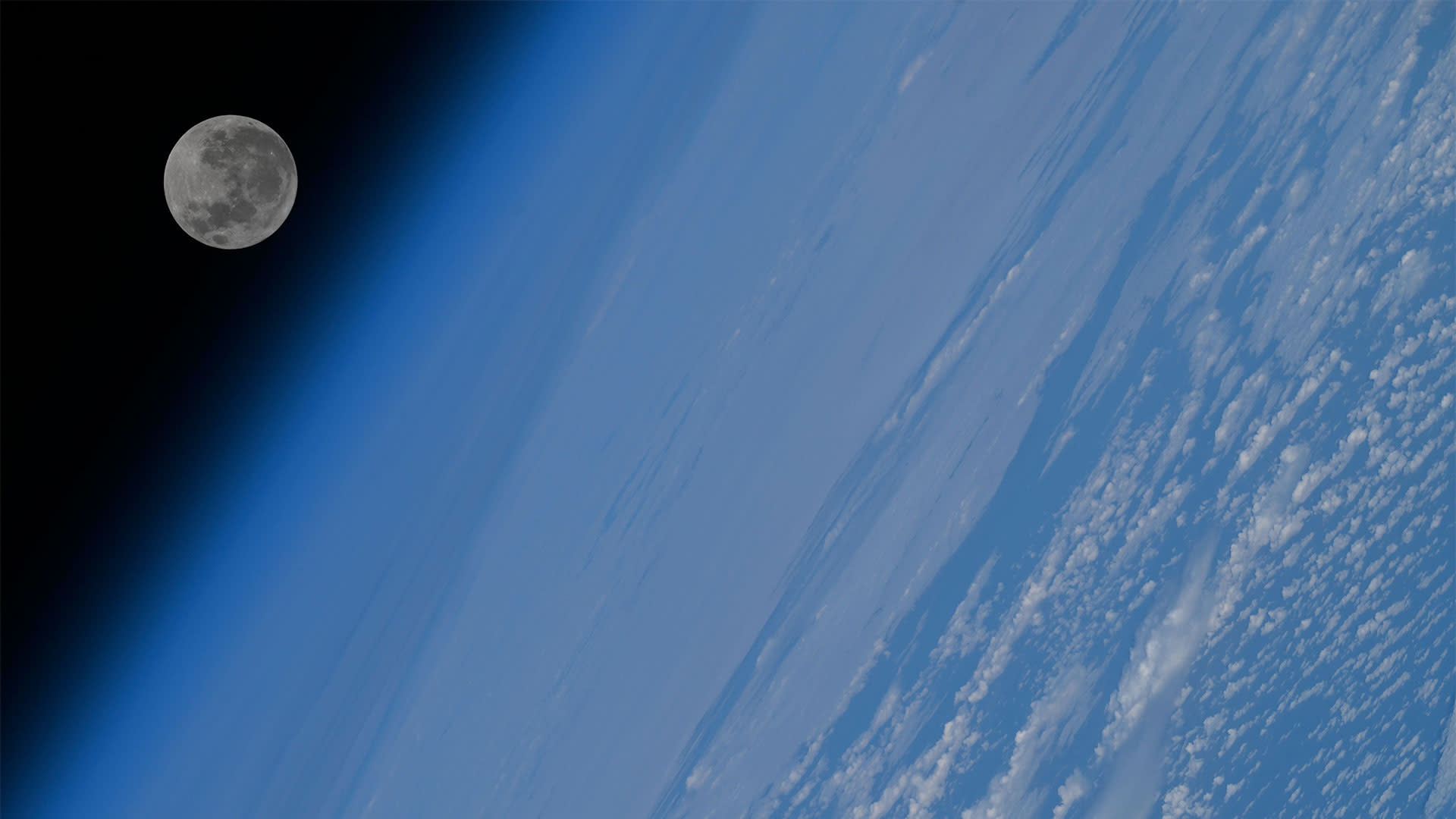
Pic of the Week: Flower Moon from the ISS

Image (Credit): The Flower Moon captured this month by NASA astronaut Nichole Ayers aboard the International Space Station (ISS) . (NASA/Nichole Ayers)

While it almost looks like the Death Star on the horizon, you are looking at this month’s Flower Moon, as captured by NASA astronaut Nichole Ayers from the ISS.

This month’s Moon was called the “Three-Milkings Month” back in 703 AD, but now it has a Native American name, either the Flower Moon, the Corn Moon, or even the Corn Planting Moon.

You can read more than you would ever want to know about this Moon via this NASA page.

Podcast: Terra-forming Mars

Credit: Cool Worlds

I recommend you check out the recent episode from the Cool Worlds Podcast about the water and atmosphere on Mars and how it has changed and may change again, with and without the intervention of humans. The episode, “Edwin Kite – Early Mars, Terraforming/Settling Mars,” is a discussion between podcast host David Kipping and Edwin Kite, Professor of Geophysical Sciences at the University of Chicago as well as Participating Scientist for the NASA Curiosity Rover.

The discussion gets into where Martian water may be today, what terra-forming efforts have been discusses in the past, the terra-forming possibilities in the future, and whether Mars should be seen as a second Earth. Oh yeah, it also discusses Elon Musk’s crazy idea to nuke the surface of Mars and even touches on the idea of a Planet 9.

It’s a fascinating discussion that is worth your time.

Space Stories: New Bacterial Species at NASA, Geologic Life on Venus, and Water Found in Distant Solar System

Image (Credit): Venus captured by NASA’s Mariner 10 spacecraft. (NASA/JPL-Caltech)

Here are some recent space-related stories of interest.

SciTechDaily: NASA Just Found New Signs of Life Inside Venus – Geologic Life, That Is

Vast, circular features on the surface of Venus may be signs that the planet is still geologically active. That’s according to new research based on data collected over 30 years ago by NASA’s Magellan spacecraft. Unlike Earth, where giant plates of crust shift and recycle through a process called plate tectonics, Venus doesn’t have these moving plates. But its surface is still being reshaped—likely by molten rock rising from deep within the planet.

USAToday: NASA ‘Cleanrooms’ Found Crawling with 26 New Bacterial Species

 A new study reports 26 new bacterial species were found growing inside cleanrooms associated with NASA space missions. Specifically, scientists looked in the cleanrooms used to prepare the Phoenix Mars lander for its launch in August 2007. In the study, scientists analyzed microorganisms growing in the NASA cleanrooms and discovered many of the new species had genes that made them resilient to decontamination and radiation.

NASA: Another First: NASA Webb Identifies Frozen Water in Young Star System

Is frozen water scattered in systems around other stars? Astronomers have long expected it is, partially based on previous detections of its gaseous form, water vapor, and its presence in our own solar system. Now there is definitive evidence: Researchers confirmed the presence of crystalline water ice in a dusty debris disk that orbits a Sun-like star 155 light-years away using detailed data known as spectra from NASA’s James Webb Space Telescope. (The term water ice specifies its makeup, since many other frozen molecules are also observed in space, such as carbon dioxide ice, or “dry ice.”)

Ed Helms and Lunar Nukes

Credit: Grand Central Publishing.

Actor Ed Helms is making his rounds to sell his book Snafu: The Definitive Guide to History’s Greatest Screwups.

One of the stories he tells is about the US “planting nukes on the moon.” Is this true?

Yes, it was a top secret effort called Project A119, with the goal of exploding a hydrogen bomb on the Moon. And believe it or not, Carl Sagan was involved in the calculations related to this zany idea.

This was in the late 1950s during the Cold War when the US and Soviet Union were doing everything they could to trump one another. It also was right after Sputnik, when the US felt it was losing the space race. In this case, the US would make a clear demonstration of its power through this distant explosion.

Fortunately, the US decided to take a better route by going into orbit and eventually to the Moon. If we had blown up the Moon, Carl Sagan would have been remembered in a very different way today – less as the educator, and more as Dr. Strangelove.

Just never underestimate the ability of the government to go down some dark roads. We needed guardrails then like we need them now.

You can read more about it in this History.com story.