Image (Credit): China’s Chang’e-4 Lander on the Moon’s surface, as captured by the Yutu-2 rover in early 2019. (CNSA)
“Politically, China’s lunar program has demonstrated an ability to undertake cutting edge scientific programs, as demonstrated in the innovative Chang’e-4 and Chang’e-6 probes. In terms of direct military benefits, its value is more limited. China is not in a direct space race with any other state, nor is it racing to establish settlements or “space colonies.” While there are theories of how one might employ a lunar base to undertake surveillance or even kinetic operations against terrestrial targets, the costs associated with such ambitions would be enormous. Surveillance platforms on the Moon, for example, would be almost 240,000 miles from Earth. To obtain high resolution images would be enormously costly. It is not at all clear that such efforts would win a cost-benefit analysis against systems in standard earth orbits (LEO, MEO, GEO), or even air-breathing systems. Instead, the most likely military benefits are in terms of improvements in Chinese space support capabilities, thus expanding the volume of space employed for military purposes.”
-Statement by Dean Cheng, Senior Fellow at the Potomac Institute for Policy Studies, from a hearing before the House Science, Space, and Technology Committee, Space and Aeronautics Subcommittee titled “Strategic Trajectories Assessing China’s Space Rise and the Risks to U.S. Leadership.” Mr. Cheng was one of four witnesses at the hearing.
The sixth episode of Apple TV+’s Pluribus dropped this week. If you haven’t heard of the new series, you may want to check in. It starts like the movie Contact, has elements of 3 Body Problem (including the clock), and turns into The Last Man on Earth, though in this case its an angry, lone woman dealing with Invasion of the Body Snatchers.
Interested? Oh yeah, it comes from Vince Gilligan, the same guy who also gave us on Breaking Bad and Better Call Saul. It also stars Rhea Seehorn from Better Call Saul.
It all starts when a radio signal from a civilization about 600 light-years away is intercepted by Earth. This signal contains a RNA sequence. Of course, the dumb Earthlings find it necessary to recreate this sequence, lose control of the experiment (alla Jurassic Park), and thereby release a virus that turns the human population into the Borg. The rest of the story is how one woman and twelve other unaffected humans make their way in this new world.
It’s an odd start to a very odd show, but it is fun and thought-provoking in its own way. It also doesn’t have simple story lines where the everyone agrees there is a problem with the new human state, or at least not all of the 13 remaining people agree. We know the collective mind seems to work in nature, be it bees or ants, so it is not impossible.
It is too early to know whether this show has a soft landing or even a future, but it’s the type of show, like Severance, that is sure to be discussed at the virtual office water cooler.
Okay, that’s enough references to other shows and movies. I counted eight, but I can also say that Pluribus is unique enough that none of those references really does it any justice.
Image (Credit): The Virgo galaxy cluster as captured by the Vera C. Rubin Observatory. (NSF–DOE Vera C. Rubin Observatory)
This week’s image comes from the Planetary Society’s recent competition to find the best space exploration images. It shows the Virgo galaxy cluster, which was the winning entry. The image was released on June 23, 2025 by the Vera C. Rubin Observatory located in Chile.
The Virgo galaxy cluster is comprised of anywhere between 1,300 and 2,000 galaxies. What you can see in this image is an impressive array of galaxies, some of them intertwined. How many different worlds within this cluster may be peering back at us? Of course, the Virgo galaxy cluster is 65 million light-years away, so the image of the Milky Way appearing on their telescopes right now was from the time when dinosaurs still walked on the Earth.
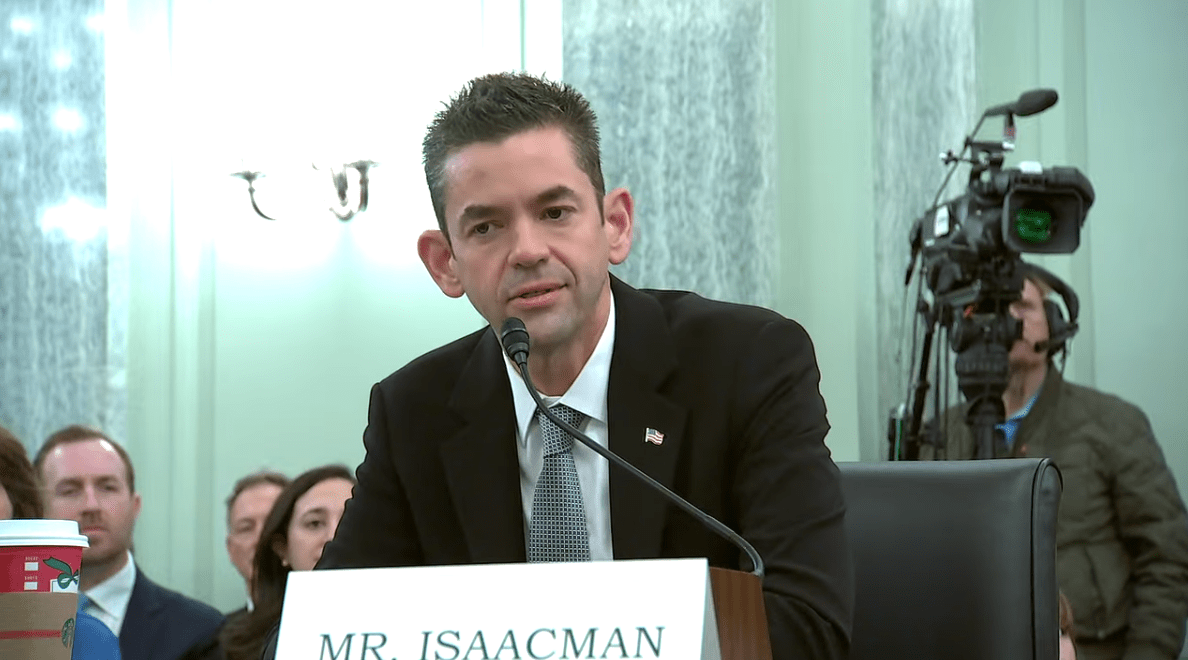
Image (Credit): Jared Isaacman answering questions at the December 3, 2025 Senate confirmation hearing. (Senate Committee on Commerce, Science, and Transportation)
Jared Isaacman appeared before the Senate Committee on Commerce, Science, and Transportation earlier today for his second confirmation hearing. Overall, everything went well and he should be ready for a full Senate vote next week that will make him NASA’s next administrator.
The success of the Artemis program that President Trump began during his first term. America will return to the Moon before our great rival, and we will establish an enduring presence to understand and realize the scientific, economic, and national security value on the lunar surface.
Along the way, we will pioneer the next ‘giant leap’ capabilities to extend America’sreach even further into space, including expanding and accelerating investments intonuclear propulsion and surface power programs. These efforts, in addition to industrypartners building reusable launch vehicles, we will set the stage for future missions toMars and beyond.
We will never accept a gap in capabilities again–not with our space station presence inlow Earth orbit or our ability to send American astronauts to the Moon.
We will strive to build an orbital and lunar economy that can fund the future we all wantto see in space and not rely exclusively on the taxpayer. We will begin making theinvestments now for the inevitable spacefaring future that is just on the horizon.
We will make the most efficient use of every dollar allocated–pushing for more xplanes, more rovers & telescopes, more exciting missions like Hubble, James Webb, and Dragonfly with the aim of enlightening the world through breakthrouh scientific discoveries–knowing that if NASA doesn’t do it, no one else will.
The third point about a “gap in capabilities” specifically addresses the hardware needed to get to the space station or the moon, but we are also facing a gap in our scientific capabilities given the loss of so much talent this year. The statement reads like a dime store space novel where all we need it a rocket and grit, but hardware can only get your to a location.
Living and thriving once we get to wherever we are going will depend upon many other factors that are outside the understanding of rocket engineers. Yet too many of the senior mission specialists with these needed skills are now sitting at home after being forced out or deciding to retire in the midst of recent chaos. This gap in this area only widened, and the full impact on the NASA’s space programs has yet to be realized. However, these personnel losses are likely to close the gap between the US and Chinese space programs to our detriment.
Maybe Mr. Isaacman needed to add a sixth goal to close this new gap in scientific capabilities created this year by the White House.