Trump Administration Proposes 25 Percent Cut to NASA’s Budget

It should come as no surprise at this point that NASA will fall victim to massive budget cuts like so many other civilian agencies. While it will not disappear like the US Agency for International Development, it will be severely wounded as the result of a proposed 25 percent cut to its budget.

The White House’s proposed 2026 budget is setting aside $7 billion for the Moon missions and $1 billion for Mars missions, but it seems just about everything else is up for grabs. For instance, we would see the show shutdown of the Space Launch System rocket and the Orion spacecraft so they could become fully commercial. In addition, the orbiting lunar Gateway will be cut completely.

Specifically, the budget summary states:

The Budget phases out the grossly expensive and delayed Space Launch System (SLS) rocket and Orion capsule after three flights. SLS alone costs $4 billion per launch and is 140 percent over budget. The Budget funds a program to replace SLS and Orion flights to the Moon with more cost-effective commercial systems that would support more ambitious subsequent lunar missions. The Budget also proposes to terminate the Gateway, a small lunar space station in development with international partners, which would have been used to support future SLS and Orion missions.

Moreover, the Mars funding would not cover the sample return mission. Hence, SpaceX might get a boost to head towards Mars while we are stranding samples that help us to understand why we might want to go to Mars. We will also see the end of the Nancy Grace Roman Space Telescope, pruning back the accomplishments we have made since the Hubble Space Telescope to make the universe more available to scientists and the public.

If we ignore the future of the Artemis mission for a moment, a NASA press release boasted about all the events over the past 100 days to prepare for the Artemis mission. This is a hopeful sign that the Moon mission is still vital and viable at the moment, even with the defunding efforts underway. However, given some of the recent failures of the private sector efforts to reach the Moon, and the continual delays in SpaceX’s Starship, the future for Moon missions after the SLS does not look too promising at the moment.

The future also looks somewhat bleak when you look at proposed cuts to NASA’s funding for space science, space technology, and STEM programs. The endless faith in the private sector forgets the benefits of a government supporting and nudging these efforts.

As Casey Dreier, Chief of Space Policy for The Planetary Society, clearly stated:

These cuts would cause irreparable losses, throwing away billions of dollars invested by the U.S. taxpayers in productive space hardware and infrastructure. Space science is a critical national investment that engages our cutting edge economic, scientific, and educational abilities across the country.


Space Quote: Escaping the Aches and Pains of Earth

Image (Credit): NASA astronaut Don Pettit. (NASA)

“You’re floating, and your body, all these little aches and pains, and everything heal up, and you feel like you’re 30 years old again and free of pain, free of everything, and ready to do your mission work. So, I love being in orbit. It’s a great place to be for me and my physiology.”

-Comment by NASA astronaut Don Pettit during a press conference after his return to Earth from the International Space Station. The 70-year-old spent 220 days on the station. His 70th birthday was the same day he returned to Earth aboard a Russian Soyuz spacecraft.

Pic of the Week: Here Comes the Sun

Image (Credit): Image of a sunspot on our Sun (with the United States in the corner for the purpose of comparison) captured by the Daniel K. Inouye Solar Telescope using its Visible Tunable Filter. (VTF/KIS/NSF/NSO/AURA)

This week’s image comes from the National Science Foundation’s (NSF) Daniel K. Inouye Solar Telescope. Using a newly developed Visible Tunable Filter, it is able to produce detailed images of the Sun’s surface.

Carrie Black, NSF program director for the NSF National Solar Observatory, stated:

When powerful solar storms hit Earth, they impact critical infrastructure across the globe and in space. High-resolution observations of the sun are necessary to improve predictions of such damaging storms…The NSF Inouye Solar Telescope puts the U.S. at the forefront of worldwide efforts to produce high-resolution solar observations and the Visible Tunable Filter will complete its initial arsenal of scientific instruments.

You can read much more about the telescope and its filter here.

Space Stories: Kuiper Launch, NASA Workforce Cuts, and Prepping for Moon Landing

Image (Credit): ULA launches the Kuiper 1 mission from Cape Canaveral on April 28, 2025. (ULA)

Here are some recent stories of interest.

ABC News: Amazon Launches First Kuiper Internet Satellites, Taking on Starlink

The first 27 satellites for Amazon’s Kuiper broadband internet constellation were launched into space from Florida on Monday, kicking off the long-delayed deployment of an internet-from-space network that will rival SpaceX’s Starlink. The satellites are the first of 3,236 that Amazon plans to send into low-Earth orbit for Project Kuiper, a $10 billion effort unveiled in 2019 to beam broadband internet globally for consumers, businesses and governments – customers that SpaceX has courted for years with its powerful Starlink business.

Government Executive: NASA preparing for steep workforce cuts but hopeful it can avoid more layoffs

As NASA ramps up plans to return to the moon and, eventually, Mars, it is moving forward with plans to shrink its workforce by incentivizing employees to leave government...NASA officials have told employees they may receive a second “deferred resignation” offer to allow staff to take paid leave until they exit government by Sept. 30, as well as early retirement and buyouts, to incentivize departures from the agency. These options were submitted as part of NASA’s reduction-in-force and reorganization plan, employees who attended the meetings in which the plans were shared said, which all agencies had to turn over to the Office of Personnel Management and the White House in recent weeks.

NASA: NASA Marshall Fires Up Hybrid Rocket Motor to Prep for Moon Landings

To better understand the physics behind the interaction of exhaust from the commercial human landing systems and the Moon’s surface, engineers and scientists at NASA’s Marshall Space Flight Center in Huntsville, Alabama, recently test-fired a 14-inch hybrid rocket motor more than 30 times. The 3D-printed hybrid rocket motor, developed at Utah State University in Logan, Utah, ignites both solid fuel and a stream of gaseous oxygen to create a powerful stream of rocket exhaust.

Podcast: The Planetary Society’s 45th Anniversary

if you missed the April 5th event celebrating the Planetary Society’s 45th anniversary, you can still tap into it via the Planetary Radio podcast.

Here is a little more on the event and related discussion:

Join us aboard the historic RMS Queen Mary for a celebration of The Planetary Society’s 45th anniversary. In this special episode of Planetary Radio, we bring you highlights from our Cosmic Shores Gala, where members, scientists, space advocates, and special guests came together to honor the past and look boldly to the future.

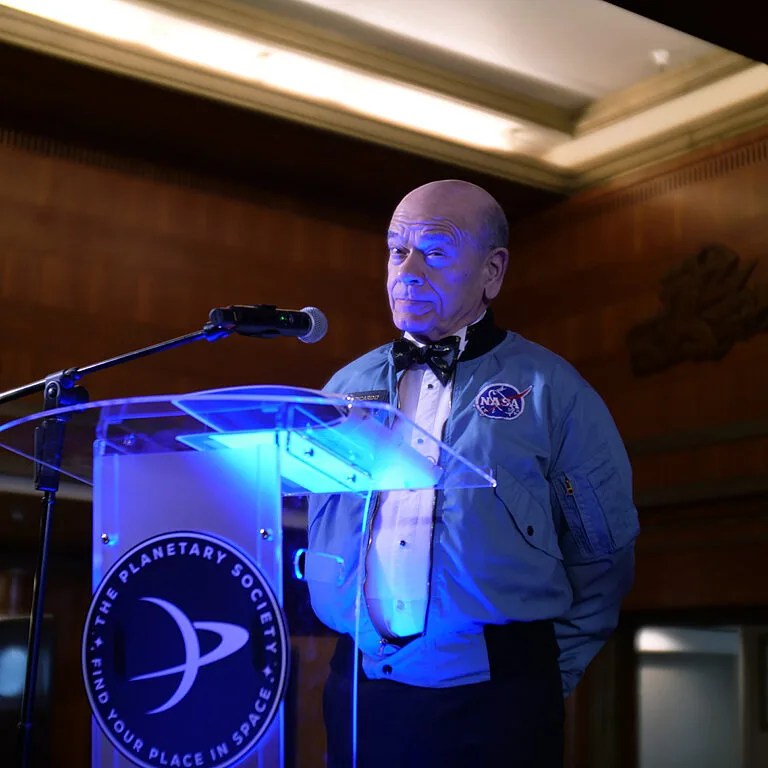
You’ll hear from CEO Bill Nye, Board President Bethany Ehlmann, Executive Director Jennifer Vaughn, founding Executive Director Lou Friedman, and Congresswoman Judy Chu, with actor and Planetary Society board member Robert Picardo as our master of ceremonies.

And of course, we close with Chief Scientist Bruce Betts in this week’s What’sUp.