Pic of the Week: Cosmic Tornado

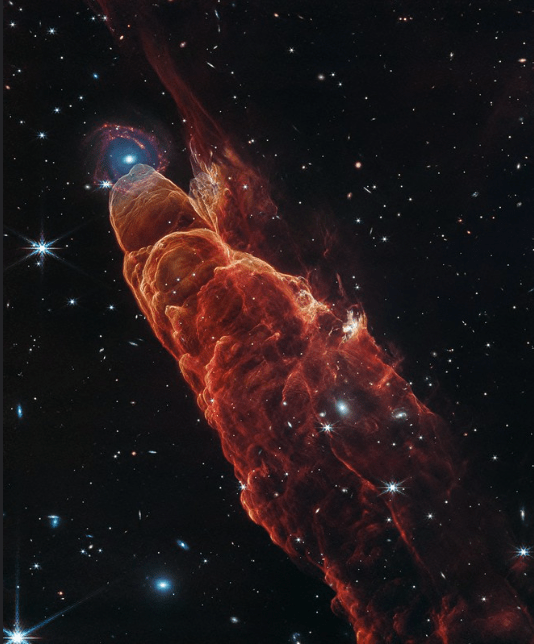
Image (Credit): Herbig-Haro 49/50 captured by the JWST. (NASA, ESA, CSA, STScI)

This week’s image is from the James Webb Space Telescope (JWST). The transparent red cloud in the middle of the image, nicknamed the “cosmic tornado,” is outflow of gas and dust from a newly formed star. Moreover, the bright blue glow at the top of the cloud has nothing to do with what you are seeing. The blue glow is a distant spiral galaxy.

Here is more about the image from NASA:

Angled from the upper left corner to the lower right corner of the image is a cone-shaped orange-red cloud known as Herbig-Haro 49/50. This feature takes up about three-fourths of the length of this angle. The tip of the cone positioned at the upper left appears translucent with a rounded end. Coincidently, a background spiral galaxy appears right near the tip too. The galaxy has a concentrated blue center that fades outwards to blend in with red spiral arms. The cones-shaped feature widens slightly from tip down to the lower right. Along the way there are additional rounded edges, like edges of a wave, and intricate foamy-like details. The nebula appears even more translucent to the lower right providing a clearer view of the black background of space. The black background of space is clearer, speckled with some white stars and smaller, more numerous, fainter white galaxies.

Upcoming Hearing on NASA Nominee

The process continues to bring on a new NASA Administrator, even as Elon Musk and his DOGE team do all they can to cripple the agency.

The nomination hearing for Jared Isaacman, announced earlier today by the Senate Committee on Commerce, Science, and Transportation, will take place next Wednesday, April 9, at 10am. The hearing will be streamed live via the Committee’s website as well as YouTube.

The same hearing will also discuss the nomination of Olivia Trusty to be a Member of the Federal Communications Commission, so it is not clear how much time will be dedicated to the NASA piece. Generally, the nominee reads from a prepared statement and the Senators who show up that day pepper the nominee with a few questions.

These hearings are usually pretty tame, but that may not be the case if Mr. Isaacman’s ties with Elon Musk become a topic. A recent Wall Street Journal story stated that Mr. Isaacman was hand-picked by Mr. Musk, which followed Mr. Isaacman paying SpaceX an undisclosed amount to go into orbit last year.

It has also been reported that Mr. Isaacman’s own companies may come under scrutiny because of their DEI initiatives, a big no-no with the White House and the ever-destructive DOGE.

Maybe it will be an interesting hearing.

Space Stories: More Space Tourists, Chinese Maglev Rocket Launches, and New Hubble Findings on Uranus

Image (Credit): Launch of the Fram2 mission earlier this week. (SpaceX)

Here are some recent stories of interest.

South China Morning Post: SpaceX Launches Fram2: 4 Astronauts Seek to Make Historic Flight Over Earth’s Poles

A SpaceX spacecraft carrying four international astronauts is on a pioneering journey circling Earth over its poles after launching Monday night from Florida…Fram2 follows in the footsteps of other commercial spaceflight ventures, including Inspiration4 and Polaris Dawn – two missions also bankrolled and led by billionaire Jared Isaacman. In fact, the Fram2 crew is now traveling on the same Dragon spacecraft that the Polaris Dawn crew rode to orbit in September for a five-day mission in which they completed a historic spacewalk.

South China Morning Post: China in Bid to Challenge SpaceX by Deploying Maglev Rocket Launch Pad by 2028

In a bid to disrupt the United States’ long-held dominance in space exploration, China is quietly advancing a radical new rocket launch system – powered not by roaring engines but by electromagnetic force – that could propel satellites into orbit with unprecedented speed and efficiency. At the heart of the ambitious project is Galactic Energy, a private aerospace company that plans to debut the world’s first electromagnetic rocket launch pad by 2028, a project that could redraw the competitive lines of the global space industry.

Space Telescope Science Institute: 20-Year Hubble Study of Uranus Yields New Atmospheric Insights

Halfway through its fourth decade, Hubble’s long life has proven invaluable for studying the atmosphere of the mysterious ice giant Uranus. By repeatedly training Hubble on the distant cyan planet over the course of 20 years, researchers chronicled a two-decade story of seasonal changes. These astronomers have gained new understanding of the atmospheric dynamics of Uranus, which can serve as a proxy for studying exoplanets of similar size and composition.

A Short Test Flight for a German Rocket in Norway

Image (Credit): The launch of the Spectrum rocket from Andøya, Norway where Isar Aerospace has its own launch pad. ( Isar Aerospace)

Elon Musk is not the only one losing rockets these days. Yesterday the German firm Isar Aerospace launched its Spectrum rocket from a spaceport in northern Norway, but the mission ended in less than a minute.

Pointing out that Isar Aerospace is the first European commercial space company to launch an orbital rocket from Continental Europe, a company press release also cited the company’s CEO and co-founder Daniel Metzler, who stated:

Our first test flight met all our expectations, achieving a great success. We had a clean liftoff, 30 seconds of flight and even got to validate our Flight Termination System. We demonstrated that we can not only design and build but also launch rockets. I could not be prouder of our entire team for working so hard over the past seven years to reach this important milestone. Today, we laid the foundation to cater to the rising global demand for flexible satellite launch services. Now it’s time to analyze all data, learn, iterate and be back on the launch pad as soon as possible.

Like the U.S., Europe has a number of rocket start-ups that should eventually offer alternatives for future European space missions and commercial businesses. In this vein, the same press release had a hopeful message:

As a company with European roots, we are proud to have shown that Europe has an enduring capacity for bold thinking and grand achievements. We have all resources to create globally competitive technology leaders. With our services, we will be able to serve customers from around the world to bring their satellites into space and to help Europe solve a major blind spot in its security architecture: access to space.

The company is already making more rockets, allowing it build upon what was learned from this test flight.

Is Russia Making a Separate Peace with Russia?

Image (Credit): The planet Mars. (NASA)

While the current White House discussions with Russia regarding its invasion of Ukraine has already raised some eyebrows, the Ukrainian newspaper The Kyiv Independent has reported that Russia appears to be making a separate offer to Elon Musk.

The newspaper reports that Russia has offered Mr. Musk a “small-sized nuclear power plant” for a future mission to Mars. Kirill Dmitriev, head of the Russian Direct Investment Fund, called Mr. Musk a “great visionary.”

The newspaper also notes that Mr. Dmitriev has plans for a set of separate talks with Mr. Musk, stating:

Russia seeks cooperation with Musk’s SpaceX company in developing Russia’s space agency, Roscosmos, and state-run nuclear energy company Rosatom.

Given that both President Trump and Mr. Musk need constant praise, it seems the Russians know who to push the buttons of both men. Of course, the Starlink system assisting the Ukranian military has been a Russian irritant from the very beginning, so you can assume any offer to Mr. Musk will come with a price tag.

Of course, maybe it makes sense to send Mr. Musk and his DOGE team to Russia now to assist with the restructuring of Roscosmos. That may be the best way to save NASA from his “vision” while ensuring Russia will not be a competitor for a very long time.