Pic of the Week: Here Comes the Sun

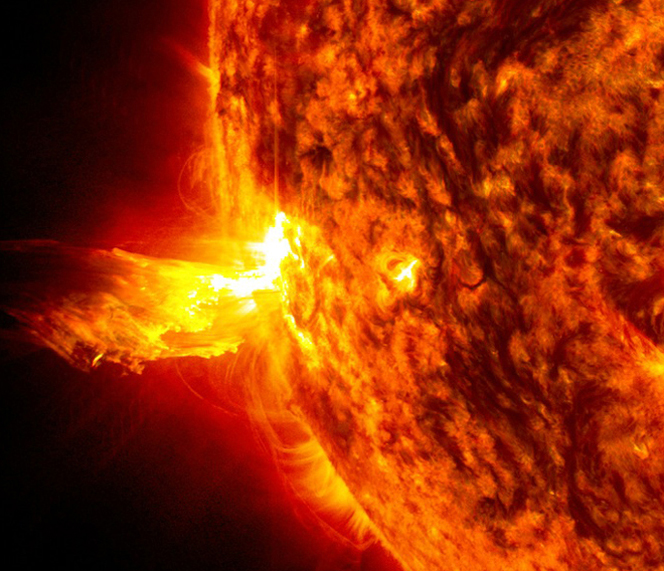
Image (Credit): Image of a sunspot on our Sun (with the United States in the corner for the purpose of comparison) captured by the Daniel K. Inouye Solar Telescope using its Visible Tunable Filter. (VTF/KIS/NSF/NSO/AURA)

This week’s image comes from the National Science Foundation’s (NSF) Daniel K. Inouye Solar Telescope. Using a newly developed Visible Tunable Filter, it is able to produce detailed images of the Sun’s surface.

Carrie Black, NSF program director for the NSF National Solar Observatory, stated:

When powerful solar storms hit Earth, they impact critical infrastructure across the globe and in space. High-resolution observations of the sun are necessary to improve predictions of such damaging storms…The NSF Inouye Solar Telescope puts the U.S. at the forefront of worldwide efforts to produce high-resolution solar observations and the Visible Tunable Filter will complete its initial arsenal of scientific instruments.

You can read much more about the telescope and its filter here.

Space Stories: Kuiper Launch, NASA Workforce Cuts, and Prepping for Moon Landing

Image (Credit): ULA launches the Kuiper 1 mission from Cape Canaveral on April 28, 2025. (ULA)

Here are some recent stories of interest.

ABC News: Amazon Launches First Kuiper Internet Satellites, Taking on Starlink

The first 27 satellites for Amazon’s Kuiper broadband internet constellation were launched into space from Florida on Monday, kicking off the long-delayed deployment of an internet-from-space network that will rival SpaceX’s Starlink. The satellites are the first of 3,236 that Amazon plans to send into low-Earth orbit for Project Kuiper, a $10 billion effort unveiled in 2019 to beam broadband internet globally for consumers, businesses and governments – customers that SpaceX has courted for years with its powerful Starlink business.

Government Executive: NASA preparing for steep workforce cuts but hopeful it can avoid more layoffs

As NASA ramps up plans to return to the moon and, eventually, Mars, it is moving forward with plans to shrink its workforce by incentivizing employees to leave government...NASA officials have told employees they may receive a second “deferred resignation” offer to allow staff to take paid leave until they exit government by Sept. 30, as well as early retirement and buyouts, to incentivize departures from the agency. These options were submitted as part of NASA’s reduction-in-force and reorganization plan, employees who attended the meetings in which the plans were shared said, which all agencies had to turn over to the Office of Personnel Management and the White House in recent weeks.

NASA: NASA Marshall Fires Up Hybrid Rocket Motor to Prep for Moon Landings

To better understand the physics behind the interaction of exhaust from the commercial human landing systems and the Moon’s surface, engineers and scientists at NASA’s Marshall Space Flight Center in Huntsville, Alabama, recently test-fired a 14-inch hybrid rocket motor more than 30 times. The 3D-printed hybrid rocket motor, developed at Utah State University in Logan, Utah, ignites both solid fuel and a stream of gaseous oxygen to create a powerful stream of rocket exhaust.

Podcast: The Planetary Society’s 45th Anniversary

if you missed the April 5th event celebrating the Planetary Society’s 45th anniversary, you can still tap into it via the Planetary Radio podcast.

Here is a little more on the event and related discussion:

Join us aboard the historic RMS Queen Mary for a celebration of The Planetary Society’s 45th anniversary. In this special episode of Planetary Radio, we bring you highlights from our Cosmic Shores Gala, where members, scientists, space advocates, and special guests came together to honor the past and look boldly to the future.

You’ll hear from CEO Bill Nye, Board President Bethany Ehlmann, Executive Director Jennifer Vaughn, founding Executive Director Lou Friedman, and Congresswoman Judy Chu, with actor and Planetary Society board member Robert Picardo as our master of ceremonies.

And of course, we close with Chief Scientist Bruce Betts in this week’s What’sUp.

Space Quote: Gambling with the NASA Administrator Nominee

Credit: Image by OpenClipart-Vectors from Pixabay

“In my early 20s, I was fortunate to experience business success at a young age, and I spent time in casinos as an immature hobby…The legal matters referenced were, in fact, forms of negotiation and were all resolved promptly. The incident at the border, following my return from the Olympics, stemmed from a payment issue that had already been resolved, which is why I was detained for only a few hours.”

-Statement by NASA Administrator nominee Jared Isaacman in a Reuters news article discussing his past arrest on fraud charges as well as lawsuits in two states for writing $2 million in bad checks to casinos. One of the casinos cited in the article is Donald Trump’s Taj Mahal casino in Atlantic City, now out of business. The early ties to Trump are interesting, particularly given Mr. Trump’s problem with his finances as well. So this is what we have coming into NASA – a man who likes to gamble large amounts and not pay his bills. Now he wants to gamble with the taxpayers’ money. This is not an auspicious start.