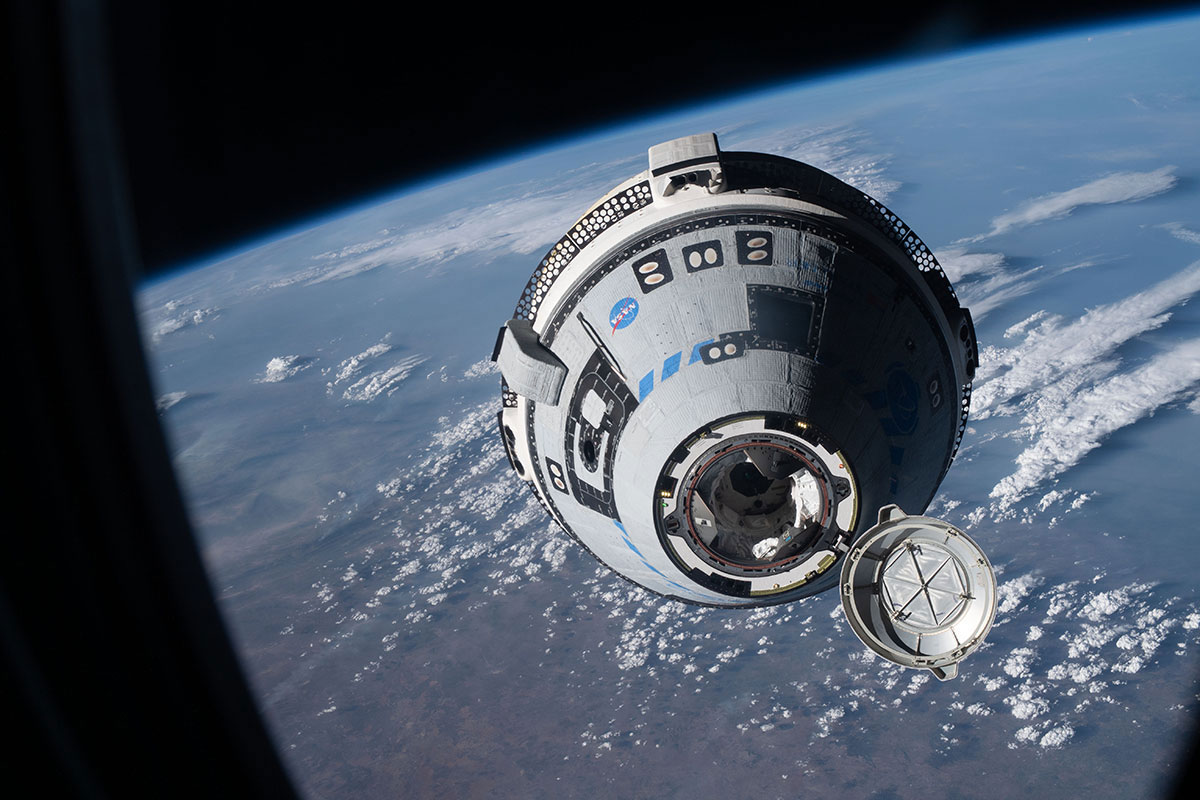
Image (Credit): The CST-100 Starliner approaching the ISS during an earlier uncrewed test flight in May 2022. (NASA)
“The @POTUS has asked @SpaceX to bring home the 2 astronauts stranded on the @Space_Station as soon as possible. We will do so. Terrible that the Biden administration left them there so long.”
-Statement tweeted by Elon Musk regarding the two astronauts on the International Space Station (ISS) following issues with the Boeing Starliner. Of course, the issue was already resolved by NASA via mission rotations, so Mr. Musk’s comments are needless and self-serving. It’s just one more chance for him to get attention as though he has not already done enough to warrant it, including that very odd hand gesture he made on stage.
Astronomers are calling on nations to ban advertising in space that can be seen from the ground, calling it the latest threat to the dark and quiet sky. At a briefing during the 245th Meeting of the American Astronomical Society earlier this month, the organization rolled out a statement calling for bans on “obtrusive space advertising” because of the interference it could cause for groundbased astronomy. Obtrusive space advertising is defined in U.S. federal law as “advertising in outer space that is capable of being recognized by a human being on the surface of the Earth without the aid of a telescope or other technological device.” Such advertising is banned in federal law through prohibitions on granting launch licenses for missions carrying payloads to carry out space advertising.
Israel has reached an agreement with NASA to send the first Israeli woman astronaut into space, Minister of Innovation, Science and Technology Gila Gamliel said on Monday. The remarks come as Israel is expanding cooperation in space technology with longtime allies such as the U.S., Italy and Azerbaijan, as well as with regional parties to the landmark 2020 Abraham Accords such as the United Arab Emirates.
A team of researchers from Australia has made a remarkable discovery by identifying over 20 intriguing signals from deep space. This achievement has been compared to the daunting task of finding a single grain of sand on a vast beach. Utilizing innovative technology pioneered by the Commonwealth Scientific and Industrial Research Organisation (CSIRO), these findings have been documented in the Publications of the Astronomical Society of Australia.
A near-Earth object (NEO) recently designated as 2018 CN41 ultimately was deleted because it was determined to be the Tesla Roadster launched into space back in 2018. As noted in an Astronomyarticle, this type of confusion over orbiting objects, including legitimate spacecraft looping past the Earth, need to be better cataloged and shared among astronomers.
And who would collect and monitor this information? The Minor Planet Center, of course, which was set up years back with this very mission. As the Center’s site notes:
The Minor Planet Center (MPC) is the single worldwide location for receipt and distribution of positional measurements of minor planets, comets and outer irregular natural satellites of the major planets. The MPC is responsible for the identification, designation and orbit computation for all of these objects. This involves maintaining the master files of observations and orbits, keeping track of the discoverer of each object, and announcing discoveries to the rest of the world via electronic circulars and an extensive website. The MPC operates at the Smithsonian Astrophysical Observatory, under the auspices of Division F of the International Astronomical Union (IAU).
It seems like a simple thing to ask given the risk of NEOs damaging spacecraft of plummeting towards the Earth. It would be an even easier monitoring task if we did not throw junk into space just for the fun or it.
One can only hope the Tesla Roadster becomes a shooting star so that we have on less piece of junk to monitor.




 Our Awesome Universe