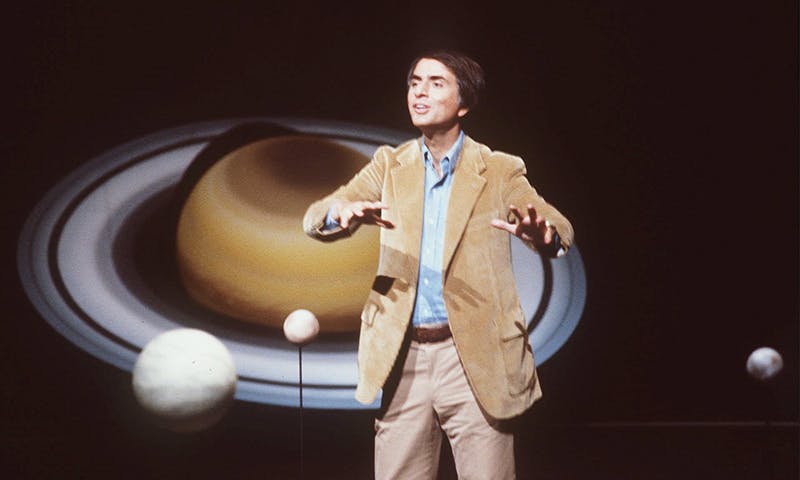
Image (Credit): Astrobiologist Carl Sagan. (Nautilus.us)
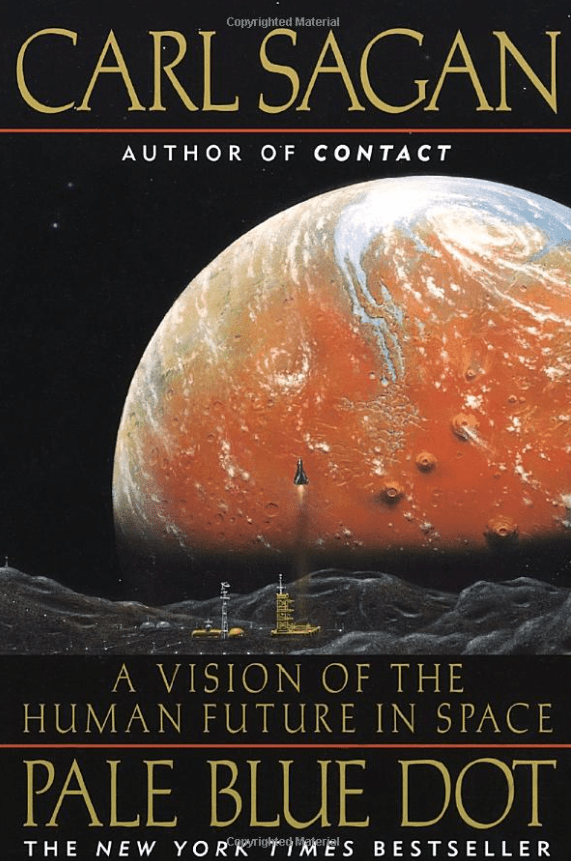
On this day in 1934, scientist and communicator Carl Edward Sagan was born in Brooklyn, NY. He was to become a great communicator of all things related to astronomy. He has played a key role over the years introducing millions to our place in the universe through his books, television series, speeches, and scientific work. His television series Cosmos was a milestone in educational television, bringing the stars and planets into everyone’s living room, while his books (Contact, Pale Blue Dot, The Dragons of Eden) continue to encourage the next generation of astronomers.
Dr. Sagan has a long resume, but I am most fascinated with his work to communicate with extraterrestrial life. He was a strong supporter of the Search for Extra-Terrestrial Intelligence (SETI) and worked with NASA to ensure our spacecraft were equipped with a record of human activity to educate other planetary civilizations, including the gold records placed on the Pioneer 10 and 11 space probes as well as the two Voyager space probes.
Years ago, the Smithsonian magazine had a good summary of Dr. Sagan’s life in the article “Why Carl Sagan is Truly Irreplaceable.” I recommend the article as a good way to get to know the man, though delving into his books is even better.
Credit: Ballantine Books
Extra: Carl Sagan was also the founder and first president of the Planetary Society. Visit this Planetary Society site, Ann Druyan wishes you a happy Sagan Day, for more on Dr. Sagan’s work.
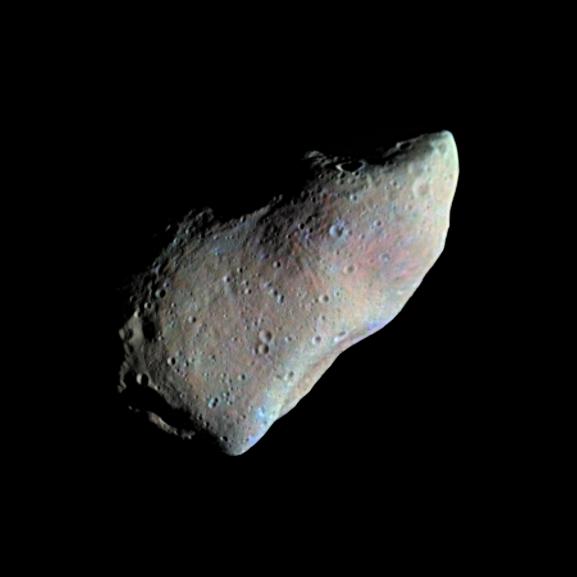
Image (Credit): Asteroid Gaspra in the asteroid belt, visited by the Galileo spacecraft on its way to Jupiter. (NASA/JPL/USGS)
On this day in 1991, NASA’s Galileo spacecraft flew by asteroid Gaspra, which is located in the asteroid belt between Mars and Jupiter. Galileo conducted a quick fly-by while flying towards Jupiter and its moons. The spacecraft also visited the asteroid Ida.
Asteroid Gasprawas first discovered back in 1916 by Russian astronomer G. N. Neujmin, who decided to name it after the Black Sea retreat of Gaspra, a Ukrainian spa town currently occupied by the Russians.
Here is some additional information from NASA about the asteroid, which has similar features to the asteroids now serving as moons to Mars (Phobos and Deimos):
A striking feature of Gaspra’s surface is the abundance of small craters. More than 600 craters, 100-500 meters (330-1650 feet) in diameter are visible here. The number of such small craters compared to larger ones is much greater for Gaspra than for previously studied bodies of comparable size such as the satellites of Mars. Gaspra’s very irregular shape suggests that the asteroid was derived from a larger body by nearly catastrophic collisions. Consistent with such a history is the prominence of groove-like linear features, believed to be related to fractures. These linear depressions, 100-300 meters wide and tens of meters deep, are in two crossing groups with slightly different morphology, one group wider and more pitted than the other. Grooves had previously been seen only on Mars’s moon Phobos, but were predicted for asteroids as well.
You car read more about the overall Galileo mission here.
Image (Credit): Artist’s rendering of the Galileo spacecraft arriving at Jupiter. (NASA)
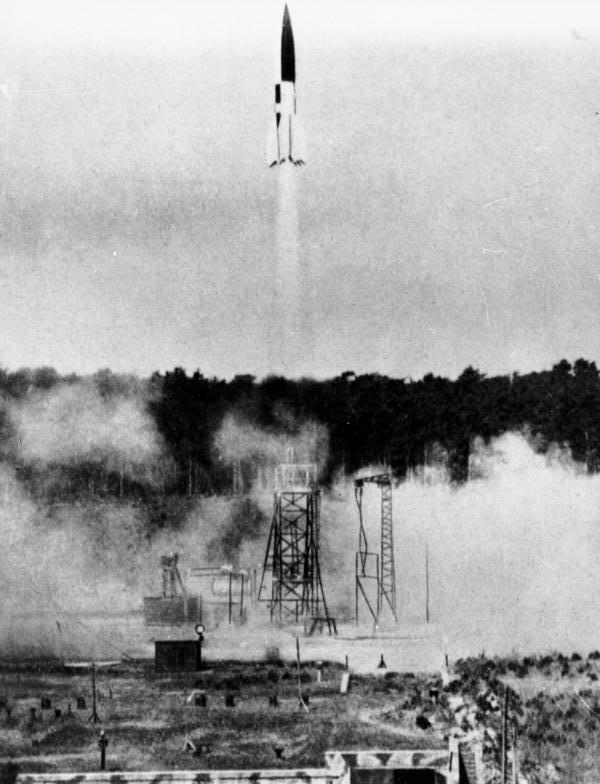
On this day in 1946, we saw the Earth from space for the first time in history, and the sub-orbital motion pictures were captured by a V-2 rocket, a deadly German weapon that was finally put to good use. The U.S. launched the missile from the White Sands Missile Range in New Mexico. The rocket went as high as 65 miles, providing the best view of Earth up to that point. You can watch a short film on YouTube about the space trip here.
If you want learn more about the man who created the V-2 rocket for the Nazis, Wernher von Braun, then I recommend you check out Moonrise, a podcast I highlighted in an earlier post.
While the V-2 was a useful step into the space age, it was less useful as a weapon to the Germans. More people died making the rocket than died as a result of being a target of it. But today, the V-2 is both the source of space exploration as well as intercontinental ballistic missiles that could end humanity once and for all.
Image (Credit): Artist’s rendering of the orbiting Sputnik 1. (thegravitywell.org/)
On this day in 1957, the Soviet Union launched Sputnik 1, humanity’s first artificial satellite, setting of a space race that continues to this day. The U.S. National Archives has a copy of minutes from an October 9 meeting between President Eisenhower and his advisors to discuss Sputnik I. The text accompanying the minutes demonstrates the shock this event caused:
At first, some in the Eisenhower administration downplayed the satellite as a “useless hunk of iron.” As David Halberstam wrote in The Fifties, “The success of Sputnik seemed to herald a kind of technological Pearl Harbor, which was exactly what Edward Teller said it was.” Others in America and around the world saw Sputnik as an ominous leap ahead in prestige and military ability, whether or not the new missiles could actually hit a target with nuclear weapons. President Eisenhower and some of his advisors, when they realized the significance of the Soviet achievement, met to discuss the alarming developments.
Of course, Russia is more of a wounded bear at the moment while China tries to take the lead in the latest space race. This is not to diminish what the Soviet Union accomplished in the last century, nor what Russia can accomplish tomorrow if it put its energy into science rather than war.
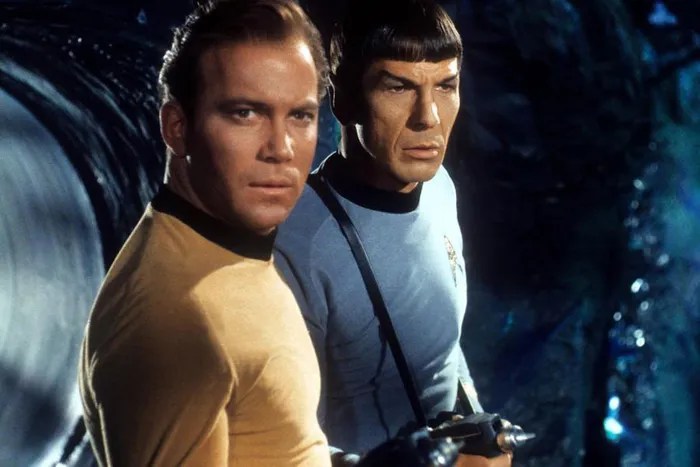
Image (Credit): Captain Kirk and Mr. Spock from Star Trek. (Paramount Pictures)
On this day in 1966, NBC television broadcast the first episode of Star Trek. The new series lasted for three seasons. It was the beginning of a “cultural phenomena,” to quote Leonard Nimoy from the 1991 television special, Star Trek 25th Anniversary Special.
While it may not technically meet the definition of astronomy, it definitely impacted many astronomers and other scientists. In 2016, NASA wrote about the technology and ideas in the Star Trek series that later matched up with reality or might exist someday. Here are two examples:
Communicators: Like Star Trek communicators, cell phones are ubiquitous now, to an annoying extent, and images and videos made with them are now collected and exchanged obsessively. Landing parties in past Star Trek shows only gave verbal reports, and did not send back images and videos, as today’s people would.
Impulse Engines: These are rocket engines based on the fusion reaction. We don’t have the technology for them yet – they are far ahead of our present chemical-fueled rockets – but they are within the bounds of real, possible future engineering.
Some Star Trek episodes also mentioned ion drive. In recent decades, Russian, U.S., European, and Japanese spacecraft have used ion drive engines, known as Hall thrusters. They are much more efficient than the usual chemical rockets and have been capable of propelling probes to asteroids and comets in our solar system.
Theoretical physicist and cosmologist Lawrence Krauss, writer of The Physics of Star Trek, also shared his insights on the influence of Star Trek in this video, Trek Talks: Lawrence Krauss on Star Trek and Science. He is among many who have seen the beneficial role of science fiction.
Fortunately, the Star Trek television and movie universe is going strong and can continue influencing young minds ready to explore this universe of ours.
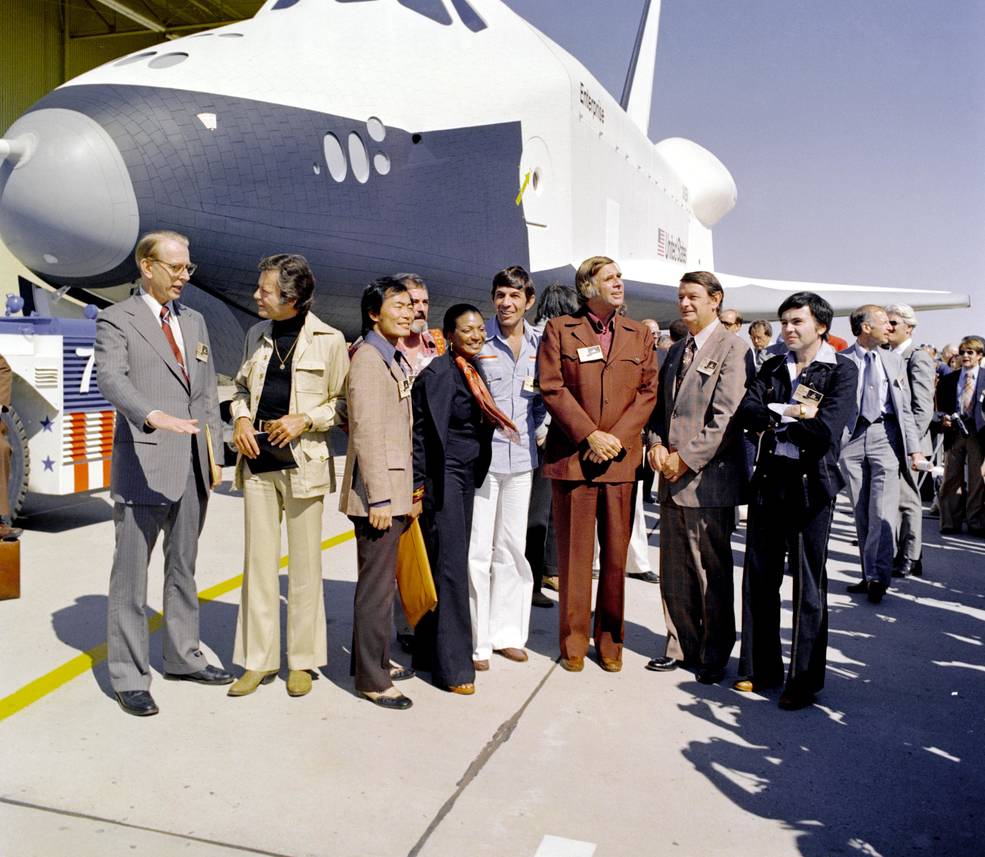
Image (Credit): In 1976, NASA’s space shuttle Enterprise rolled out of the Palmdale manufacturing facilities and was greeted by NASA officials and cast members from the Star Trek television series. From left to right they are: NASA Administrator Dr. James D. Fletcher; DeForest Kelley, who portrayed Dr. “Bones” McCoy on the series; George Takei (Mr. Sulu); James Doohan (Chief Engineer Montgomery “Scotty” Scott); Nichelle Nichols (Lt. Uhura); Leonard Nimoy (Mr. Spock); series creator Gene Roddenberry; U.S. Rep. Don Fuqua (D.-Fla.); and, Walter Koenig (Ensign Pavel Chekov). (NASA)
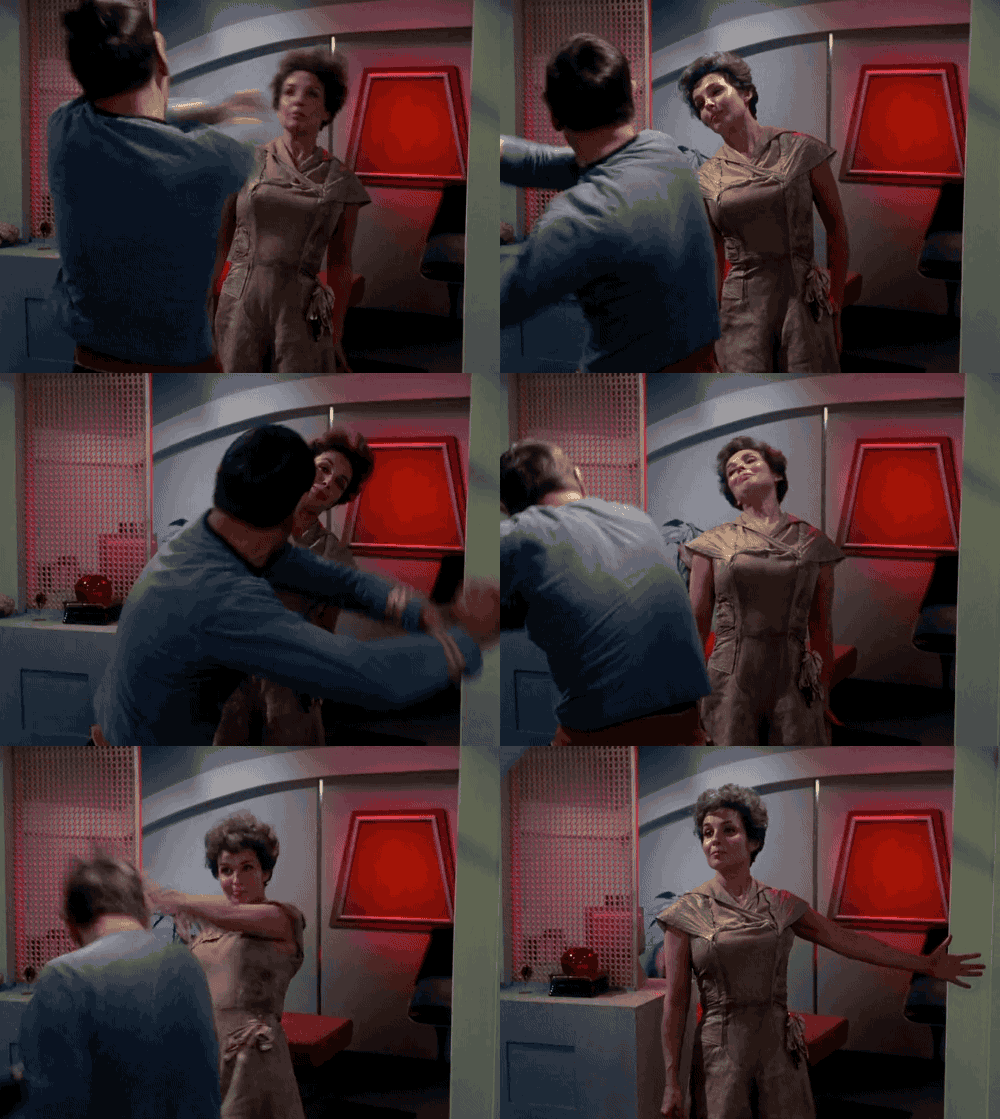
Extra: The pilot episode of Star Trek was named “The Man Trap.” It was not really the pilot but instead an episode in the wrong order, and the original pilot was dropped, but that is beside the point. The point is that it was bad. Really bad. You can read all about it in this article from Entertainment Weekly, “Star Trek Turns 50: A Look Back at the Desperately Sad First Episode.”
Image (Credit): Spock and Nancy in Star Trek’s “The Man Cage.” (Paramount Pictures)