Image (Credit): Russian cosmonaut Yuri Gagarin before his first flight on April 12, 1961. (London Science Museum)
On this day in 1961, Russian cosmonaut Yuri Gagarin became the first human to go into outer space. He was launched into orbit aboard the Soviet Vostok 1 spacecraft. He orbited the Earth for 108 minutes before landing in Kazakstan. He did not come down in the capsule, but instead landed separately using a parachute.
Yuri Gagarin was later quoted as saying:
When I orbited the Earth in a spaceship, I saw for the first time how beautiful our planet is. Mankind, let us preserve and increase this beauty, and not destroy it!
It was his only flight into space. He died in 1968 in a training flight accident.
The following month, on May 5, 1961, Alan B. Shepard became the first American in space. He was aboard a Mercury capsule named Freedom 7.
Image (Credit): Reentry capsule of the Vostok 1 with charring and its parachute on the ground after landing in Kazakhstan. (European Space Agency)
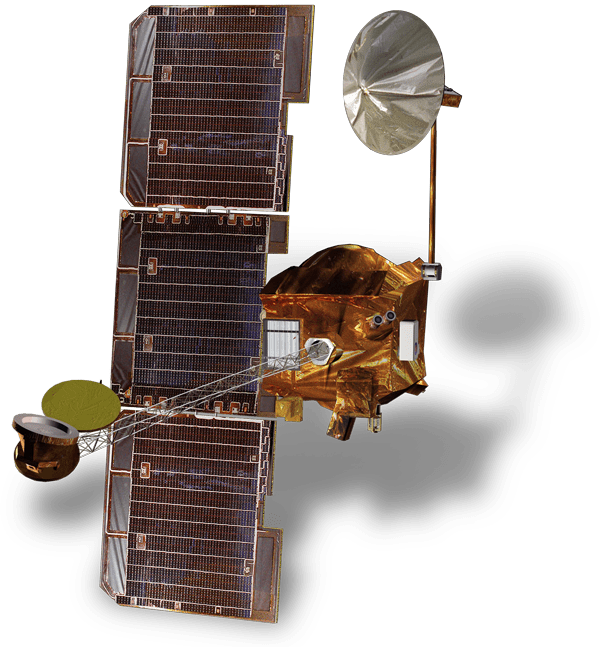
On this day in 2001, NASA’s Mars Odyssey orbiter was launched towards Mars to map and search the Red Planet for water. The mission itself took its name from Arthur C. Clarke’s novel 2001: A Space Odyssey.
The Mars Odyssey successfully discovered Martian water. Project Scientist Jeffrey Plaut of NASA’s Jet Propulsion Laboratory in Southern California, which leads the Odyssey mission, stated that “Before Odyssey, we didn’t know where this water was stored on the planet…We detected it for the first time from orbit and later confirmed it was there using the Phoenix lander.”
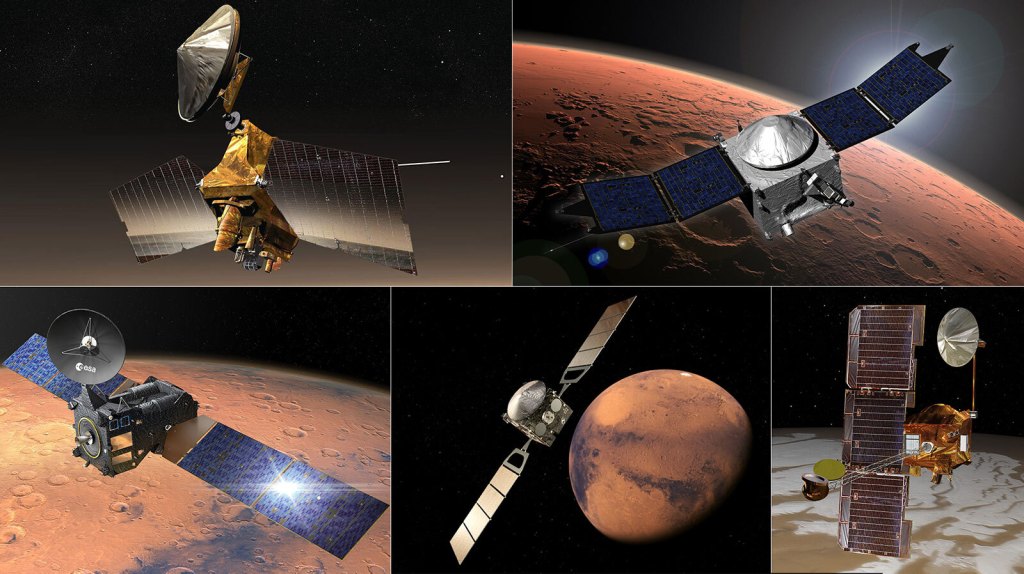
In addition to conducting its own studies, the Mars Odyssey was also used as a space satellite relaying data between Earth and Mars from other scientific missions, such as NASA’s Spirit and Opportunity rovers. The orbiter is part of what is called the Mars Relay Network, currently consisting of five orbiters (see below).
The Mars Odyssey is now the oldest oldest spacecraft still working at the Red Planet. It should be able to continue its work through 2025. You can find more information about the mission from this NASA site.
Image (Credit): Five spacecraft currently in orbit about the Red Planet make up the Mars Relay Network to transmit commands from Earth to surface missions and receive science data back from them. Clockwise from top left: NASA’s Mars Reconnaissance Orbiter (MRO), Mars Atmospheric and Volatile EvolutioN (MAVEN), Mars Odyssey, and the European Space Agency’s (ESA’s) Mars Express and Trace Gas Orbiter (TGO). (NASA/JPL-Caltech, ESA)
Image (Credit): Artist’s image of MESSENGER orbiting Mercury (NASA).
On this day in 2011, NASA’s MErcury Surface, Space ENvironment, GEochemistry, and Ranging (MESSENGER) probe became the first spacecraft to orbit Mercury. NASA prepared the 10-year summary below explaining MESSENGER’s accomplishments from the time it was launched on August 3, 2004 through August 1, 2014. The probe later impacted the surface of Mercury on April 30, 2015.
NASA issued this high-level summary of the mission:
The MESSENGER spacecraft fundamentally changed our understanding of Mercury during its four-year orbital exploration of the planet, returning nearly 300,000 photographs and a wealth of information from its instruments. The formatted data totaling more than 10 terabytes reside in NASA’s Planetary Data System archive. Among the major findings were that Mercury harbors water ice and organic compounds at its north pole, that volcanism played a major role in shaping the planet’s surface, and that Mercury’s surface materials are more volatile-rich and chemically reduced than expected.
Image (Credit): 10-Year Summary of MESSENGER’s activities as of August 1, 2014. (NASA)
Source/Credit: Image of Uranus taken by Voyager 2 in 1986 (NASA).
On this day in 1781, astronomer Frederick William Herschel noticed a new object in the constellation of Gemini. With further study, he found he had discovered a new planet in our solar system – Uranus. Following his discovery, King George III appointed him Court Astronomer (yes, that King George who did not get many kind words from the embattled colonists on the other side of the pond).
While Frederick William Herschel is credited with numerous astronomical findings (including finding a number of moons, such as Saturn’s Enceladus, and discovering infrared radiation), he was also an accomplished musician. He played the oboe, violin, harpsichord and organ, and composed 24 symphonies as well as concertos, sonatas, and more. You can hear one of his symphonies here.
He was also a man with strong views about life beyond the Earth, including believing the Moon and the planets were populated with intelligent life (stating the surface of the Moon was similar to the English countryside) and speculating that the interior of the sun was heavy populated. Of course, he was a bit off the mark, but I expect he would be fascinated with the discovery of other planets and moons around the galaxy.
Extra: Frederick William Herschel’s sister Caroline assisted him with his work and also became an astronomer herself. For instance, she discovered a companion galaxy to the Andromeda Galaxy, M110 (NGC 205). She also discovered 14 nebulae and 8 comets. For her work cataloging stars, she was awarded the Gold Medal of the Royal Astronomical Society. She also became an Honorary Member of the Royal Astronomical Society in 1835.