A Day in Astronomy: The Birth of Edwin Hubble

Image (Credit): Edwin Hubble at the Mount Wilson Observatory in California. (Edwin P. Hubble Papers, Huntington Library, San Marino, California)

On this day in 1889, Edwin Powell Hubble was born in Marshfield, Missouri. He would go on to become an important astronomer who found that the “nebulae” in his time were actually galaxies far beyond our Milky Way. He also determined that the galaxies were moving away from one another, indicating an expanding universe. Of course, name is probably most recognizable to the pubic today as it relates to the Hubble Space Telescope.

Edwin Hubble knew he was part of long list of astronomers seeking answers about our universe when he said:

From our home on the Earth, we look out into the distances and strive to imagine the sort of world into which we were born. Today, we have reached far into space. Our immediate neighborhood we know rather intimately. But with increasing distance our knowledge fades … The search will continue. The urge is older than history. It is not satisfied and will not be suppressed.

You can read more about Edwin Hubble here.

A Day in Astronomy: The Birth of Ursula Le Guin

On this day in 1929, Ursula K. Le Guin was born in Berkeley, California. She would gain her masters degree in French only to later become a well known author of many fantasy and science fiction stories, including the Earthsea series and stories set in a Hainish universe of her making. She would go on to win eight Hugo Awards and six Nebula Awards.

Her style was different from many other authors of her period, focusing more on planetary culture than spacecraft hardware. When asked about her style, she stated the following:

The “hard”–science fiction writers dismiss everything except, well, physics, astronomy, and maybe chemistry. Biology, sociology, anthropology—that’s not science to them, that’s soft stuff. They’re not that interested in what human beings do, really. But I am. I draw on the social sciences a great deal. I get a lot of ideas from them, particularly from anthropology. When I create another planet, another world, with a society on it, I try to hint at the complexity of the society I’m creating, instead of just referring to an empire or something like that.

Given that her mother an anthropologist, it is not surprising that she saw a different way of telling story.

Her books represented a unique part of the science fiction genre that has only expanded over time as the writing community has expanded.

If you need an entry point to her work, you cannot go wrong starting with the short story “The Ones Who Walk Away from Omelas.” However, one of my favorite short stories is “The Island of the Immortals,” which you can find here.

I doubt you will be able to stop with one short story.

A Day in Astronomy: The Birth of Ray Bradbury

On this day in 1920, Ray Douglas Bradbury was born in Waukegan, Illinois. Mr. Bradybury would grow up to be a famous American author and screenwriter.

One of his science fiction works,The Martian Chronicles stories, tells the story of mankind’s colonization of Mars and the ultimate effect on the colonizers.

He wrote numerous other famous books and short story collections, including Fahrenheit 541, Something Wicked This Way Comes, The Illustrated Man, and Dandelion Wine.

Speaking on science fiction, Mr. Bradbury once stated:

Science fiction is any idea that occurs in the head and doesn’t exist yet, but soon will, and will change everything for everybody, and nothing will ever be the same again. As soon as you have an idea that changes some small part of the world you are writing science fiction. It is always the art of the possible, never the impossible.

Asked in a 2004 interview what he thought about the US space program, he stated:

It’s too late, isn’t it? We’ve let 30 years go by. It’s stupid. It’s stupid. We should have stayed on the moon. We should have made moon the base, instead of building space stations, which are fragile and which fly apart. The moon is a good, solid base to build a space travel organization in the community. Then we take off from the moon and we go to Mars. But it’s terribly late. We’ve let too much time go by. We’ve been busy with war instead of being busy with peace. And that’s what space travel is all about. It’s all about peace and exploration and wonder and beauty.

Fortunately, it is not too late to visit the Moon or Mars, as demonstrated by NASA’s Artemis program. It’s the art (and science) of the possible.

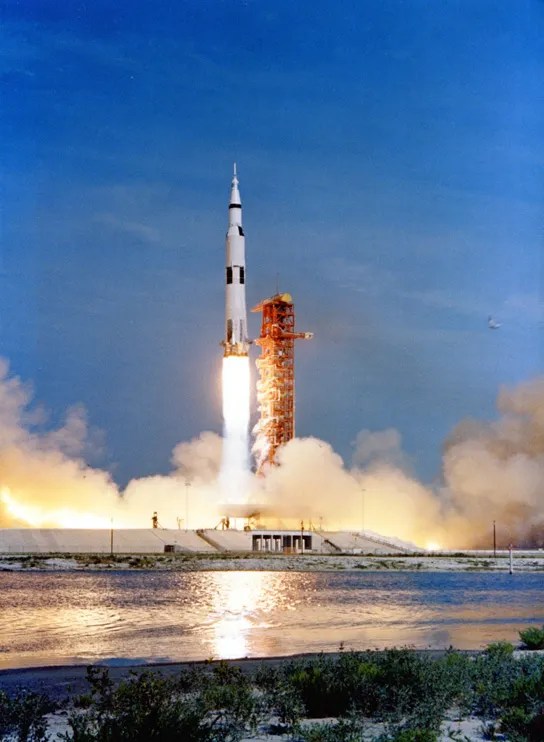
A Day in Astronomy: Launch of the Manned Saturn V Rocket to the Moon

Image (Credit): The launch of the Apollo 11 space vehicle from the launch pad on July 16, 1969. (NASA/ Kipp Teague)

On this day in 1969, NASA launched the Saturn V rocket that carried astronauts Armstrong, Edwin “Buzz” Aldrin, and Michael Collins on the first manned lunar landing. The 363-feet tall Saturn V rocket was launched from Pad A, Launch Complex 39, Kennedy Space Center, at 9:32 a.m. EDT. 

While this was the most significant use of the Saturn V at that point in time, it was the backbone of the Apollo program. The first crewed Saturn V to launch was Apollo 8, which orbited the Moon without landing.

You can listen in on the control room chatter surrounding the launch at this NASA launch history site.

NASA has a number of events planned for this month to celebrate the 55th anniversary of the Moon landing. You can read about the planned activities at this NASA anniversary site.

A Day in Astronomy: Birth of George Lucas

Image (Credit): George Lucas. (https://static.wikia.nocookie.net/)

On this day in 1944, George Walton Lucas Jr. was born in Modesto, CA. He graduated from the University of Southern California in 1967, co-founded American Zoetrope with another filmmaker Francis Ford Coppola, and started making films that eventually changed America cinema.

He would one day go on to create the Star Wars franchise, one of the most popular space-based science fiction empires in history. The Star Wars franchise now includes the nine primary movies, at lease two additional movie spin-offs, a whole bunch of TV series, both animated and otherwise, and many fan films as well.

Here are a few fun facts about Mr. Lucas:

  • George and his family attended Disneyland during its opening week in July 1955. Disney would later buy his Star Wars film empire, Lucasfilm, for about $4 billion.
  • While the Vietnam War was drawing in many American youth to fight overseas, George was first turned down by the US Air Force because of all his speeding tickets and later by the US Army because of his diabetes. He later taught documentary cinematography a class of U.S. Navy students.
  • A divorce and financial setbacks caused George to step back from making any additional Star Wars films after The Return of the Jedi. Of course, he later came back to direct the first three films of the series (I-III) and hand-picked director J. J. Abrams to direct the last three (VII-IX), even though Disney had thrown out George’s ideas for these last three films.

While Star Trek has probably done more to push viewers towards questions about space travel and exoplanets, Star Wars did introduce some ideas that kept some scientists chattering.

No matter what set of Star Wars films you prefer (my favorites were the three original films), there has been plenty action-packed films and spin-offs since 1977. We are fortunate that Mr. Lucas did not give up on his science fiction dream.

Happy 80th birthday, Mr. Lucas.