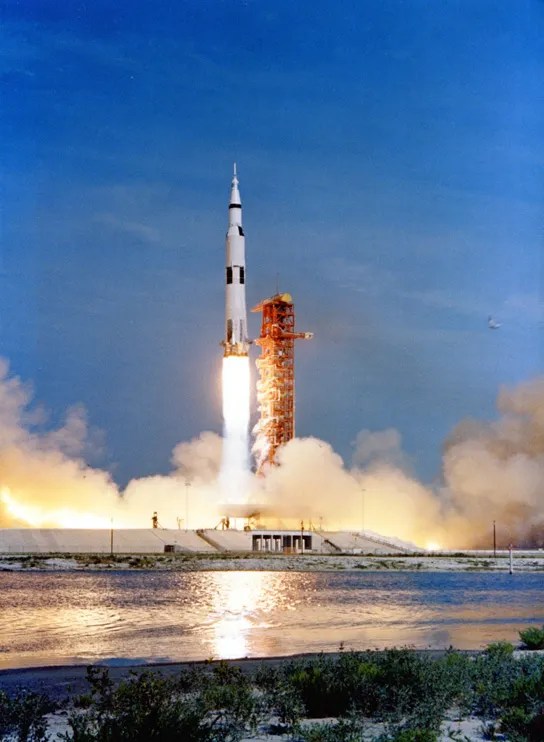
A Day in Astronomy: Launch of the Manned Saturn V Rocket to the Moon

Image (Credit): The launch of the Apollo 11 space vehicle from the launch pad on July 16, 1969. (NASA/ Kipp Teague)

On this day in 1969, NASA launched the Saturn V rocket that carried astronauts Armstrong, Edwin “Buzz” Aldrin, and Michael Collins on the first manned lunar landing. The 363-feet tall Saturn V rocket was launched from Pad A, Launch Complex 39, Kennedy Space Center, at 9:32 a.m. EDT. 

While this was the most significant use of the Saturn V at that point in time, it was the backbone of the Apollo program. The first crewed Saturn V to launch was Apollo 8, which orbited the Moon without landing.

You can listen in on the control room chatter surrounding the launch at this NASA launch history site.

NASA has a number of events planned for this month to celebrate the 55th anniversary of the Moon landing. You can read about the planned activities at this NASA anniversary site.

A Day in Astronomy: Birth of George Lucas

Image (Credit): George Lucas. (https://static.wikia.nocookie.net/)

On this day in 1944, George Walton Lucas Jr. was born in Modesto, CA. He graduated from the University of Southern California in 1967, co-founded American Zoetrope with another filmmaker Francis Ford Coppola, and started making films that eventually changed America cinema.

He would one day go on to create the Star Wars franchise, one of the most popular space-based science fiction empires in history. The Star Wars franchise now includes the nine primary movies, at lease two additional movie spin-offs, a whole bunch of TV series, both animated and otherwise, and many fan films as well.

Here are a few fun facts about Mr. Lucas:

  • George and his family attended Disneyland during its opening week in July 1955. Disney would later buy his Star Wars film empire, Lucasfilm, for about $4 billion.
  • While the Vietnam War was drawing in many American youth to fight overseas, George was first turned down by the US Air Force because of all his speeding tickets and later by the US Army because of his diabetes. He later taught documentary cinematography a class of U.S. Navy students.
  • A divorce and financial setbacks caused George to step back from making any additional Star Wars films after The Return of the Jedi. Of course, he later came back to direct the first three films of the series (I-III) and hand-picked director J. J. Abrams to direct the last three (VII-IX), even though Disney had thrown out George’s ideas for these last three films.

While Star Trek has probably done more to push viewers towards questions about space travel and exoplanets, Star Wars did introduce some ideas that kept some scientists chattering.

No matter what set of Star Wars films you prefer (my favorites were the three original films), there has been plenty action-packed films and spin-offs since 1977. We are fortunate that Mr. Lucas did not give up on his science fiction dream.

Happy 80th birthday, Mr. Lucas.

A Day in Astronomy: First Spaceflight Fatality

Image (Credit): Soviet cosmonaut Vladimir Komarov. (RIA Novosti)

On this day in 1967, the Soviet Union’s Vladimir Komarov became the first spaceflight fatality when his Soyuz 1 spacecraft crashed during reentry as the result of a failed parachute. The accident occurred during what was his second trip to space, his first being aboard the Voskhod 1. Yuri Gagarin served as the backup cosmonaut on the Soyuz 1 flight.

The Soyuz 1 mission was already experiencing problems before reentry, particularly with its solar panels. These problems were enough to end the mission early and delay the launch of a second Soyuz spacecraft that would have met up with the orbiting Soyuz 1. The spacecraft was not up to the mission. Before the crash, Komarov could be heard stating, “This devil ship! Nothing I lay my hands on works properly.”

This fellow cosmonauts had this to say via Pravda:

For the forerunners it is always more difficult. They tread the unknown paths and these paths are not straight, they have sharp turns, surprises and dangers. But anyone who takes the pathway into orbit never wants to leave it. And no matter what difficulties or obstacles there are, they are never strong enough to deflect such a man from his chosen path. While his heart beats in his chest, a cosmonaut will always continue to challenge the universe. Vladimir Komarov was one of the first on this treacherous path.

Image (Credit): Burkina Faso stamps commemorating cosmonaut Vladimir Komarov. (stamps-world.eu)

A Day in Astronomy: Birth of Wernher von Braun

Image (Credit): Walt Disney (left) and Wernher von Braun. (NASA)

On this day in 1912, German-American aerospace engineer Wernher von Braun was born in Wyrzysk, which was part of Germany at the time and later became a Polish city. His full name was Wernher Magnus Maximilian, Freiherr von Braun.

Mr. Braun is best remembered for his part in the construction of Nazi Germany’s V-2 rockets as well as his later participation in development of the Saturn V rocket that became the workhorse of the U.S. Apollo space program.

In the above photo from 1954, you can see Walt Disney with Mr. Braun at the Guided Missile Development Operation Division at Army Ballistic Missile Agency in Redstone Arsenal, Alabama. Mr. Braun served as a technical consultant on a few Disney space films.

A Day in Astronomy: The Mariner 6 Heads to Mars

Image (Credit): The Mariner 6 spacecraft. (NASA)

On this day in 1969, NASA’s Mariner 6 was launched from Cape Canaveral using the Atlas-Centaur AC-20 rocket. The mission of Mariner 6 was to conduct a flyby of Mars and analyze the Martian atmosphere and surface with remote sensors.

This mission, as well as the Mariner 7 launch the following month, provided solid evidence that the dark features on the planet’s surface were not canals (as astronomer Percival Lowell and other had proposed).

You can find NASA’s Mariner information here.

Image (Credit): Close up of Mars taken by Mariner 6. (NASA)