Artemis and More Under a New Administration

Credit: The Planetary Society.

Will NASA be pulled in a new direction under a Trump administration? The Planetary Society does not think so, as noted in a recent article, “Space in the 2024 Elections: A Space Advocate’s Guide to the U.S. Presidential Election.

The graphic above highlights the party platforms on space, showing a lot of similarity between the two parties. If you also consider the fact that the Artemis program was started under the first Trump Administration, as well as the close association between Trump and Elon Musk (at the moment), then one sees an even stronger indication that the Moon and Mars will remain a large part of the new administration’s focus.

The article notes:

For former President Trump, maintaining U.S. preeminence is a major component of his campaign rhetoric. To that end, a second Trump Administration would likely view space as a key arena for competition with China, and would therefore prioritize initiatives aimed at maintaining American dominance in the space domain. This could include bolstering programs that accelerate the development of commercial space capabilities, like Artemis and the Commercial Lunar Payload Services program. Mars Sample Return is an example of a program that offers an opportunity to leverage the burgeoning commercial space industry to accomplish something that no other nation has: returning scientifically significant samples from another planet.

All of this should offer some protection for NASA in a new administration that is already talking about downsizing government and eliminating at least one department. Besides, I doubt a cost-cutting panel headed by Mr. Musk will cut off the hand that feeds him. NASA has been good to SpaceX, and that is likely to continue.

We will see many more papers and opinion pieces on potential changes in the days and weeks to come.

Space Stories: Questions About Orion, NASA’s Impact on Economy, and a New Crew for the Chinese Space Station

Image (Credit): Components of the Orion spacecraft. (NASA)

Here are some recent stories of interest.

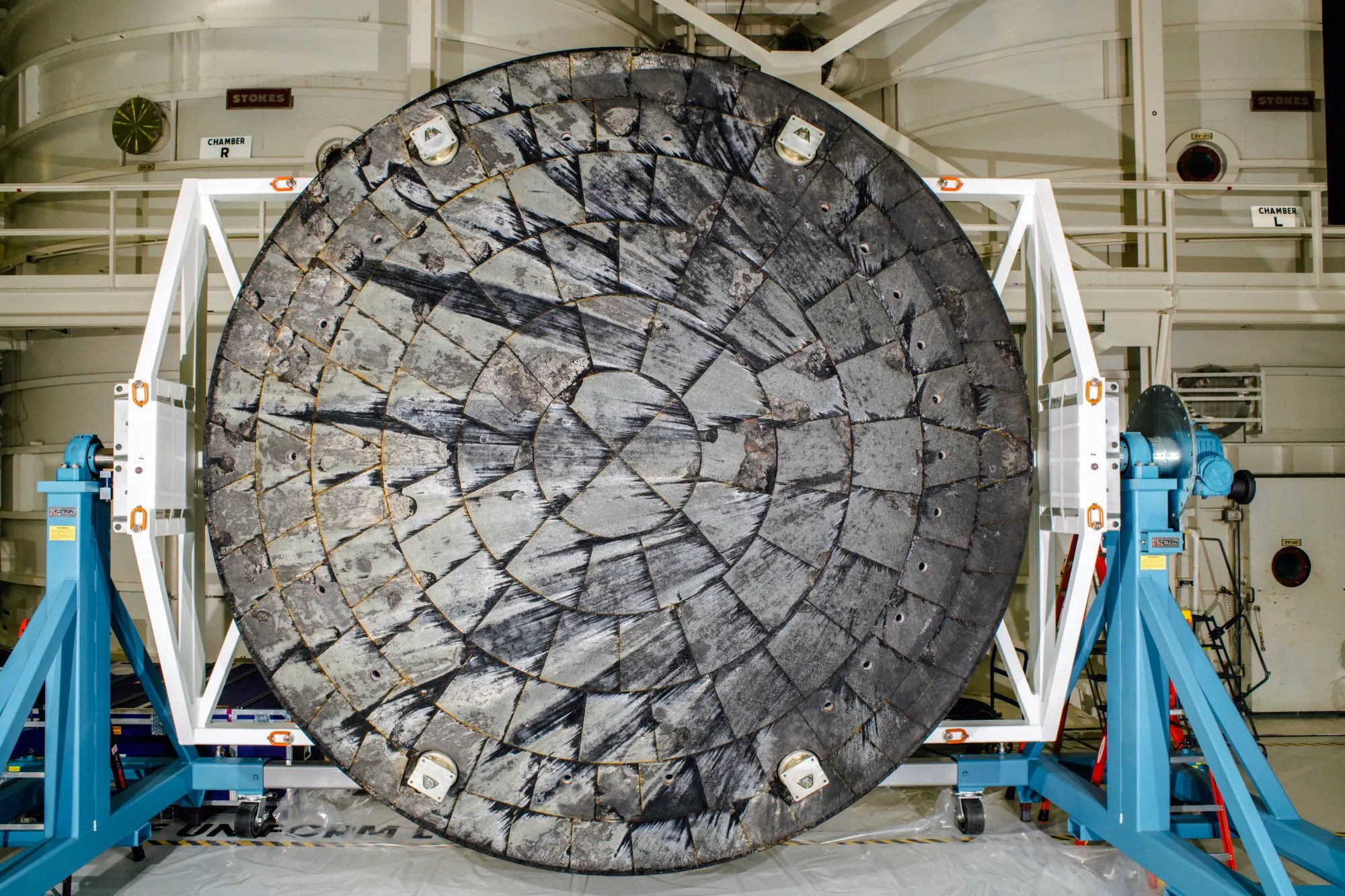
ARSTechnicaFor Some Reason, NASA is Treating Orion’s Heat Shield Problems as a Secret

For those who follow NASA’s human spaceflight program, when the Orion spacecraft’s heat shield cracked and chipped away during atmospheric reentry on the unpiloted Artemis I test flight in late 2022, what caused it became a burning question. Multiple NASA officials said Monday they now know the answer, but they’re not telling. Instead, agency officials want to wait until more reviews are done to determine what this means for Artemis II, the Orion spacecraft’s first crew mission around the Moon, officially scheduled for launch in September 2025.

NASANew Report Shows NASA’s $75.6 Billion Boost to US Economy

In its third agencywide economic impact report, NASA highlighted how its Moon to Mars activities, climate change research and technology development, and other projects generated more than $75.6 billion in economic output across all 50 states and Washington, D.C., in fiscal year 2023…Combined, NASA’s missions supported 304,803 jobs nationwide, and generated an estimated $9.5 billion in federal, state, and local taxes throughout the United States.

ABC NewsChina Launches New Crew to its Space Station as it Seeks to Expand Exploration

China declared a “complete success” after it launched a new three-person crew to its orbiting space station early Wednesday as the country seeks to expand its exploration of outer space with missions to the moon and beyond. The Shenzhou-19 spaceship carrying the trio blasted off from the Jiuquan Satellite Launch Center in northwest China at 4:27 a.m. local time atop a Long March-2F rocket, the backbone of China’s crewed space missions.

Space Stories: Starliner Not on the Schedule, More Questions About Artemis, and the Origin of Most Meteorites

Image (Credit): The International Space Station. (NASA)

Here are some recent stories of interest.

Space NewsNASA Further Delays First Operational Starliner Flight

NASA will use SpaceX’s Crew Dragon for its two crew rotation missions to the International Space Station in 2025 as it continues to evaluate if it will require Boeing to perform another test flight of its Starliner spacecraft. In an Oct. 15 statement, NASA said it will use Crew Dragon for both the Crew-10 mission to the ISS, scheduled for no earlier than February 2025, and the Crew-11 mission scheduled for no earlier than July. Crew-10 will fly NASA astronauts Anne McClain and Nichole Ayers along with astronaut Takuya Onishi from the Japanese space agency JAXA and Roscosmos cosmonaut Kirill Peskov. NASA has not yet announced the crew for the Crew-11 mission.

BloombergNASA’s $100 Billion Moon Mission Is Going Nowhere

There are government boondoggles, and then there’s NASA’s Artemis program. More than a half century after Neil Armstrong’s giant leap for mankind, Artemis was intended to land astronauts back on the moon. It has so far spent nearly $100 billion without anyone getting off the ground, yet its complexity and outrageous waste are still spiraling upward. The next US president should rethink the program in its entirety.

CNRSThe Origin of Most Meteorites Finally Revealed

An international team led by three researchers from the CNRS1 , the European Southern Observatory (ESO, Europe), and Charles University (Czech Republic) has successfully demonstrated that 70% of all known meteorite falls originate from just three young asteroid families. These families were produced by three recent collisions that occurred in the main asteroid belt 5.8, 7.5, and about 40 million years ago. The team also revealed the sources of other types of meteorites; with this research, the origin of more than 90% of meteorites has now been identified. This discovery is detailed in three papers, a first published on 13 September 2024 in the journal Astronomy and Astrophysics, and two new papers published on 16 October 2024 in Nature.

Space Quote: Axiom Space and Prada Reveal Artemis III Space Suit

Image (Credit): The AxEMU spacesuit. (Axiom Space)

“At the International Astronautical Congress in Milan, Italy, Axiom Space and Prada revealed for the first time today the flight design of the Axiom Extravehicular Mobility Unit (AxEMU) spacesuit that will be used for NASA’s Artemis III mission…The AxEMU suit is nearing the final development stage. It completed a successful pressurized simulation with Artemis III partners – NASA, SpaceX, and Axiom Space – marking the first test of its kind since the Apollo era. It will continue to undergo testing including crewed underwater tests at the NBL facility, integrated tests with the Artemis Lunar Terrain Vehicle prototypes, and will enter the critical design review phase in 2025.

-Statement from an Axiom Space press release. Specifics about the new space suit can be found in the graphic below. Now it is a matter of getting the other pieces together in time for the Artemis III mission, which will entail sending astronauts to explore the Moon’s South Pole.

Credit: Axiom Space.

The Fifth Test of Starship Goes Well

Image (Credit): An image showing SpaceX’s Super Heavy booster being grabbed midair after the fifth flight test from Boca Chica, Texas. (Taken from a SpaceX video)

Earlier today, SpaceX conducted its fifth Starship test earlier today. It appears it was an overall success, with a new twist. This time the rocket’s Super Heavy booster returned to the launch pad to be captured midair by two metal arms. It seemed like an unnecessary risk to the landing site, but the stunt was successful.

The rocket itself “landed” without incident off Australia’s coast before falling into the sea and exploding.

All in all it went according to plan, which is a good sign for NASA and its future plans for the rocket.

While all the attention today related to the booster bravado, I just want to see a Starship that is ready for the upcoming Artemis mission. After all, all the fancy tricks related to the Starship will look pretty useless should the Chinese be the first to return to the Moon.