Television: PBS Documentary on Space Travel

Credit: Greenwich Entertainment)

If you are looking for a television show on the hazards of space travel, PBS has created a worthwhile documentary titled Space: The Longest Goodbye. It is playing on your local PBS station as well as online.

Here is a little more about the series:

NASA’s goal to send astronauts to Mars would require a three-year absence from Earth, during which communication in real time would be impossible due to the immense distance. Meet the psychologists whose job is to keep astronauts mentally stable in outer space, as they are caught between their dream of reaching new frontiers and the basic human need to stay connected to home.

The series covers various attempts to understand the human mind when constrained to a small place, be it a rocket, a space station, or a planetary/moon base.

The PBS website also has more information on the series as well as comments from the participants. For example, the story “How Science Fiction Confronts the Real Isolation of Space” touches on our favorite movies and television shows to see what they say on the issue, from Black Mirror and For All Mankind to 2001: A Space Odyssey and Alien.

We still have a lot to learn about the human mind before we go any real distance into space or simply sit in place on the Moon or Mars. We may find that equipment challenges are the easiest challenges to resolve in future Artemis missions.

Space Stories: Truncated Artemis III Mission, Origins of a Local Galaxy, and Chandra X-ray Observatory Exoplanet Efforts

Image (Credit): The launch of a Starship. (SpaceX)

Here are some recent stories of interest.

Ars Technica: As NASA Watches Starship Closely, Here’s What the Agency Wants to See Next

NASA and SpaceX are planning for the possibility of modifying the Artemis III mission. Instead of landing on the Moon, a crew would launch in the Orion spacecraft and rendezvous with Starship in low-Earth orbit. This would essentially be a repeat of the Apollo 9 mission, buying down risk and providing a meaningful stepping stone between Artemis missions. Officially, NASA maintains that the agency will fly a crewed lunar landing, the Artemis III mission, in September 2026. But almost no one in the space community regards that launch date as more than aspirational. Some of my best sources have put the most likely range of dates for such a mission from 2028 to 2032. A modified Artemis III mission, in low-Earth orbit, would therefore bridge a gap between Artemis II and an eventual landing.

Sci.News: Astrophysicists Offer Explanation for Origin of One of Milky Way’s Largest Satellites

The satellite galaxy Crater II (or Crater 2) of the Milky Way is located approximately 380,000 light-years away from Earth in the constellation of Crater. This galaxy is extremely cold and exceptionally diffuse, and has low surface brightness. According to new research, Crater II exists thanks to a self-interacting dark matter.

Harvard-Smithsonian Center for Astrophysics: Coming in Hot: NASA’s Chandra Checks Habitability of Exoplanets

Using NASA’s Chandra X-ray Observatory and ESA’s (European Space Agency’s) XMM-Newton, astronomers are exploring whether nearby stars could host habitable exoplanets, based on whether they emit radiation that could destroy potential conditions for life as we know it. This type of research will help guide observations with the next generation of telescopes aiming to make the first images of planets like Earth. A team of researchers examined stars that are close enough to Earth that future telescopes could take images of planets in their so-called habitable zones, defined as orbits where the planets could have liquid water on their surfaces. Any images of planets will be single points of light and will not directly show surface features like clouds, continents, and oceans. However, their spectra — the amount of light at different wavelengths — will reveal information about the planet’s surface composition and atmosphere.

Audit Report: Is NASA Ready for Artemis II?

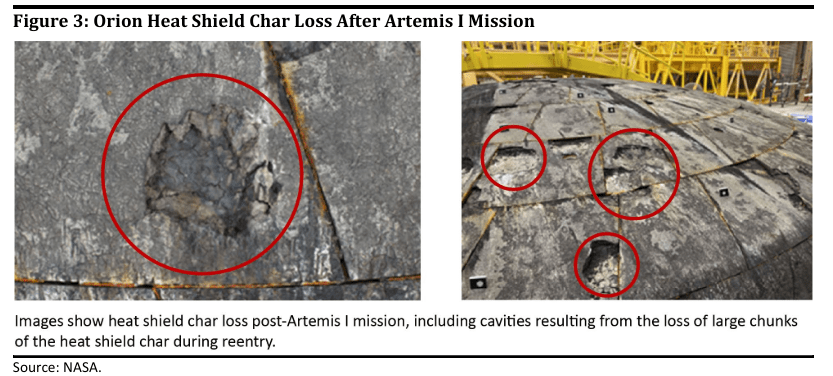
The NASA Office of Inspector General (OIG) issued an audit report earlier this week, NASA’s Readiness for the Artemis II Crewed Mission to Lunar Orbit, that expressed concerns about problems with the Artemis I test flight mission in late 2022. For example, the report noted:

…the Artemis I test flight revealed critical issues that need to be addressed before placing crew on the Artemis II mission. In particular, the test flight revealed anomalies with the Orion heat shield, separation bolts, and power distribution that pose significant risks to the safety of the crew…Specifically, NASA identified more than 100 locations where ablative thermal protective material from Orion’s heat shield wore away differently than expected during reentry into Earth’s atmosphere…Beyond the Orion anomalies, the Artemis I launch-induced environment caused greater than expected damage to ML-1 elevators, electrical equipment, enclosure panel doors, and pneumatic tubing, requiring extensive repairs that will cost more than $26 million, roughly 5 times more than the $5 million the EGS Program had originally set aside for postArtemis I launch repairs.

While NASA is already working on repairs and improvements in each of these areas, it still puts a bit of a damper on NASA’s earlier video about all of the successes of Artemis I. NASA has already lost too many astronauts to heat shield issues in the past, so this is a serious matter that needs to be resolved before putting humans in the Orion capsule.

The OIG auditors made six recommendations to NASA management. NASA concurred with these recommendations, but noted that the audit was conducted at a difficult time, stating:

Being audited in the middle of a development process presents several challenges including disruptions to ongoing workflow and priorities due to the reallocation of resources and the coordination challenges associated with audit activities.

Of course, auditors are never really welcome at any point in the process. If they come too late, they are accused of shooting the dead.

NASA conducted the test flight to learn about such issues, so in that sense it was a success. Hopefully, the space agency can make the necessary improvements while keeping the Artemis II mission on track given that it has already been delayed.

Television: For All Mankind

Image (Credit): Promotion for season two of For All Mankind. (Apple TV+)

While awaiting the return of the Star Trek and Star Wars televisions series (by the way, do not forget that the fifth and final season of Star Trek: Discovery is slated to start tomorrow), I started to watch For All Mankind on Apple TV+. I am only halfway through season two, but I have enjoyed every minute so far. I am just surprised there has not been more press about this impressive series.

I was somewhat skeptical to start the series because I knew it was an alternate reality to our actual space program. Yet what I saw as a weakness was actually the show’s strength. The series re-imagines the space race with the Russians, having the U.S. set up a Moon base after the Russians are the first to step foot on the Moon. It just shows us what could have been if we did not stop the Apollo program 50 years ago and dither around until the Artemis program.

And while the series has plenty of action – almost as though your are watching multiple Apollo 13 movies – what makes it different is that it has heart. It is almost the Mad Men of NASA, showing the good and bad of that period in terms of human lives.

For All Mankind is honest about the period from the 1960s through the 1980s, showing that the real drama was right here on Earth as we dealt with Vietnam, racism, immigration, marital and family issues, and even a lesbian astronaut.

I did not expect all of this in one show, nor the superb acting that makes it all come to life. I am now hooked on the series, finding it strange that I already have nostalgia for an American lunar space program that never existed even though it could have.

The series continues with a Mars program in seasons 3 and 4, but I do not want to get ahead of myself. Let’s just say this other America gets to the Red Planet long before we do.

We are creating plenty of drama today with the real lunar program currently under way, as well as an eventual Mars program. It may in fact lead to some great television series down the line. I just hope we stick to the script and keep the current drama going for years to come.

Space Quote: Maybe China Can Beat Us Back to the Moon

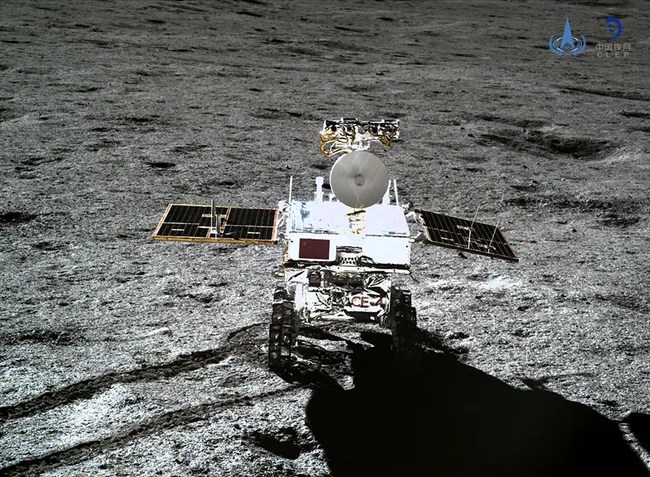
Image (Credit): China’s Yutu 2 rover, as seen by the Chang’e 4 lander, both of which landed on the lunar surface in January 2019. (CNSA)

“If the space agency holds to its notion of flying the Artemis II crew on a looping journey around the far side of the moon late next year, and landing the Artemis III crew in the south polar region in 2026 or 2027, the next boot prints on the moon will indeed be American. But don’t count on it.”

-Statement in a Time magazine article titled, “Why China Might Beat the U.S. Back to the Moon.” The article cites NASA’s delays and budget shortfall related to the Artemis mission. Interestingly, the article notes that the U.S. might have lacked the discipline to return to the Moon if China did not have similar plans. Finally, one key point to remember is that the U.S. beat the Chinese to the Moon by more than 50 years, so this is not really the same as the earlier space race with Russia. As a result, China is taking its time to do it right. We may need to keep that in mind as we face our own struggles.