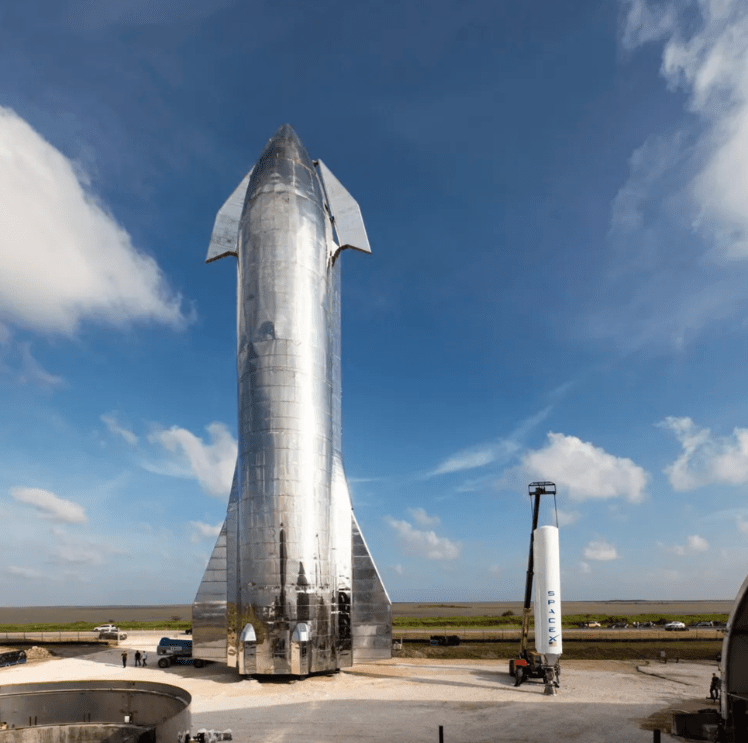
Image (Credit): Image from 2019 showing the SpaceX’s Starship prototype (left) next to a Falcon 1 rocket. (SpaceX)
Elon Musk is eager to get his Starship launches back on track, but the 10th launch scheduled for yesterday had to be scrubbed due to “ground system” issues. The launched was pushed by a day or two.
The most recent reminder of the difficulties getting this rocket into orbit came in June, when a pre-flight engine test ended in an explosion.
Even with all of the acrimony between Musk and President Trump, NASA and the White House are depending on the Starship rocket to make the Artemis program a reality.
Like him or not, the US space program’s success is locked in with Musk’s company at the moment.
We can only hope for a successful test.
Update: The launch was scheduled for late Monday, August 25th, but cancelled again, this time due to the weather.
Blue Origin is gearing up for the second-ever launch of its powerful New Glenn rocket, which will loft NASA’s ESCAPADE mission to Mars. The company says it has been working closely with NASA on preparations leading up to New Glenn’s next launch, dubbed NG-2, and is targeting no earlier than (NET) Sep. 29. The twin ESCAPADE (Escape and Plasma Acceleration and Dynamics Explorers) probes have been awaiting their turn aboard New Glenn, which was originally slated to carry the satellites on its maiden launch in January. However, NASA opted not to risk a costly mission delay due to the debut liftoff of the new rocket.
NASA, which is committing to a new era of human spaceflight with its Artemis mission, is working with Google to test a proof of concept for Crew Medical Officer Digital Assistant (CMO‑DA), a type of Clinical Decision Support System (CDSS). This has been created to allow astronauts to diagnose and treat symptoms when no doctor is available or communications to Earth are blacked out. “Trained on spaceflight literature, the AI system uses cutting-edge natural language processing and machine learning techniques to safely provide real-time analyses of crew health and performance,” Google representatives said in a statement.
In the spring of 2022 the U.S. space community selected its top priority for the nation’s next decade of science and exploration: a mission to Uranus, the gassy, bluish planet only seen up close during a brief spacecraft flyby in 1986. More than 2.6 billion kilometers from Earth at its nearest approach, Uranus still beckons with what it could reveal about the solar system’s early history—and the overwhelming numbers of Uranus-sized worlds that astronomers have spied around other stars. Now President Donald Trump’s proposed cuts to NASA could push those discoveries further away than ever—not by directly canceling the mission but by abandoning the fuel needed to pull it off.
The above image is one of 24 winning posters designed by students at the School of Visual Arts (SVA) in New York City. The contest, sponsored by SVA and NASA, is called The Artemis II/Earthrise Poster Project.
All of the posters will be on display next month at the SVA Gramercy Gallery located at 209 East 23rd Street, 1st floor, New York, NY 10010.
You can learn more about the event and view more of these creative posters at this link.
Image (Credit): International partners empowering NASA’s mission on Mars. (US Embassy & Consulates in Italy)
While spreading out the manned missions to the International Space Station (ISS) among various private sector partners sounded like a great idea, it has proven less than perfect. First we had to worry about the emotional stability of SpaceX’s CEO, and now we need to worry about the financial viability of Boeing, the only other company on a path to bring astronauts to the ISS.
…faced challenges including labor actions, production delays, quality control problems, and financial losses on government contracts. Given Boeing’s importance to the defense industrial base, Congress may assess whether or not these developments have implications for U.S. national security…Some analysts have speculated that Boeing could declare bankruptcy or seek to sell elements of its space or defense business.
One of the author’s suggestions is for the US government to expand its contracting efforts with “trusted international companies.” While the article is focused on the defense realm, it sounds like a good idea for the space realm as well.
The major US space goals already include our trusted international partners, such as the ISS, Artemis and Mars programs, so none of this much of a stretch. Maybe it just needs to be more of the focus as the current US firms show their vulnerabilities when poorly managed. I would add to this list the need to offer greater support to other, newer US-based space companies to further diversity the workload.
This may not be a time to call for greater international coordination led by NASA when the agency is also showing its vulnerabilities when poorly managed, yet we need to plan for future days when the craziness dies down. In the meantime, as Europe prepares for NASA cuts to joint programs, we have a lot of convincing to do if we want a deeper international space industry.
A new administrator for NASA may help, as well as a Congress that does its job and protects the future of our space programs.
I don’t care if you call it “Make the Moon the Goal Again.” Just get started.
A second “new star” has unexpectedly appeared in the night sky, less than two weeks after a near-identical point of light first burst into view without warning. The first nova, dubbed V462 Lupi, was initially spotted June 12 shining in the Lupus constellation, after its progenitor star suddenly became more than 3 million times brighter than normal. Then, on June 25, multiple astronomers detected another nova, dubbed V572 Velorum, within the Vela constellation, according to EarthSky.org. Astronomers normally expect to see a classical nova once a year at most, and more than one of these explosions shining simultaneously is almost unheard of.
Legacy aerospace giants scored a win Tuesday when the U.S. Senate passed President Trump’s budget reconciliation bill that earmarks billions more for NASA’s flagship Artemis program. The $10 billion addition to the Artemis architecture, which includes funding for additional Space Launch System rockets and an orbiting station around the moon called Gateway, is a rebuke to critics who wished to see alternative technologies used instead. Among those critics are SpaceX CEO Elon Musk and billionaire entrepreneur Jared Isaacman, who Musk proposed as the next NASA administrator.
NASA has extended recovery efforts for its stricken Lunar Trailblazer spacecraft to mid-July, but is warning that if the probe remains silent, the mission could end. Contact with the small satellite was lost the day after its launch on February 26. Controllers were initially able to receive engineering data from the vehicle, but the telemetry indicated power system issues, and the spacecraft eventually fell silent.