“You don’t go from one uncrewed launch of SLS [Artemis I], wait three years, go around the Moon [Artemis II], wait three years and land on it…I would certainly much rather have the astronauts testing out the integrated systems of the lander and Orion in low-Earth orbit than on the Moon.”
-Statement by NASA Administrator Jared Isaacman regarding the addition of one more Artemis mission – let’s call it Artemis III-A – to test out the lunar lander before the crew actually heads to the Moon – or Artemis III-B. The Moon landing itself is still planned for 2028, but we know how these dates continue to slip. SpaceX with its Starship issues is not making it any easier. Just like SpaceX saved the Starliner crew from a problem Boeing capsule, Blue Origin may eventually save the Artemis astronauts from a problem SpaceX rocket.
Note: Actually, I think it will just be an uncrewed Artemis III mission followed by the first Moon landing as Artemis IV, but for some reason I think we will be adding even more Roman numerals before we hit the Moon. Maybe we will get to X, Musk’s favorite letter, before we approach the Moon.
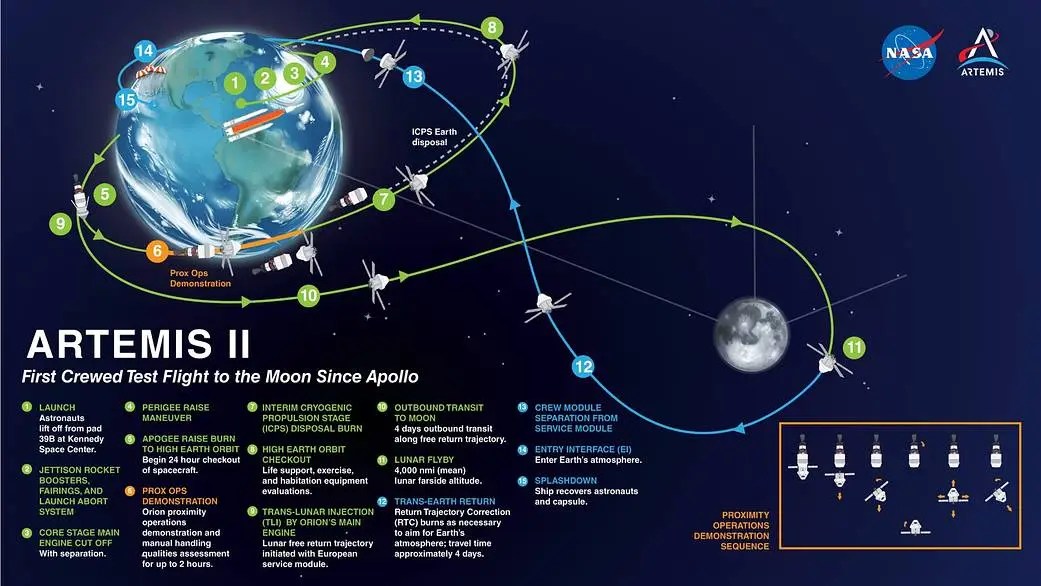
Just one day after NASA said it was eyeing a potential March 6 launch date for the Artemis II lunar mission, the space agency said Saturday that complications with the rocket could delay all launch attempts in March from the Kennedy Space Center in Florida...In a blog post, NASA said it is “taking steps to potentially roll back the Artemis II rocket and Orion spacecraft to the Vehicle Assembly Building,” after technicians observed an “interrupted flow of helium” to the rocket system. NASA says its teams are “actively reviewing data” and taking steps to “address the issue as soon as possible while engineers determine the best path forward.”
On Thursday, NASA released sobering results from an independent investigation into the 2024 crewed Boeing Starliner test flight that left two astronauts stranded in space for months, placing blame not only on hardware failures, but the agency’s own leadership and culture. In a press conference, NASA Administrator Jared Isaacman said the agency had now categorized the incident as a type A mishap — the same classification applied to the Columbia and Challenger shuttle disasters — something he believes should have happened from the start.
For the first time, an international team of astronomers have mapped the vertical structure of Uranus’s upper atmosphere, uncovering how temperature and charged particles vary with height across the planet. Using NASA/ESA/CSA James Webb Space Telescope’s NIRSpec instrument, the team observed Uranus for nearly a full rotation, detecting the faint glow from molecules high above the clouds. The results offer a new window into how ice-giant planets distribute energy in their upper layers.
The latest Harper’s Index from Harper’s magazine had a few interesting statistics related to space travel and alien encounters (something discussed in Friday’s post).
Here are the two stastistics:
Portion of Americans in 1998 who believed that space travel would be common for ordinary Americans by 2025: 3/10
Portion of Americans in 1998 who believed that humans would make contact with extraterrestrial life by 2025: 1/4
Both come from a Gallup poll conducted back in 1998. You can read more about the various survey results in this Gallup story.
Given that the Artemis II mission is still struggling to get to the Moon, and the only new life we seem to have encountered was created in a laboratory by OpenAI and others, I would say we are far from this mark. However, Americans were a little better at predicting some of the social trends, including the 69 percent who expected the country would elect a Black president by 2025.
It is also good that some of the predictions were off, particularly those related to disease, disaster, and war (shown below). Then again, the respondents (76 percent) who predicted the emergence of a deadly new disease were spot on regarding COVID.
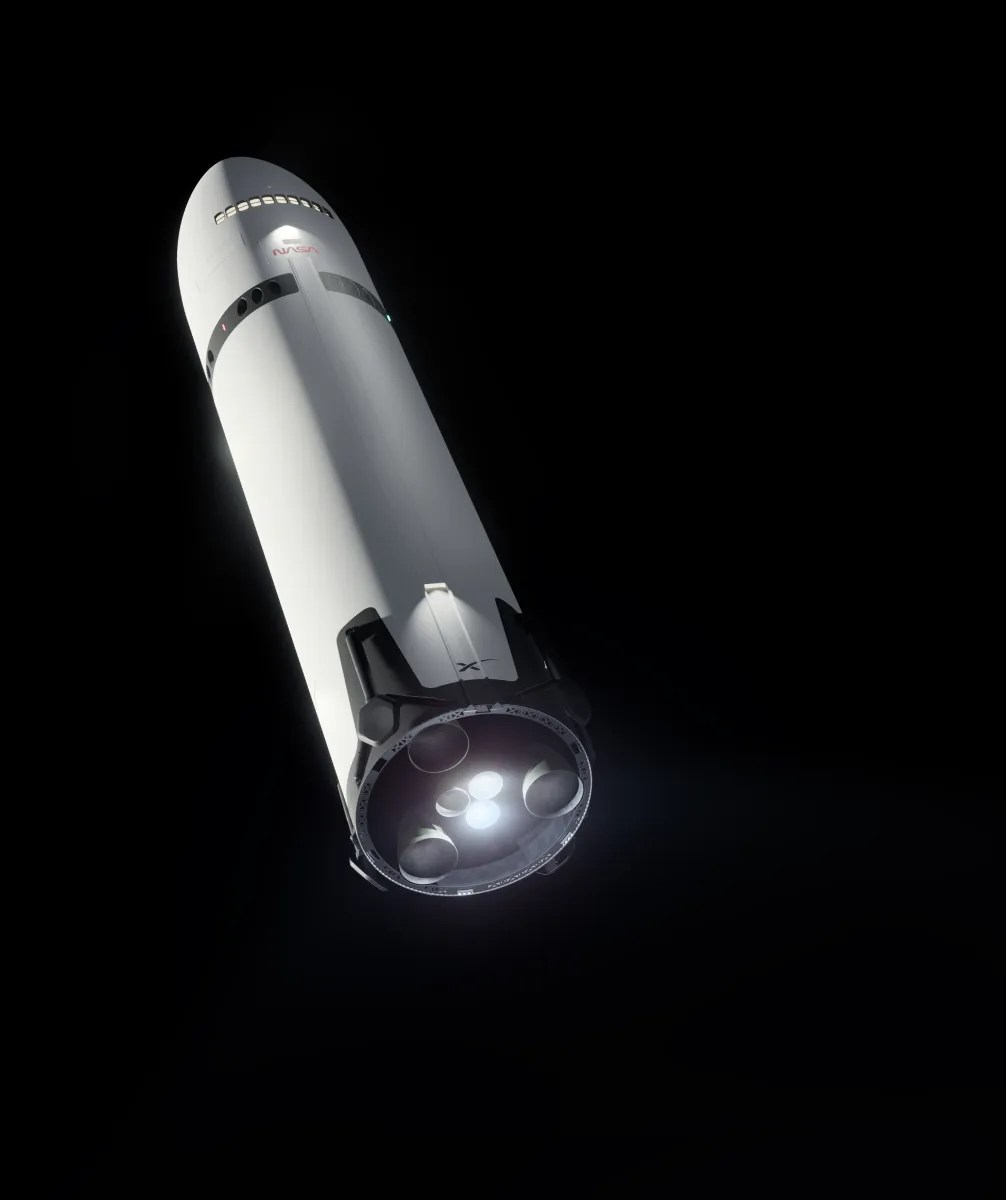
Image (Credit): Artist’s rendering of SpaceX’s Starship HLS preparing for a Moon landing. (SpaceX)
Mr. Musk seems to move like a weather vane regarding where SpaceX is going next, but whether SpaceX is heading for the Moon or Mars it still needs a functioning Starship.
First the confusion. For all of Musk’s ongoing criticism of a Moon mission, it appears he is finally focusing on Artemis III. On Sunday, he tweeted:
For those unaware, SpaceX has already shifted focus to building a self-growing city on the Moon, as we can potentially achieve that in less than 10 years, whereas Mars would take 20+ years.
The mission of SpaceX remains the same: extend consciousness and life as we know it to the stars.
It is only possible to travel to Mars when the planets align every 26 months (six month trip time), whereas we can launch to the Moon every 10 days (2 day trip time). This means we can iterate much faster to complete a Moon city than a Mars city.
That said, SpaceX will also strive to build a Mars city and begin doing so in about 5 to 7 years, but the overriding priority is securing the future of civilization and the Moon is faster.
It seems that someone explained planetary alignment to him over the weekend, but that’s a point for another day.
So the target this week will be the Moon. But a crewed landing on the Moon depends on SpaceX’s Human Landing System (HLS) at the moment, which is where the Starship comes in. Or, more to the point, this is where a multitude of Starships come into play between the refueling in orbit as well and the HLS.
Given that SpaceX planned for 25 Starship launches in 2025 yet achieved only 5, we have an issue Houston (or should I say “Starbase”?).
All indications are that the first launch in 2026 will be early next month (based on one sentence from Musk on January 26th stating “Starship launch in six weeks”), following the last launch of October 13th. Five months between launches is not a very robust schedule given that the Starship not only needs to work but also needs to test the idea of fueling in space before landing a crew on the Moon in 2028.
So far the only parts of Artemis that have proven to work are the Space Launch System and Orion capsule, which are also the two most demonized components said to be substandard based on what the private sector can provide. However, waiting on SpaceX for a workable Moon model is becoming about as logical as waiting for Twitter to become profitable.
Remember, Musk was supposed to have a crew on Mars two years ago. As the Planetary Society noted in 2017:
SpaceX’s previous plan called for landing its first transport ship on Mars in 2022. The timeline Musk gave today was similar; two cargo landers would land on Mars in 2022, with four vehicles launching in 2024. Two of those 2024 ships would be crewed, meaning, in Musk’s timeline, humans could walk on Mars in just seven years.
It now seems like 50/50 that SpaceX can get a crew on the Moon before the Chinese. NASA may need the help of Blue Origin before it has a workable plan.
It may be time to ignore SpaceX’s promises and plan for some new players without tossing out the older technology just yet.
Apple’s iPhone may be one of the most popular phones on Earth, but it’s about to start conquering space as well. According to NASA administrator Jared Isaacman, NASA astronauts are now cleared to take smartphones into space, starting with the SpaceX Crew-12 and Artemis II missions. “We are giving our crews the tools to capture special moments for their families and share inspiring images and video with the world,” he wrote in a tweet.
AES Andes has announced that it will abandon plans to build the INNA industrial complex in Chile’s Atacama Desert. The implementation of this project could jeopardize astronomical observations…On January 23, AES Andes announced that it had decided to discontinue INNA in order to focus on its renewable energy portfolio. “When the cancellation is confirmed, we’ll be relieved that the INNA industrial complex will not be built near Paranal,” said ESO Director General Xavier Barcons. “Due to its planned location, the project would pose a major threat to the darkest and clearest skies on Earth and to the performance of the most advanced astronomical facilities anywhere in the world.”
The current image of Mars as an arid and hostile desert contrasts sharply with the history revealed by its surface. Channels, minerals altered by water, and other geological traces indicate that the Red Planet was, in its early days, a much wetter and more dynamic world. Reconstructing how this water-rich environment disappeared remains one of the great challenges of planetary science. Although several processes are known that can explain some of this loss, the fate of much of Martian water remains a mystery.A new study from an international team of researchers published in Communications: Earth & Environment on February 2, 2026, has brought us a significant step closer to solving this puzzle. For the first time, researchers demonstrated that an anomalous, intense, but localized dust storm was able to drive the transport of water to the upper layers of the Martian atmosphere during the Northern Hemisphere summer – a time when this process was previously considered to be irrelevant.





 Our Awesome Universe