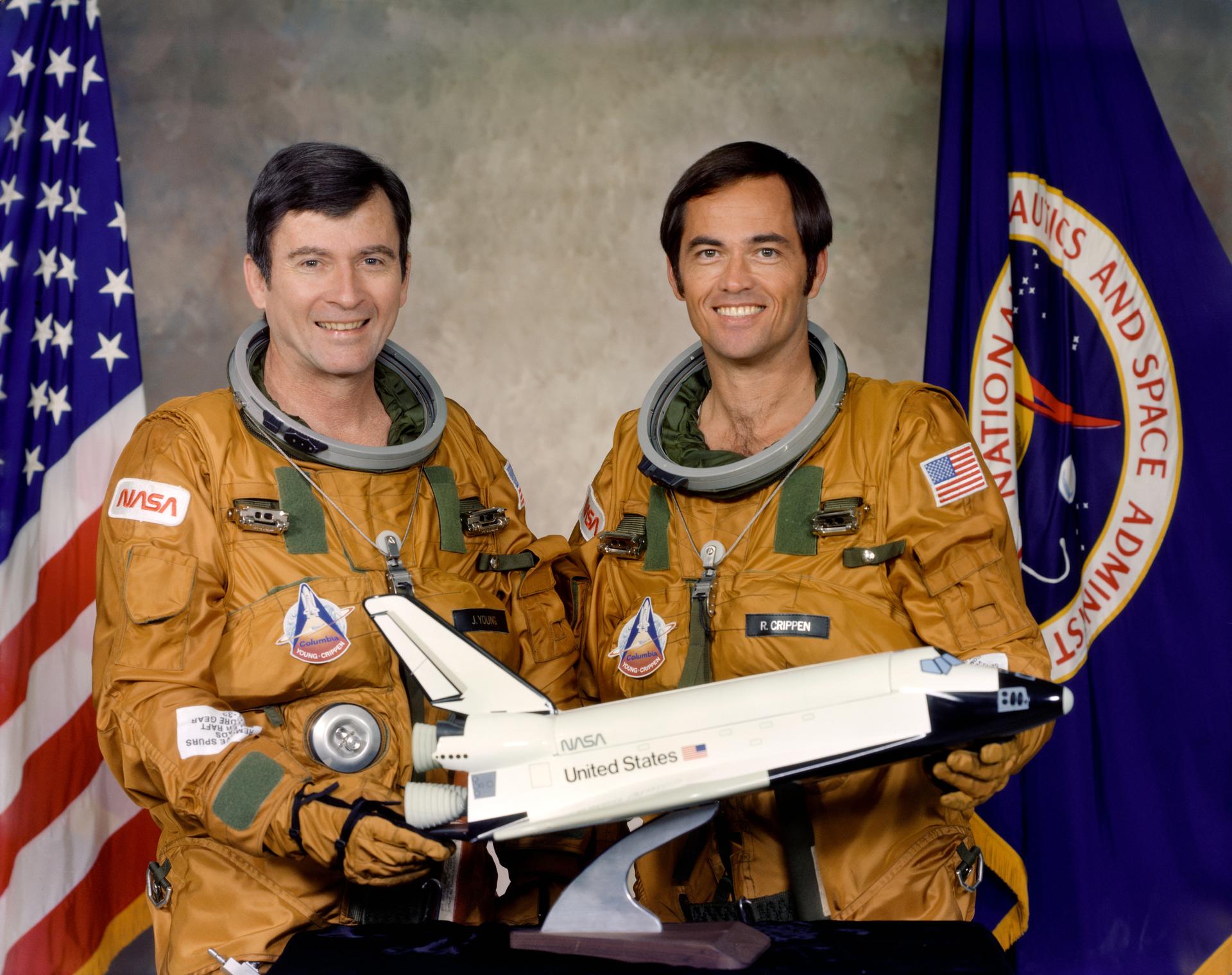
Image (Credit): The first two space shuttle passengers – astronauts John W. Young, left, commander, and Robert L. Crippen, pilot, who flew on the space shuttle orbiter 102 Columbia for the first orbital flight test. (NASA)
On this day in 2011, NASA ended the space shuttle program after 30 years. The space shuttles took 852 passengers on 135 missions. The passengers included astronauts from the U.S. and 60 different countries.
The first space shuttle flight was on April 12, 1981 when Columbia launched from NASA’s Kennedy Space Center in Florida. It was only a two day mission to test whether the shuttle system would work, but it set the stage for the 134 flights that followed.
Commenting later on NASA’s Artemis program, Mr. Crippen stated:
We do need to get out of Earth orbit. We need to go back to the Moon. It is the right thing to do. We need to learn to live and work off this planet. There are still some great things we can do on the Moon. And then, eventually fly on to Mars.
Go to this link for more about this first space shuttle mission.
Image (Credit):Mission patch for first space shuttle flight. (NASA)
Image (Credit): The crew of the latest mission to China’s Tiangong space station – the Shenzhou 23 mission. (CMSA/CCTV)
“Well, I would just say, first, it’s not arguably like there- we are very much in a space race right now, and the Chinese are moving at incredible speeds, and they are certainly capable of doing what the Soviets were not during the- the first space race. The Chinese will land their taikonauts on the moon. There’s no question. The question is, will the United States return before them, and will we do so in a different way this time, when we build a base, establish that enduring presence? I think the answer is yes.“
-Statement by NASA Administrator Jared Isaacman on CBS’s Face the Nation this past Sunday. The interview addresses other issues in addition to the Artemis mission to the Moon, including efforts to save the Swift space telescope as well as the status of Blue Origin’s efforts to recover from the recent explosion of its New Glenn rocket.
Image (Credit): The PROMISE rover, as shown at a recent “NASA Moon Base Update” press conference. (NASA)
It seems NASA is looking for some shortcuts to get back on the Moon, including repurposing an earlier rover designed for Mars. The rover in question is called the Polar Rover for Observation, Mapping and In-Situ Exploration, or simply PROMISE. It is the test model for the Perseverance and Curiosity rovers currently exploring Mars.
One of the advantages of the Mars rover is its power source. Instead of relying on solar panels, the rover is powered by a nuclear battery. This will give it greater range on the Moon’s surface without having to wait for lunar daylight. Another advantage is that it is proven technology, as the two Martian rovers have demonstrated for years.
It sounds like a smart way to take something off the shelf, but one can only wonder why this is only being considered now after NASA spent more than $450 million on the Volatiles Investigating Polar Exploration Rover (VIPER) project. Was a nuclear battery ever considered for VIPER? These Martian rovers have been around for quite some time, and a nuclear reactor has been discussed as part of the Moon Base itself, so this is not a new idea.
Given this change in plans, one might expect that the contract with Blue Origin to bring the VIPER to the Moon in 2027 is no longer needed. Maybe VIPER will put on a shelf for years like PROMISE until someone comes up with a new purpose for it.
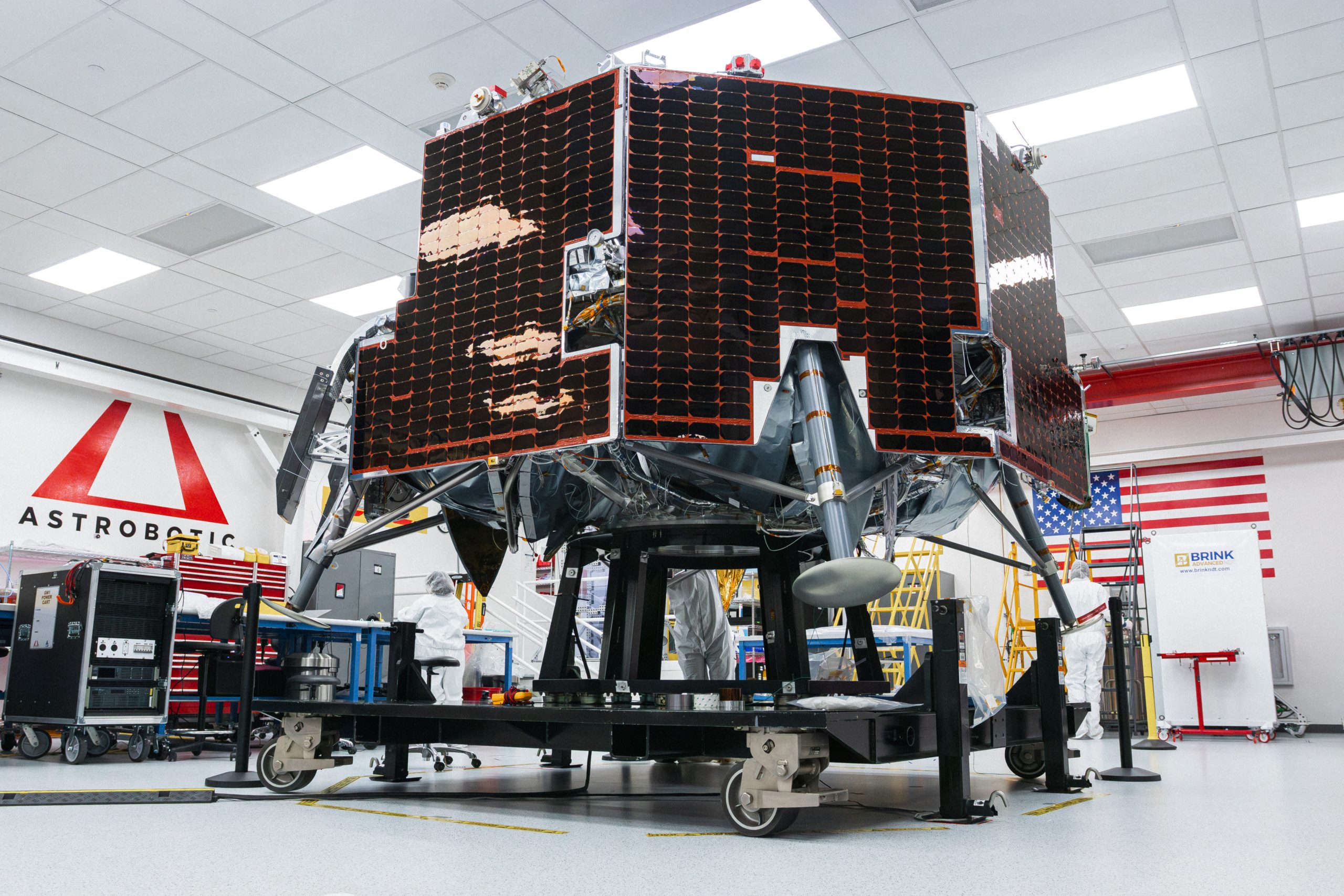
Emerging as a powerful symbol of regional industrial pride and the rapid privatization of deep-space logistics, Astrobotic Technology has officially unveiled its massive Griffin-1 lunar lander. The vehicle, which has been formally designated by NASA as the primary infrastructure vehicle for the Moon Base II task order under the Commercial Lunar Payload Services (CLPS) program, represents a critical stepping stone toward establishing a permanent, self-sustaining human presence on the lunar surface. Unlike smaller, first-generation commercial scouts, the Griffin platform is an “infrastructure-class” logistics vehicle engineered to transport heavy industrial cargo. Boasting a massive 625 to 650-kilogram payload capacity, the stout aluminum isogrid lander is designed to ferry bulky machinery, scientific sensor arrays, and alternative energy installations directly to the rugged, hazardous terrain of the lunar south pole.
Caltech has approved the final design for the Deep Synoptic Array, a $200 million radio telescope project that will blanket a chunk of desert with 1,650 dishes over roughly 120 square miles—an array designed to scan the sky about 100 times faster than any existing telescope. Backed in part by Schmidt Sciences, the philanthropic effort of former Google CEO Eric Schmidt and his wife Wendy, the project is slated to be finished by 2029 and will be powered by a supercomputer that turns torrents of radio signals into sharp images on the fly.
Astronomers using W. M. Keck Observatory on Maunakea, Hawaiʻi Island, have discovered the third known galaxy apparently lacking dark matter, part of a strange linear structure that may have formed during a violent collision between galaxies.The discovery strengthens evidence for a rare and previously unseen process in which ordinary matter becomes separated from dark matter, offering astronomers a powerful new way to study one of the universe’s greatest mysteries.
“The office gets what it needs when it needs it, and we’ll certainly have all these other people that you mentioned, you know, female military test pilots or just other female astronauts, that’ll be picking up on the follow-on Artemis missions.”
-Statement by Artemis III mission commander Randy Bresnik, as quoted by CBS News. He was noting NASA’s diversity of personnel that is ready for the various missions after some criticized NASA for not having a female astronaut among the Artemis III crew. NASA Administrator Jared Isaacman also noted his work with women throughout his career, adding in the same news story that:
The last astronaut candidate class selected under this administration was majority female [six women and four men] because they were the best of the best, including one astronaut [Anna Menon] I previously went to space with.
Note: It is worth mentioning that in March 2025 NASA eliminated from its webpage its earlier pledge to land the “the first woman, first person of color” on the lunar service as part of Artemis III mission. The removal was said to be related to an anti-DEI Executive Order. Of course, we are now dealing with a different Artemis III, with the Artemis IV mission now scheduled to be the first to land a crew on the Moon.