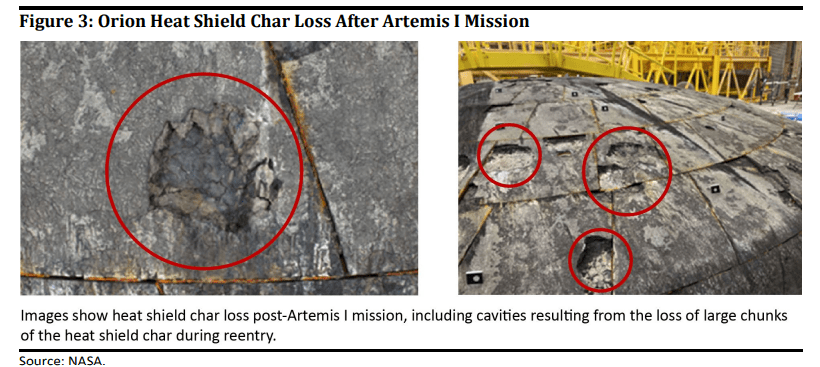
Credit: Taken from a 2024 NASA Office of the Inspector General report – NASA’s Readiness for the Artemis II Crewed Mission to Lunar Orbit (IG-24-011)
“What they’re talking about doing is crazy…We could have solved this problem way back when…Instead, they keep kicking the can down the road.”
-Statement by former astronaut Charlie Camarda, who does not believe the upcoming Artemis II mission is safe for the astronauts given his concerns about the Orion’s heat shield, as quoted by CNN. The news story cites others who state that the Orion heat shield issue has been resolved and the mission is ready to go. The Artemis II mission is set to launch as early as February 6th.
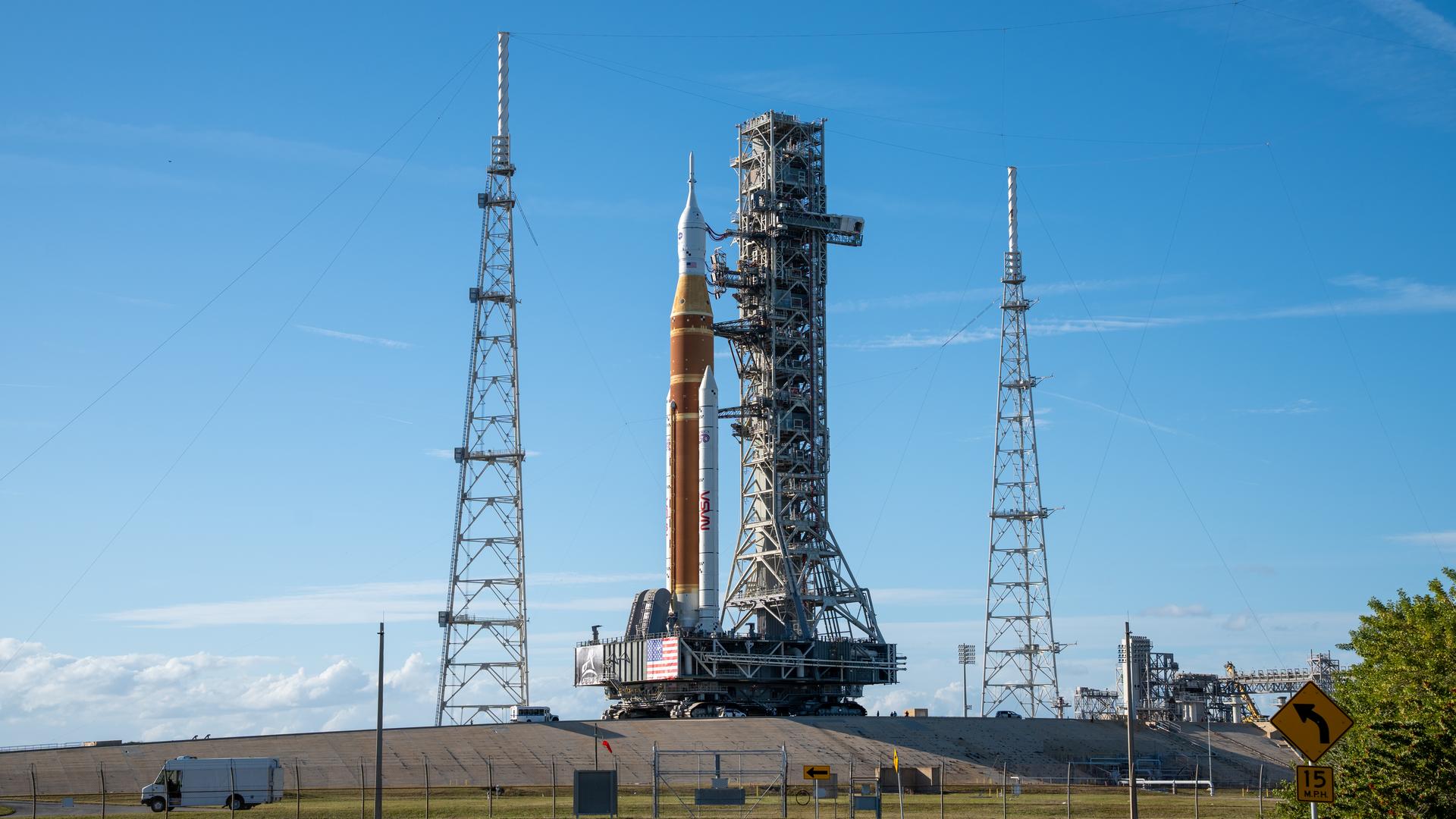
Image (Credit): NASA’s SLS and Orion spacecraft moving from the Vehicle Assembly Building to Launch Pad 39B at the Kennedy Space Center. (NASA)
This week’s image shows NASA’s Space Launch System (SLS) and Orion spacecraft making its way from the Kennedy Space Center’s Vehicle Assembly Building to Launch Pad 39B via the crawler-transporter. All of this is in preparation for the Artemis II mission, which will take four astronauts around the Moon. The flight could launch as early as February 6th.
NASA has reported that the Artemis II mission will include various items to mark the 250th anniversary of the United States, including:
a 1-inch by-1-inch swatch of muslin fabric from the original Wright Flyer the Wright Brothers used to make the first powered flight in 1903;
a 13-by-8-inch American flag, which flew with the first shuttle mission, STS-1, the final shuttle mission, STS-135, and NASA’s first crewed test flight of SpaceX’s Crew Dragon spacecraft, SpaceX Demo-2;
a flag that was set to fly on NASA’s Apollo 18 mission is included in the flight kit and will make its premiere flight with Orion;
a 4-by-5-inch negative of a photo from the Ranger 7 mission, the first U.S. mission to successfully make contact with the lunar surface;
soil samples collected from the base of established Artemis I Moon Trees planted at NASA’s 10 centers;
an SD card including the millions of names of those who participated in the “Send Your Name to Space” campaign, bringing the public along on this journey; and
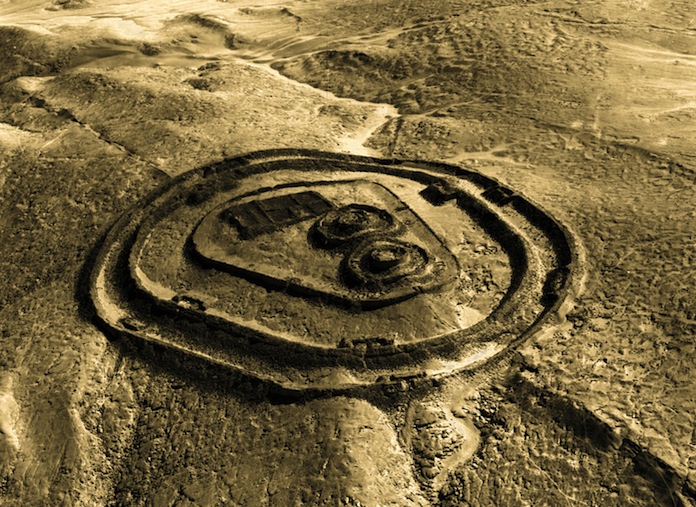
There was a time when Stonehenge was believed to be a kind of “Neolithic computer.” Archaeology has since corrected that misconception. Today, the evidence points strongly in another direction: to an arid hill in the Casma Valley on Peru’s northern coast, about 200 miles north of Lima.There stands Chankillo, a complex built around 250 B.C.E., considered the earliest known solar observatory in the Americas and the clearest known example of a monument designed to track the sun’s position throughout the entire year, according to a study in Science. Modest in appearance and largely absent from tourist posters and classic postcards, Chankillo has renewed attention as archaeologists report preliminary findings from ongoing excavations.
With a space station medical evacuation safely completed, NASA is focused on two challenging missions proceeding in parallel: launching four astronauts on a flight around the moon, at the same time as the agency is planning to send four replacement astronauts to the International Space Station...The Artemis 2 mission and Crew 12’s planned space station flight present a unique challenge for NASA. The agency has not managed two piloted spacecraft at the same time since a pair of two-man Gemini capsules tested rendezvous procedures in low-Earth orbit in 1965. The agency has never flown a deep space mission amid another launch to Earth orbit.
One of the most vivid portraits of “reborn” black hole activity – likened to the eruption of a “cosmic volcano” spreading almost one million light-years across space – has been captured in a gigantic radio galaxy. The dramatic scene was uncovered when astronomers spotted the supermassive black hole at the heart of J1007+3540 restarting its jet emission after nearly 100 million years of silence.
Note: Please ignore the previous posting for today about the Apollo 17 mission. It’s a good story, but I will need to retell it at another time (that is, on December 19th).
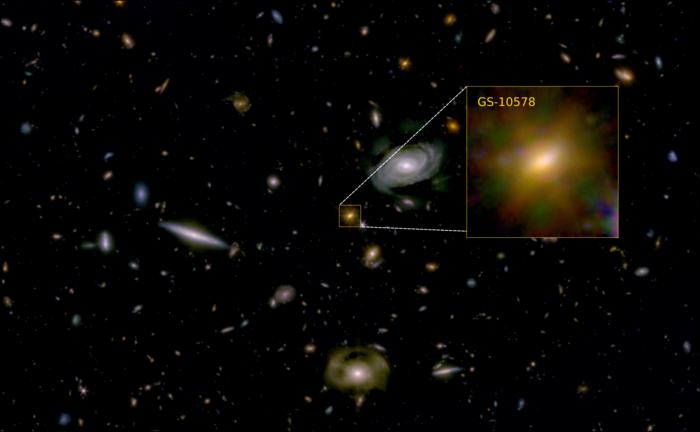
Using observations from the James Webb Space Telescope (JWST) and the Atacama Large Millimeter Array (ALMA), researchers found that a growing supermassive black hole can slowly starve a galaxy rather than destroy it outright.The galaxy, catalogued as GS-10578 and nicknamed Pablo’s Galaxy, existed just three billion years after the Big Bang. Despite this early stage in cosmic history, it is enormous – around 200 billion times the mass of the Sun. Most of its stars formed between 12.5 and 11.5 billion years ago, indicating a rapid burst of star formation before the galaxy suddenly shut down.
Astronomers may have discovered a previously unknown type of astronomical object, nicknamed “Cloud-9,” that could shed light on dark matter, one of the biggest mysteries in the universe. …Cloud-9 is thought to be a dark matter cloud that could be a remnant of galaxy formation from the early days of the universe, according to new research published Monday in The Astrophysical Journal Letters.
The first crewed moon mission in more than 50 years remains on track to launch as soon as Feb. 6. NASA announced on Friday evening (Jan. 9) that it plans to roll the Space Launch System (SLS) rocket and Orion spacecraft that will fly the Artemis 2 moon mission out to the pad for prelaunch checks on Jan. 17, weather and technical readiness permitting.
In a recent episode of What Next: TBD, titled “Are We Over the Moon?,” the host spoke with Joel Achenbach, freelance journalist and author of an article in Slate called Moondoggle about the upcoming Artemis missions.
The discussion covers the plans for multiple missions to the Moon, the difference in generational interest, and the confusion last year about NASA’s leadership and budget that only brings up more questions.
Overall, Mr. Achenback does not believe the younger generations have much interest in a mission to the Moon. This is a scary statement at a time that NASA is fighting to remain funded and relevant.
It is a podcast (and article) with lessons for NASA’s public relations team, assuming anyone over there is interested.


 Our Awesome Universe