Space Stories: Approaching Lucy, Chinese Space Ambitions, and Conan the Bacterium

Image (Credit): Image from NASA’s Lucy spacecraft showing the Earth and Moon from 890,000 miles away (look closely – the moon on the left is a very pale dot). (NASA/Goddard/SwRI)

Here are some recent stories of interest.

NASA.gov: “NASA’s Lucy Spacecraft Captures Images of Earth, Moon Ahead of Gravity Assist

On October 13, 2022, NASA’s Lucy spacecraft captured [the above] image of the Earth and the Moon from a distance of 890,000 miles (1.4 million km). The image was taken as part of an instrument calibration sequence as the spacecraft approached Earth for its first of three Earth gravity assists. These Earth flybys provide Lucy with the speed required to reach the Trojan asteroids — small bodies that orbit the Sun at the same distance as Jupiter. On its 12 year journey, Lucy will fly by a record breaking number of asteroids and survey their diversity, looking for clues to better understand the formation of the solar system.

SpaceNews.com: “China Considering Mission to Ceres and Large Dark Matter Space Telescope

The Chinese Academy of Sciences is considering potential missions including a Ceres orbiter and a huge telescope to hunt for clues about the nature of dark matter. More than 20 candidates are vying for funding for further study under the Chinese Academy of Sciences Strategic Priority Program on Space Science, also known as the New Horizon Program, and are currently undergoing evaluation.

Space.com: “Extremophiles on Mars Could Survive for Hundreds of Millions of Years

One of Earth’s toughest microbes could survive on Mars, lying dormant beneath the surface, for 280 million years, new research has shown. The findings increase the probability that microbial life could still exist on the Red Planet. Deinococcus radiodurans, nicknamed “Conan the Bacterium,” is one of the world’s toughest microbes, capable of surviving in radiation strong enough to kill any other known life-form. Experiments have now shown that if Conan the Bacterium or a similar microbe existed on Mars, it could survive 33 feet (10 meters) beneath the surface, frozen and dried out, for 280 million years.

Space Stories: Volcanic Exoplanets, Medieval Star Maps, and Near-Earth Asteroids

Image (Credit): The lava lake that sits atop Mount Nyiragongo in the Democratic Republic of Congo (Stocktrek Images / Richard Roscoe via Getty Images)

Here are some recent stories of interest.

Universe.com: “Scientists Discover a New Way Exoplanets Could Make Oxygen; Unfortunately, it Doesn’t Require Life

The researchers have found an abiotic source of oxygen that stems from sulphur dioxide. Sulphur is not rare in celestial bodies, and since volcanoes produce sulphur and pump it into the atmosphere, terrestrial volcanic exoplanets may have oxygen in their atmospheres. And life needn’t be involved.

Nature.com: “First Known Map of Night Sky Found Hidden in Medieval Parchment

A medieval parchment from a monastery in Egypt has yielded a surprising treasure. Hidden beneath Christian texts, scholars have discovered what seems to be part of the long-lost star catalogue of the astronomer Hipparchus — believed to be the earliest known attempt to map the entire sky.

Phys.org: “30,000 Near-Earth Asteroids Discovered, and Numbers are Rising

We have now discovered 30,039 near-Earth asteroids in the solar system—rocky bodies orbiting the sun on a path that brings them close to Earth’s orbit. The majority of these were discovered in the last decade, showing how our ability to detect potentially risky asteroids is rapidly improving.

NASA Confirms Success of DART Mission

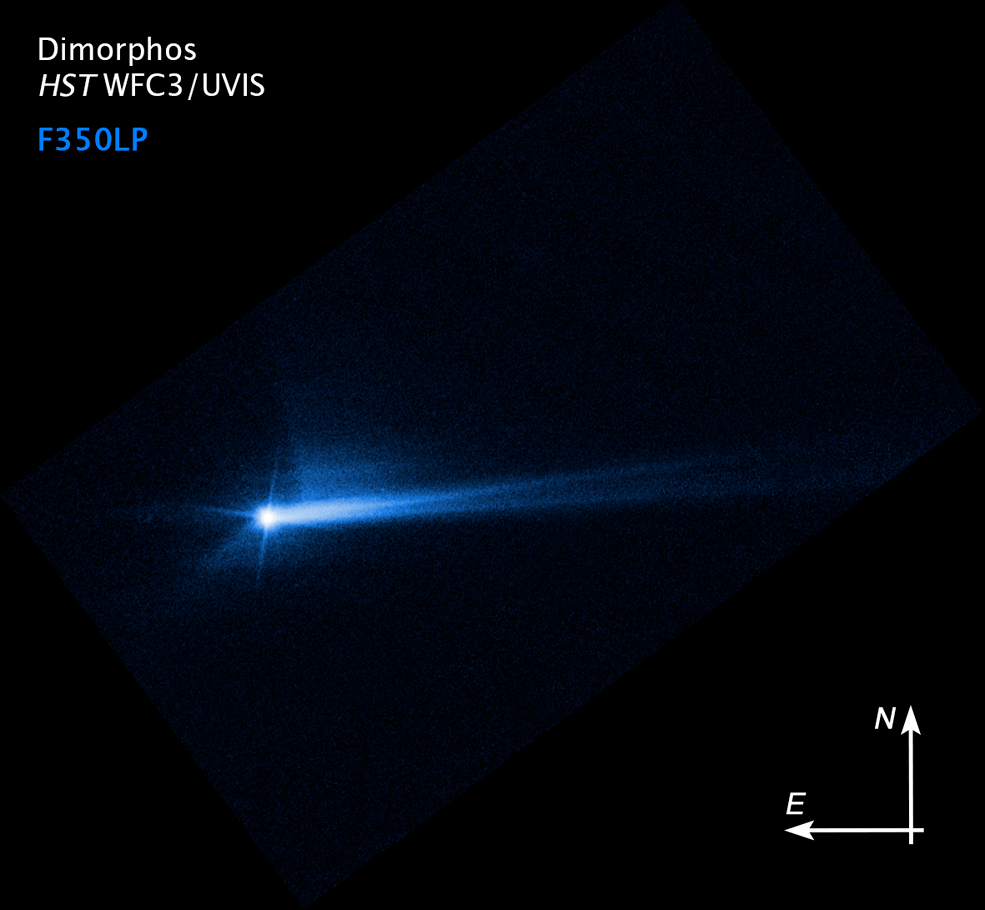
Image (Credit): The image above was taken on October 8, 2022 by NASA’s Hubble Space Telescope. It shows the debris blasted from the surface of Dimorphos 285 hours after the asteroid was intentionally hit by NASA’s DART spacecraft on September 26th. NASA stated that the shape of that tail has changed over time. ( NASA/ESA/STScI/Hubble)

NASA has saved the Earth, or it would have had the asteroid Dimorphos and its partner been heading towards us. That is the news from earlier today from the space agency. NASA’s Administrator Bill Nelson made the following comments regarding the results of the impact by the Double Asteroid Redirection Test (DART) spacecraft:

This mission shows that NASA is trying to be ready for whatever the universe throws at us. NASA has proven we are serious as a defender of the planet. This is a watershed moment for planetary defense and all of humanity, demonstrating commitment from NASA’s exceptional team and partners from around the world.

NASA scientists determined that the orbit of Dimorphos around its parent asteroid, Didymos, was truncated by 32 minutes as a result of the impact. Since minimum success would have been 1 minute 13 seconds, DART was a great success.

Hollywood may prefer a more dramatic method with oil rig astronauts and nuclear bombs, but sometimes a simple nudge will do the job.

Credit: Touchstone Pictures

Hubble: SpaceX to the Rescue

Image (Credit): The Hubble Space Telescope orbiting Earth. (Hubblesite.org)

The Washington Post reports that NASA and SpaceX are looking into the idea of extending the life of the NASA/ESA Hubble Space Telescope, which has already been in service more than 30 years. The space telescope’s orbit has been deteriorating since 2009, when it was last visited for repairs. The current orbit should be okay until the mid-2030s, and then it will fall to Earth.

To keep the Hubble in service for even more years, it would need to be pushed into a higher orbit. This is where SpaceX comes in. It can assist NASA by moving Hubble just 40 miles higher in order to get another 15 to 20 years out of the space telescope.

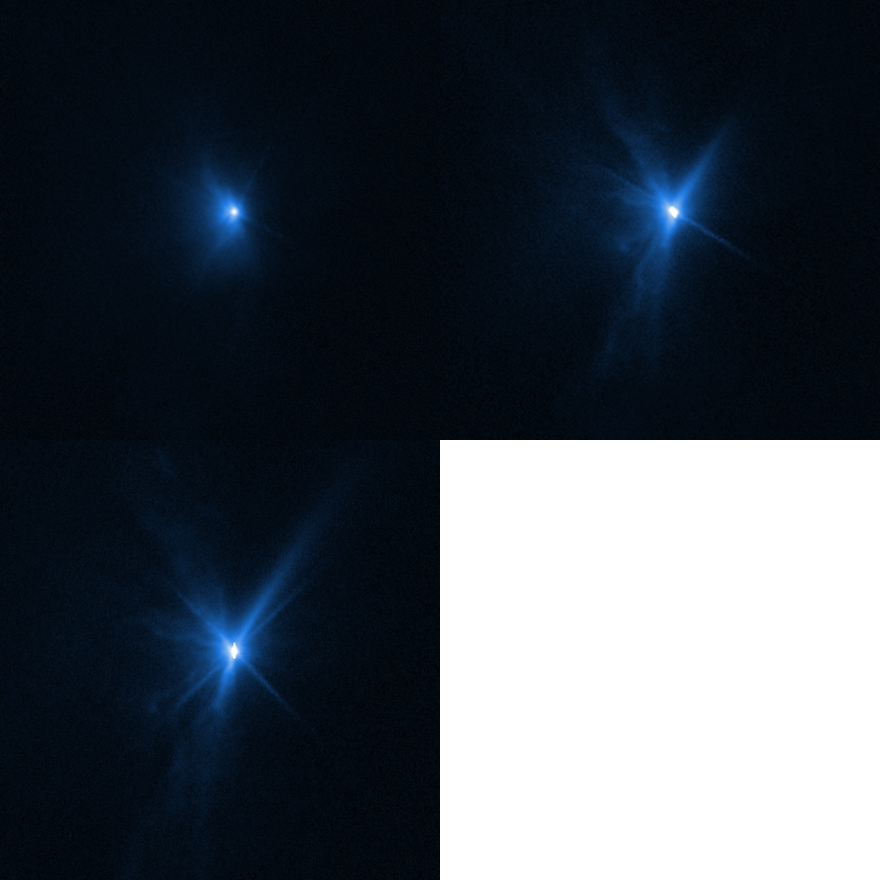
The article notes that the James Webb Space Telescope (JWST) was not developed to replace Hubble but rather to complement it. Hence, the extra life for Hubble means more and better astronomical observations over additional years in conjunction with the JWST. For instance, we will get more shots like the one below where the Hubble captured the Double Asteroid Redirection Test (DART) mission before and after it struck the asteroid.

Update: I have also included the JWST DART image below just to show the two space telescopes can work in tandem.

Image (Credit): This animated GIF combines three of the images NASA’s Hubble Space Telescope captured after NASA’s DART spacecraft intentionally impacted Dimorphos, a moonlet asteroid in the double asteroid system of Didymos. The animation spans from 22 minutes after impact to 8.2 hours after the collision took place. As a result of the impact, the brightness of the Didymos-Dimorphos system increased by 3 times. The brightness also appears to hold fairly steady, even eight hours after impact. (NASA, ESA, Jian-Yang Li (PSI); animation: Alyssa Pagan (STScI))
Image (Credit): This animation gif is a timelapse of images from NASA’s JWST. It covers the time spanning just before impact at 7:14 p.m. EDT, Sept. 26, through 5 hours post-impact. Plumes of material from a compact core appear as wisps streaming away from where the impact took place. An area of rapid, extreme brightening is also visible in the animation. (NASA, ESA, CSA, Cristina Thomas (Northern Arizona University), Ian Wong (NASA-GSFC); Joseph DePasquale (STScI))

DART: Watch the Asteroid Impact

Image (Credit): Artist’s rendering of NASA’s DART spacecraft and the Italian Space Agency’s LICIACube prior to impact at the Didymos binary system. (NASA)

The Americans and Italians are putting on a show tomorrow night. NASA’s Double Asteroid Redirection Test (DART) spacecraft is ready to strike Dimorphos, which is a moonlet to the asteroid Didymos. All of it should be captured by Italy’s Light Italian CubeSat for Imaging Asteroids (LICIACub) in addition to DART’s own camera called the Didymos Reconnaissance and Asteroid Camera for Optical navigation (DRACO). Are you overwhelmed with acronyms yet?

The mission is a practice run on diverting an asteroid. While we are not threatened by this pair of asteroids, we may be threatened by others in the future, so what we learn here is critical.

You can view the impact later tomorrow via this NASA site starting at 6pm ET (the collision is expected at 7:14pm ET).

Extra: Here is another DART site to watch from The Johns Hopkins University Applied Physics Laboratory.

Image (Credit): NASA live broadcast for the DART mission. (NASA)

Update: The mission was a success. The video showing the DART spacecraft approaching the dirty potato called Dimorphos was impressive. The actual moonlet shown below is considerably different than the smooth asteroid in the artist’s rendering above.

Image (Credit): Moonlet Dimorphos as the DART spacecraft approaches. (NASA)