Hubble: SpaceX to the Rescue

Image (Credit): The Hubble Space Telescope orbiting Earth. (Hubblesite.org)

The Washington Post reports that NASA and SpaceX are looking into the idea of extending the life of the NASA/ESA Hubble Space Telescope, which has already been in service more than 30 years. The space telescope’s orbit has been deteriorating since 2009, when it was last visited for repairs. The current orbit should be okay until the mid-2030s, and then it will fall to Earth.

To keep the Hubble in service for even more years, it would need to be pushed into a higher orbit. This is where SpaceX comes in. It can assist NASA by moving Hubble just 40 miles higher in order to get another 15 to 20 years out of the space telescope.

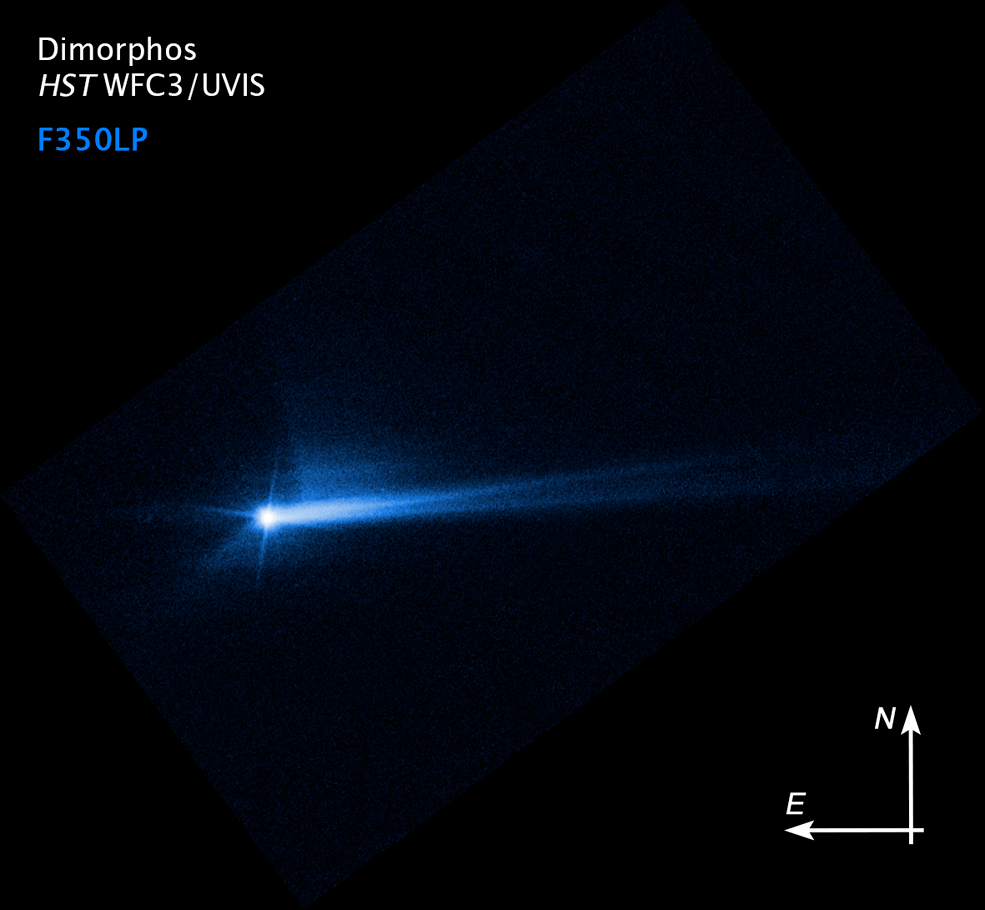
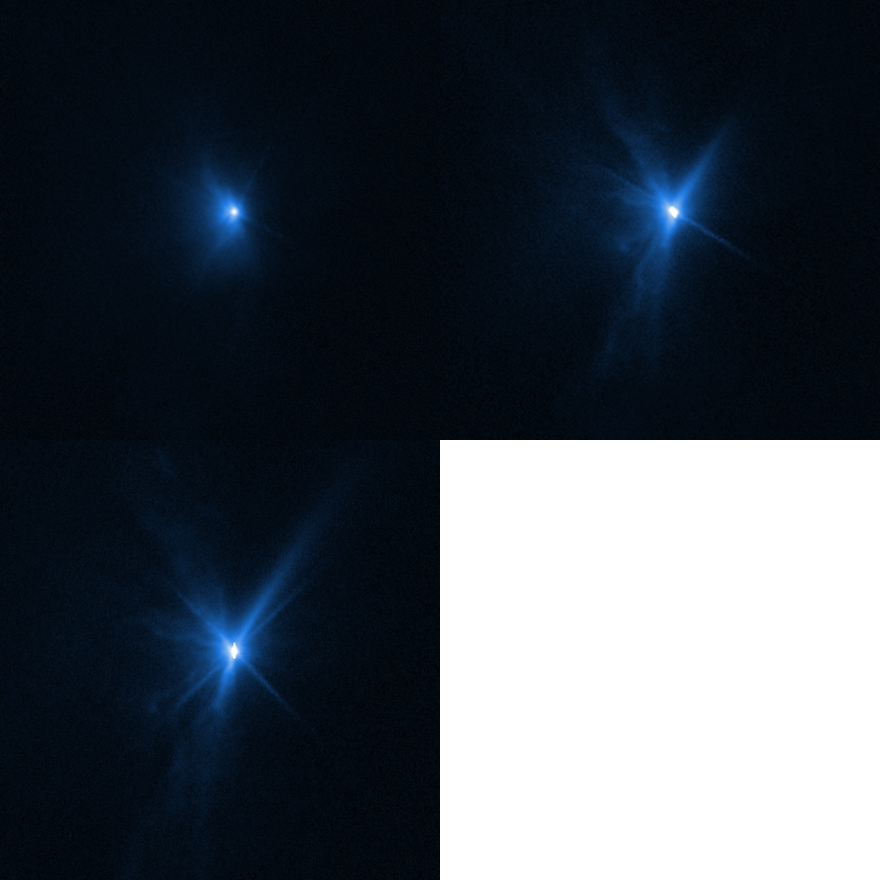
The article notes that the James Webb Space Telescope (JWST) was not developed to replace Hubble but rather to complement it. Hence, the extra life for Hubble means more and better astronomical observations over additional years in conjunction with the JWST. For instance, we will get more shots like the one below where the Hubble captured the Double Asteroid Redirection Test (DART) mission before and after it struck the asteroid.

Update: I have also included the JWST DART image below just to show the two space telescopes can work in tandem.

Image (Credit): This animated GIF combines three of the images NASA’s Hubble Space Telescope captured after NASA’s DART spacecraft intentionally impacted Dimorphos, a moonlet asteroid in the double asteroid system of Didymos. The animation spans from 22 minutes after impact to 8.2 hours after the collision took place. As a result of the impact, the brightness of the Didymos-Dimorphos system increased by 3 times. The brightness also appears to hold fairly steady, even eight hours after impact. (NASA, ESA, Jian-Yang Li (PSI); animation: Alyssa Pagan (STScI))
Image (Credit): This animation gif is a timelapse of images from NASA’s JWST. It covers the time spanning just before impact at 7:14 p.m. EDT, Sept. 26, through 5 hours post-impact. Plumes of material from a compact core appear as wisps streaming away from where the impact took place. An area of rapid, extreme brightening is also visible in the animation. (NASA, ESA, CSA, Cristina Thomas (Northern Arizona University), Ian Wong (NASA-GSFC); Joseph DePasquale (STScI))

DART: Watch the Asteroid Impact

Image (Credit): Artist’s rendering of NASA’s DART spacecraft and the Italian Space Agency’s LICIACube prior to impact at the Didymos binary system. (NASA)

The Americans and Italians are putting on a show tomorrow night. NASA’s Double Asteroid Redirection Test (DART) spacecraft is ready to strike Dimorphos, which is a moonlet to the asteroid Didymos. All of it should be captured by Italy’s Light Italian CubeSat for Imaging Asteroids (LICIACub) in addition to DART’s own camera called the Didymos Reconnaissance and Asteroid Camera for Optical navigation (DRACO). Are you overwhelmed with acronyms yet?

The mission is a practice run on diverting an asteroid. While we are not threatened by this pair of asteroids, we may be threatened by others in the future, so what we learn here is critical.

You can view the impact later tomorrow via this NASA site starting at 6pm ET (the collision is expected at 7:14pm ET).

Extra: Here is another DART site to watch from The Johns Hopkins University Applied Physics Laboratory.

Image (Credit): NASA live broadcast for the DART mission. (NASA)

Update: The mission was a success. The video showing the DART spacecraft approaching the dirty potato called Dimorphos was impressive. The actual moonlet shown below is considerably different than the smooth asteroid in the artist’s rendering above.

Image (Credit): Moonlet Dimorphos as the DART spacecraft approaches. (NASA)

Space Stories: Radioactive Ceres, Moon Clues, and Starlink’s Shine

Here are some recent stories of interest.

SkyandTelescope.org: “Asteroid Ceres Was Radioactive — And That Could Explain a Lot

A team of U.S. planetary scientists has shown that unexpected surface features on the dwarf planet Ceres can be explained by radioactive decay in its interior long ago. If they are right, their model could explain features not just on other dwarf planets, but also on some of the icy moons in the outer solar system.

ScienceDaily.com: “One More Clue to the Moon’s Origin

Researchers discover the first definitive proof that the Moon inherited indigenous noble gases from the Earth’s mantle. The discovery represents a significant piece of the puzzle towards understanding how the Moon and, potentially, the Earth and other celestial bodies were formed.

UniverseToday.com: “Starlink Satellites Are Still Bright

The new generation of Starlink satellites remain above the accepted brightness threshold. It’s one of the stranger sights of the modern Space Age. Recently, we found ourselves under the relatively dark skies of southern Spain. Sure enough, within a few minutes, we caught sight of a chain of flashing ‘stars’ winking in and out of view in quick succession.

More JWST Priorities

Image (Credit): This diagram shows Lucy’s orbital path in green after her October 2021 launch to visit the Trojan asteroids. (Southwest Research Institute)

Last week I noted some of the mission priorities in the James Webb Space Telescope’s (JWST) first year. Those priorities were listed under “Exoplanets and Disks.” I thought I would highlight a few more, this time from the “Solar System Astronomy” list. Here are five more priorities:

  • Pluto’s Climate System with JWST;
  • The Moons of Uranus: A NIRSpec Investigation of Their Origins, Organic Constituents, and Possible Ocean World Activity;
  • A Pure Parallel Survey of Water in the Asteroid Belt;
  • DiSCo-TNOs: Discovering the Composition of the Trans-Neptunian Objects, Icy Embryos for Planet Formation; and
  • JWST Observations of Lucy Mission Targets.

Each of these priorities come with an explanation of the mission. For example, here is a little more about NASA’s Lucy mission from the JWST proposal:

The Lucy spacecraft – to be launched at approximately the same time as JWST – will perform the first ever in situ exploration of the Jupiter Trojan asteroids. Trojans are the largest population of solar system bodies currently unvisited by spacecraft, and revealing their composition and formation history is the key to untangling disparate hypothesis for the early dynamical evolution of the entire solar system.

Understanding these enigmatic bodies requires not just the high spatial resolution imagery and spectroscopy that will be afforded by Lucy, but also the superb near- and mid-infrared spectroscopy of which JWST is uniquely capable. The high signal-to-noise, high spectral resolution, and extended wavelength coverage beyond the capabilities of Lucy will allow JWST to sensitively probe the organic, carbonate, and silicate components of the surfaces of the Trojans. Meanwhile, the Lucy spectra and images will place these observations into their geological and historical context, greatly extending the scientific utility of both the JWST observations and the Lucy visit. Together these observations will paint a rich picture of this population, allowing us to trace connections with other bodies studied remotely and in situ across the solar system.

Lucy was launched last October and is expected to encounter its first Trojan asteroid until August 2027. You can find the full mission timeline here.

Space Quotes: Worry about Asteroids, Not Aliens

Image (Credit): Image of a UFO. (SETI Institute)

“This paper attempts to provide an estimation of the prevalence of hostile extraterrestrial civilizations through an extrapolation of the probability that we, as the human civilization, would attack or invade an inhabited exoplanet once we become a Type-1 civilization in the Kardashev Scale capable of nearby interstellar travel. The estimation is based on the world’s history of invasions in the last century, the military capabilities of the countries involved, and the global growth rate of energy consumption. Upper limits of standard deviations are used in order to obtain the estimated probability of extraterrestrial invasion by a civilization whose planet we send a message to. Results show that such probability is two orders of magnitude lower than the impact probability of a planet-killer asteroid. These findings could serve as a starting point for an international debate about sending the first serious interstellar radio messages to nearby potentially habitable planets.”

-Abstract to a study, Estimating the prevalence of malicious extraterrestrial civilizations, by amateur astronomer Alberto Caballero. I suppose the results of this latest study is encouraging since we can expand to other planets in the solar system and beyond to reduce the impact of an asteroid on the human race, but trying to outrun another civilization could be somewhat more difficult. This gives us a green light for SETI as well as exploration on Mars.