Space Stories: Radioactive Ceres, Moon Clues, and Starlink’s Shine

Here are some recent stories of interest.

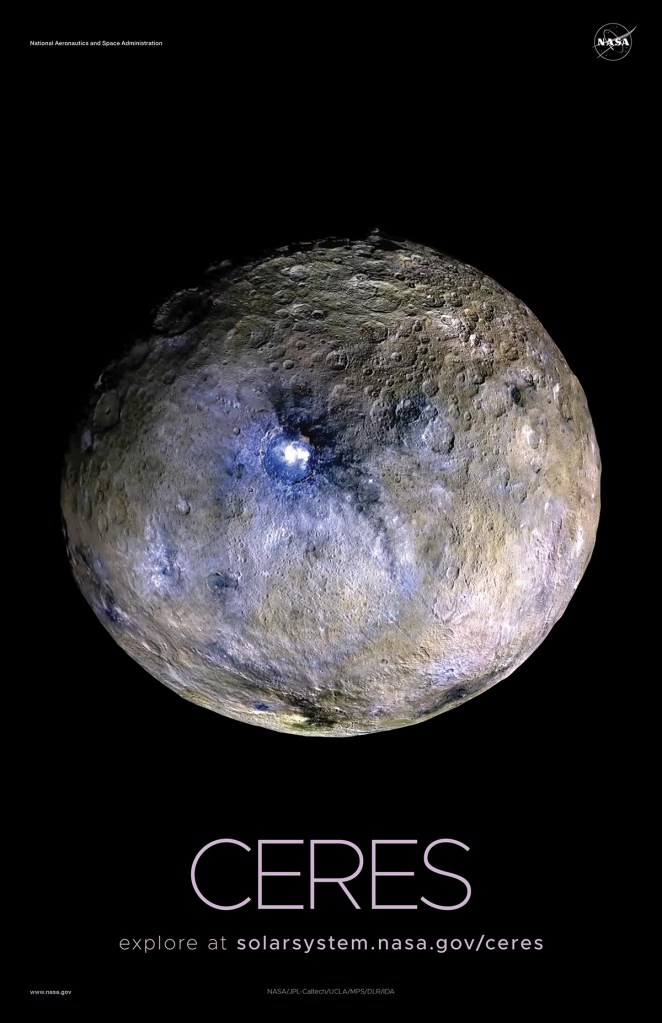
SkyandTelescope.org: “Asteroid Ceres Was Radioactive — And That Could Explain a Lot

A team of U.S. planetary scientists has shown that unexpected surface features on the dwarf planet Ceres can be explained by radioactive decay in its interior long ago. If they are right, their model could explain features not just on other dwarf planets, but also on some of the icy moons in the outer solar system.

ScienceDaily.com: “One More Clue to the Moon’s Origin

Researchers discover the first definitive proof that the Moon inherited indigenous noble gases from the Earth’s mantle. The discovery represents a significant piece of the puzzle towards understanding how the Moon and, potentially, the Earth and other celestial bodies were formed.

UniverseToday.com: “Starlink Satellites Are Still Bright

The new generation of Starlink satellites remain above the accepted brightness threshold. It’s one of the stranger sights of the modern Space Age. Recently, we found ourselves under the relatively dark skies of southern Spain. Sure enough, within a few minutes, we caught sight of a chain of flashing ‘stars’ winking in and out of view in quick succession.
More JWST Priorities

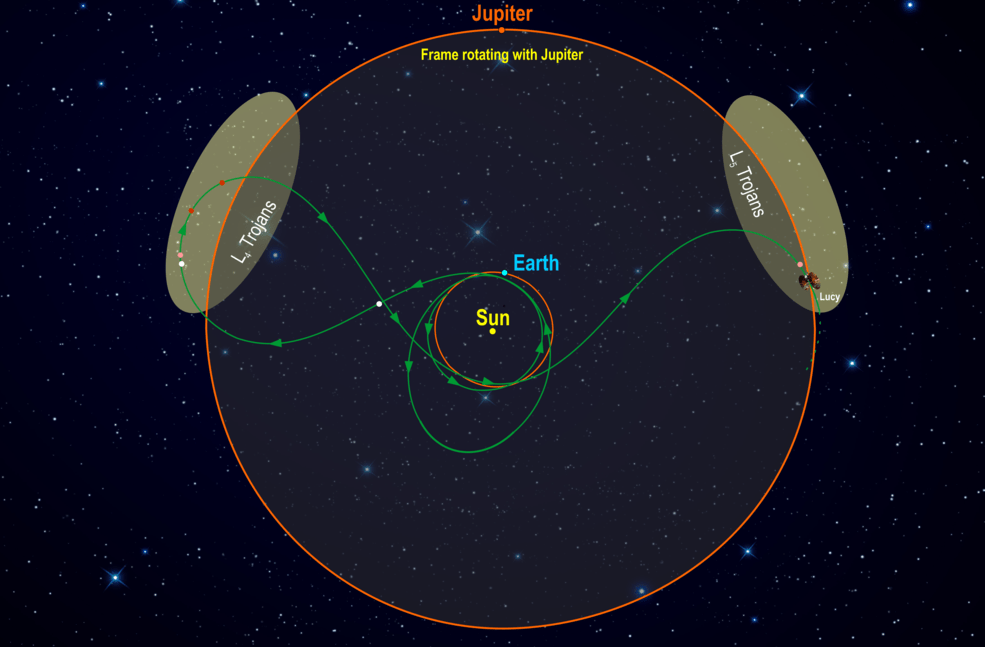
Image (Credit): This diagram shows Lucy’s orbital path in green after her October 2021 launch to visit the Trojan asteroids. (Southwest Research Institute)

Last week I noted some of the mission priorities in the James Webb Space Telescope’s (JWST) first year. Those priorities were listed under “Exoplanets and Disks.” I thought I would highlight a few more, this time from the “Solar System Astronomy” list. Here are five more priorities:

  • Pluto’s Climate System with JWST;
  • The Moons of Uranus: A NIRSpec Investigation of Their Origins, Organic Constituents, and Possible Ocean World Activity;
  • A Pure Parallel Survey of Water in the Asteroid Belt;
  • DiSCo-TNOs: Discovering the Composition of the Trans-Neptunian Objects, Icy Embryos for Planet Formation; and
  • JWST Observations of Lucy Mission Targets.

Each of these priorities come with an explanation of the mission. For example, here is a little more about NASA’s Lucy mission from the JWST proposal:

The Lucy spacecraft – to be launched at approximately the same time as JWST – will perform the first ever in situ exploration of the Jupiter Trojan asteroids. Trojans are the largest population of solar system bodies currently unvisited by spacecraft, and revealing their composition and formation history is the key to untangling disparate hypothesis for the early dynamical evolution of the entire solar system.

Understanding these enigmatic bodies requires not just the high spatial resolution imagery and spectroscopy that will be afforded by Lucy, but also the superb near- and mid-infrared spectroscopy of which JWST is uniquely capable. The high signal-to-noise, high spectral resolution, and extended wavelength coverage beyond the capabilities of Lucy will allow JWST to sensitively probe the organic, carbonate, and silicate components of the surfaces of the Trojans. Meanwhile, the Lucy spectra and images will place these observations into their geological and historical context, greatly extending the scientific utility of both the JWST observations and the Lucy visit. Together these observations will paint a rich picture of this population, allowing us to trace connections with other bodies studied remotely and in situ across the solar system.

Lucy was launched last October and is expected to encounter its first Trojan asteroid until August 2027. You can find the full mission timeline here.

Space Quotes: Worry about Asteroids, Not Aliens

Image (Credit): Image of a UFO. (SETI Institute)

“This paper attempts to provide an estimation of the prevalence of hostile extraterrestrial civilizations through an extrapolation of the probability that we, as the human civilization, would attack or invade an inhabited exoplanet once we become a Type-1 civilization in the Kardashev Scale capable of nearby interstellar travel. The estimation is based on the world’s history of invasions in the last century, the military capabilities of the countries involved, and the global growth rate of energy consumption. Upper limits of standard deviations are used in order to obtain the estimated probability of extraterrestrial invasion by a civilization whose planet we send a message to. Results show that such probability is two orders of magnitude lower than the impact probability of a planet-killer asteroid. These findings could serve as a starting point for an international debate about sending the first serious interstellar radio messages to nearby potentially habitable planets.”

-Abstract to a study, Estimating the prevalence of malicious extraterrestrial civilizations, by amateur astronomer Alberto Caballero. I suppose the results of this latest study is encouraging since we can expand to other planets in the solar system and beyond to reduce the impact of an asteroid on the human race, but trying to outrun another civilization could be somewhat more difficult. This gives us a green light for SETI as well as exploration on Mars.

Space Stories: Near Earth Hazards, Mars Helicopter, and Super-Earths

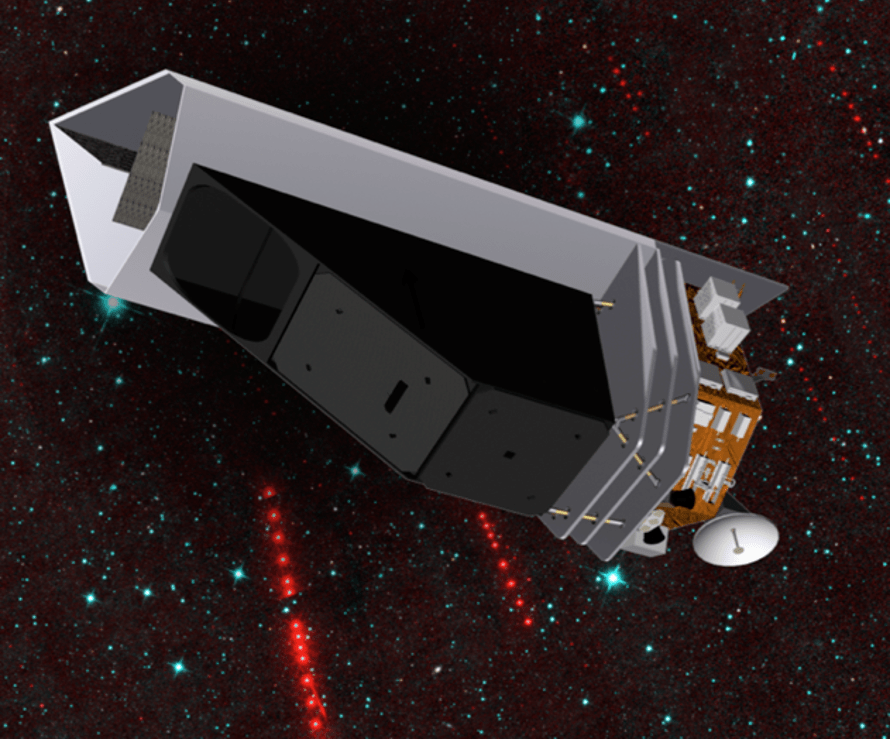
Image (Credit): he NEO Surveyor infrared space telescope is optimized for finding, tracking and characterizing potentially hazardous asteroids and comets. (NASA/JPL)

Here are some recent stories of interest.

Spacenews.com:House committee questions proposed delay in NASA asteroid mission

Members of the House Science Committee used a hearing about the planetary science decadal survey to criticize a proposal in NASA’s budget request to delay work on a space telescope to track near Earth objects (NEOs).

NASA: NASA’s Ingenuity Mars Helicopter Captures Video of Record Flight

The Ingenuity Mars Helicopter’s black-and-white navigation camera has provided dramatic video of its record-breaking 25th flight, which took place on April 8. Covering a distance of 2,310 feet (704 meters) at a speed of 12 mph (5.5 meters per second), it was the Red Planet rotorcraft’s longest and fastest flight to date. (Ingenuity is currently preparing for its 29th flight.)

Space.com:James Webb Space Telescope will study two strange ‘super-Earths

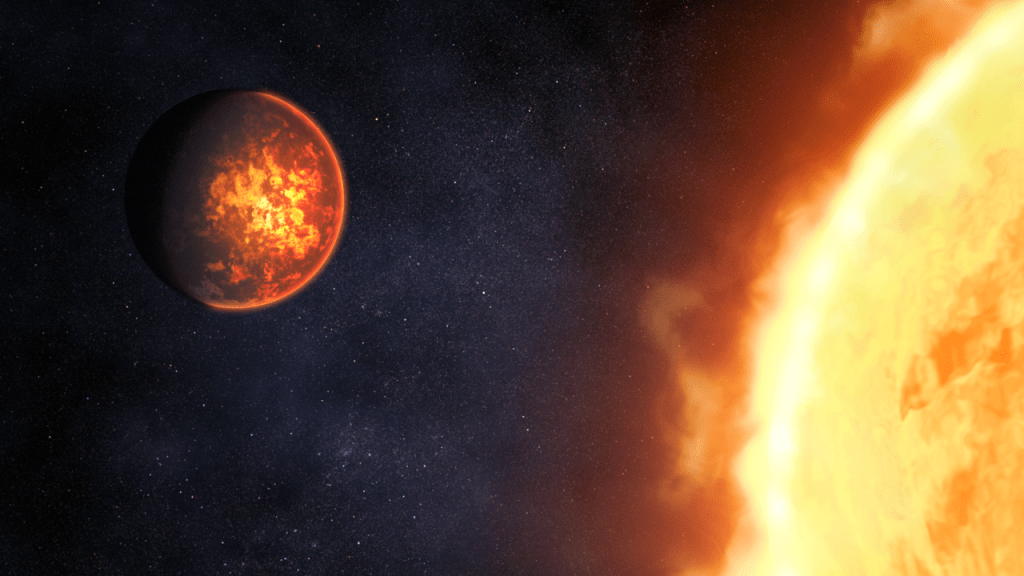
The James Webb Space Telescope plans to explore strange, new rocky worlds in unprecedented detail...Rocky planets are more difficult to sight than gas giants in current telescope technology, due to the smaller planets’ relative brightness next to a star, and their relatively tiny size. But Webb’s powerful mirror and deep-space location should allow it to examine two planets slightly larger than Earth, known as “super-Earths.”

Image (Credit): Illustration showing what exoplanet 55 Cancri e could look like, based on current understanding of the planet. (webbtelescope.org)

Profile: Asteroid Bennu

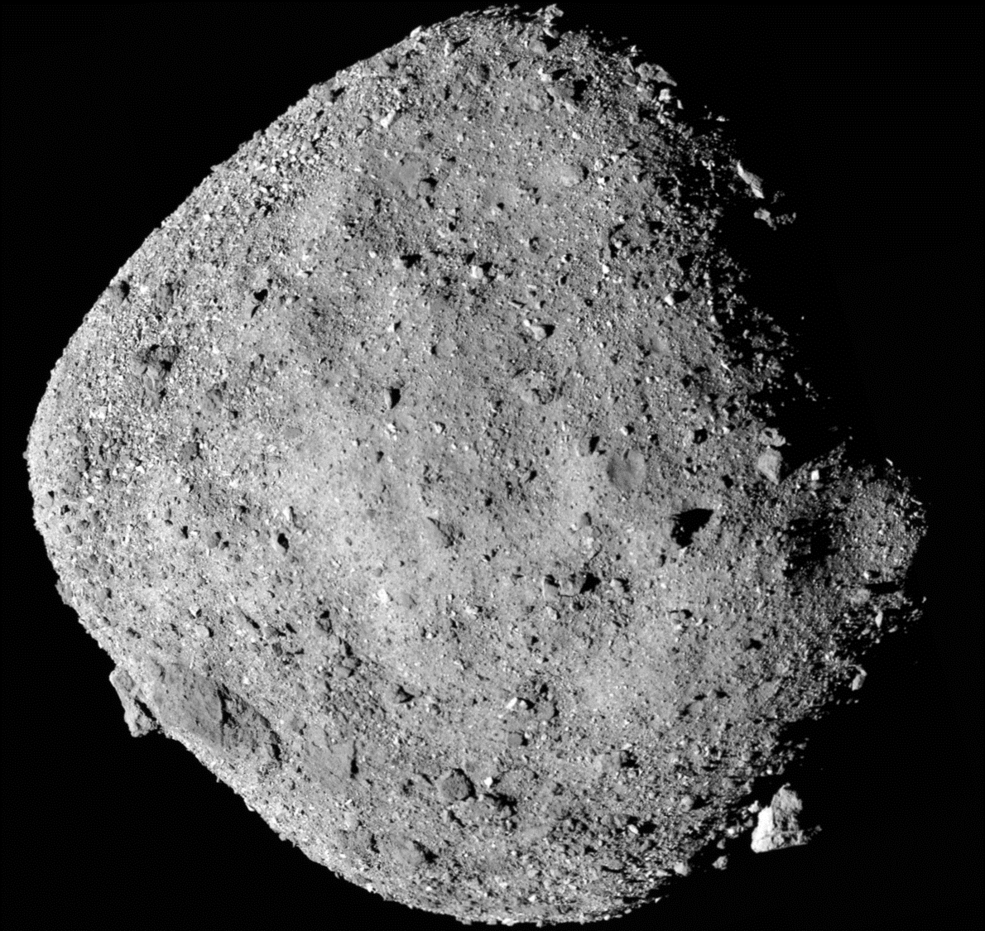
Image (Credit): Mosaic image of asteroid Bennu composed of 12 PolyCam images collected on Dec. 2, 2018 by the OSIRIS-REx spacecraft from a range of 15 miles. (NASA/Goddard/University of Arizona)

Back in 2020, NASA’s OSIRIS-REx spacecraft collected samples from asteroid Bennu, named after the ancient Egyptian mythological bird associated with the Sun, creation, and rebirth. These samples are scheduled to return to Earth until next year, but in the meantime there is already a lot that NASA knows about this asteroid. Some of the key points are listed below:

  • Bennu is over 4.5 billion years old.
  • Bennu is a “rubble-pile” asteroid, meaning it is rocky debris compressed by gravity.
  • Bennu is likely to be rich in platinum and gold compared to the average crust on Earth.
  • Between the years 2175 and 2199, the chance that Bennu will impact Earth is only 1-in-2,700.

You can tour the surface of Bennu by viewing a video produced by NASA’s Goddard Space Flight Center in Greenbelt, Maryland. Titled “Tour of Asteroid Bennu,” the film was featured in the SIGGRAPH Computer Animation Festival Electronic Theater. While it did not win any awards, it was still a great opportunity to share the mission with a wider audience.

Missions to planets and moons tend to get most of the attention, but asteroids can reveal plenty about the origins of our solar system. You can learn more about the OSIRIS-REx mission to Bennu here.