If you are looking for new podcast material, you may want to check out NASA’s Curious Universe podcast. It has been around for a while, but it is starting a new series celebrating Earth from April 15 to May 13.
The first episode in the new Earth series is titled “How NASA Sees Our Blue Marble.” In the episode, we hear from Karen St. Germain, the director of NASA’s Earth Science Division. It is a chance to learn about the planet that NASA spends the most time studying.
If you like this series, you can go back and listen to other episodes, such as:
-“Inside the Team That Keeps Hubble Flying” (March 14, 2025) -“The Sun Series” (March 19 to May 3, 2024) -“Defending the Planet from Asteroids” (February 21, 2023) -“The Search For Life: Are We Alone?” (June 21, 2022)
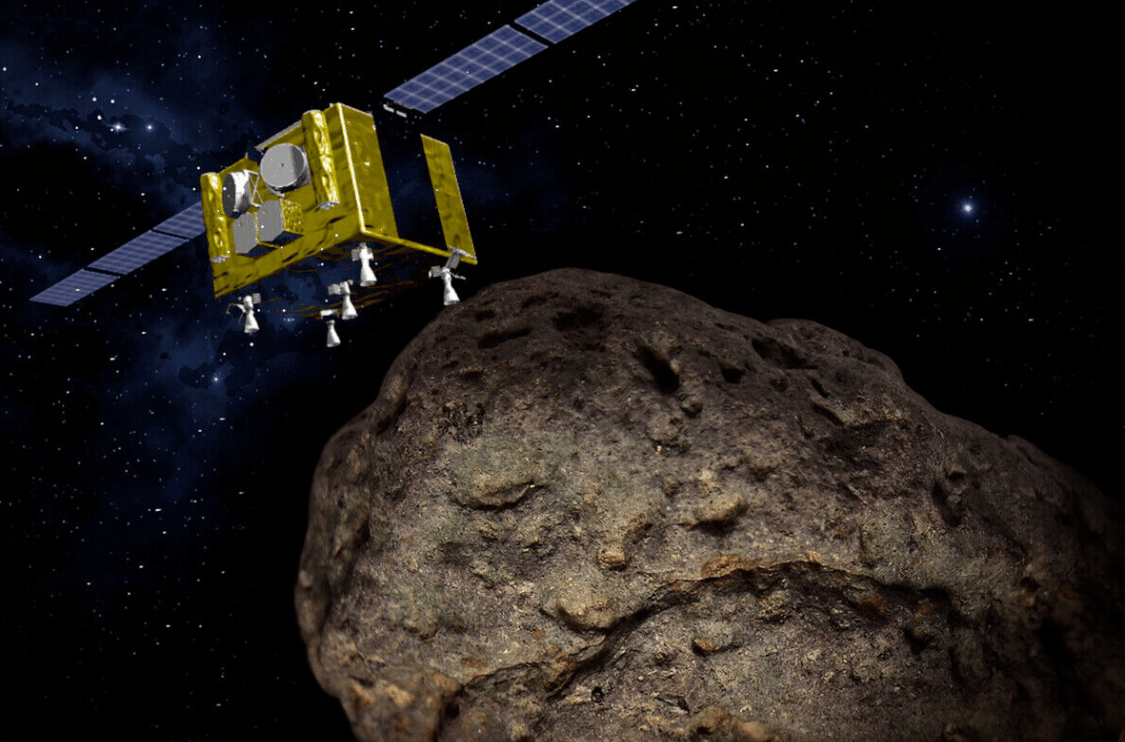
His venture may seem far out, but asteroid mining CEO Matt Gialich has no illusions. The engineer cofounded the bold California startup AstroForge in 2022 with the aim of hunting for precious metals in space, and he is all too aware that success is not guaranteed…The probe is set to lift off aboard a SpaceX Falcon 9 rocket from NASA’s Kennedy Space Center in Florida on February 26. AstroForge’s spacecraft will ride alongside Athena, a lunar lander developed by the startup Intuitive Machines, until it breaks off on its own.
NASA’s Lunar Trailblazer mission is led by Caltech’s Bethany Ehlmann, professor of planetary science and the Allen V. C. Davis and Lenabelle Davis Leadership Chair and director of the Keck Institute for Space Studies, and the mission is operated by IPAC at Caltech. The Lunar Trailblazer small satellite, or smallsat, will orbit the Moon to understand the nature of water on the Moon’s surface, providing maps to guide future robotic and human explorers. Prior missions have seen hints of ice and other forms of water that could be used in a variety of ways, from purifying it for human use, to processing it for fuel and breathable oxygen for future human Moon landings.
NASA and Intuitive Machines are gearing up for a Wednesday evening liftoff, and one of the payloads will test a moon-based cell network. Researchers with Nokia Bell Labs Solutions Research developed the network and say it’s the same tool that we use here on Earth when we pick up our phones and make a call. But they had to make a cell tower much smaller so it could fit in a rocket and land on the moon.
“We do want to keep an eye on it. We do take it seriously, but we want to put it in perspective … There’s still a very low probability that it would even impact the Earth at all.”
-Statement by Kelly Fast, the acting planetary defense officer for NASA’s Planetary Defense Coordination Office, as quoted by National Pubic Radio. She is referring to asteroid 2024 YR4, which is between 30 feet to about 300 feet in diameter. Scientists believe the asteroid has about a 1.6 percent chance of hitting the Earth in 2032.
Evaporation or freezing of water-rich fluids with dilute concentrations of dissolved salts can produce brines, as observed in closed basins on Earth and detected by remote sensing on icy bodies in the outer Solar System. The mineralogical evolution of these brines is well understood in regard to terrestrial environments, but poorly constrained for extraterrestrial systems owing to a lack of direct sampling. Here we report the occurrence of salt minerals in samples of the asteroid (101955) Bennu returned by the OSIRIS-REx mission. These include sodium-bearing phosphates and sodium-rich carbonates, sulfates, chlorides and fluorides formed during evaporation of a late-stage brine that existed early in the history of Bennu’s parent body. Discovery of diverse salts would not be possible without mission sample return and careful curation and storage, because these decompose with prolonged exposure to Earth’s atmosphere. Similar brines probably still occur in the interior of icy bodies Ceres and Enceladus, as indicated by spectra or measurement of sodium carbonate on the surface or in plumes.
Citation: McCoy, T.J., Russell, S.S., Zega, T.J. et al. An evaporite sequence from ancient brine recorded in Bennu samples. Nature637, 1072–1077 (2025). https://doi.org/10.1038/s41586-024-08495-6
A near-Earth object (NEO) recently designated as 2018 CN41 ultimately was deleted because it was determined to be the Tesla Roadster launched into space back in 2018. As noted in an Astronomyarticle, this type of confusion over orbiting objects, including legitimate spacecraft looping past the Earth, need to be better cataloged and shared among astronomers.
And who would collect and monitor this information? The Minor Planet Center, of course, which was set up years back with this very mission. As the Center’s site notes:
The Minor Planet Center (MPC) is the single worldwide location for receipt and distribution of positional measurements of minor planets, comets and outer irregular natural satellites of the major planets. The MPC is responsible for the identification, designation and orbit computation for all of these objects. This involves maintaining the master files of observations and orbits, keeping track of the discoverer of each object, and announcing discoveries to the rest of the world via electronic circulars and an extensive website. The MPC operates at the Smithsonian Astrophysical Observatory, under the auspices of Division F of the International Astronomical Union (IAU).
It seems like a simple thing to ask given the risk of NEOs damaging spacecraft of plummeting towards the Earth. It would be an even easier monitoring task if we did not throw junk into space just for the fun or it.
One can only hope the Tesla Roadster becomes a shooting star so that we have on less piece of junk to monitor.




 Our Awesome Universe