Pic of the Week: The Launch of Hera

Image (Credit): Visitors at ESA’s control center in Germany watching the Hera launch. (ESA / J.Mai)

This week’s image shows a crowd in Germany watching the launch of the European Space Agency’s (ESA) Hera mission on October 7, 2024. The launch itself took place from Cape Canaveral Space Force Station in Florida via a SpaceX Falcon 9.

Hera’s goal is to study how binary asteroid systems like Didymos form and function to learn more about to defend the Earth from approaching asteroids. You may remember Didymos from the earlier NASA Double Asteroid Redirection Test (DART) mission.

Here is more from the ESA on the mission:

Hera’s first deep space manoeuvre will begin in late October and put the spacecraft on course for its next major milestone, a flyby of Mars in March 2025. During this flyby, Hera will use its instruments to study Deimos, the smaller and more enigmatic of Mars’s two moons. This will serve as an important test for many of the spacecraft’s instruments, ensuring they are fully operational before the spacecraft arrives at its final destination, Didymos.

Hera will perform a second deep space manoeuvre in February 2026. An ‘impulsive rendezvous’ in October 2026 will bring Hera into the vicinity of the Didymos asteroid system. The spacecraft will begin its detailed survey of the moonlet Dimorphos in 2027, which will turn the 151 m asteroid into one of the most studied objects in the Solar System.

Space Stories: Oceans on Ariel, Dinosaur-Killer Asteroid from Beyond Jupiter, and the Launch of the Polaris Dawn Mission

Image (Credit): Uranus and distant galaxies as seen by the James Webb Space Telescope. (NASA, ESA, CSA, STScI)

Here are some recent stories of interest.

ForbesNASA’s Webb Telescope Finds Evidence For An Ocean World Around Uranus

New observations by the James Webb Space Telescope suggest that an icy moon around Uranus may have an underground liquid ocean. Ariel is one of 27 moons around Uranus, the seventh planet from the sun and the third largest planet in the solar system. It’s one of four moons that scientists have long been interested in as part of a search for water across the solar system, the others being Umbriel, Titania and Oberon.

Nature: Dinosaur-killing Chicxulub Asteroid Formed in Solar System’s Outer Reaches

The object that smashed into Earth and kick-started the extinction that wiped out almost all dinosaurs 66 million years ago was an asteroid that originally formed beyond the orbit of Jupiter, according to geochemical evidence from the impact site in Chicxulub, Mexico. The findings, published on 15 August in Science, suggest that the mass extinction was the result of a train of events that began during the birth of the Solar System. Scientists had long suspected that the Chicxulub impactor, as it is known, was an asteroid from the outer Solar System, and these observations bolster the case.

Space DailyPolaris Dawn Mission Set for August 26 to Advance Commercial Space Exploration

The Polaris Program, focused on testing and developing new spaceflight technology, is preparing to launch its first mission, Polaris Dawn, aboard SpaceX’s Falcon 9 rocket on Monday, August 26, 2024. This mission marks a significant step forward in commercial space exploration. Key objectives include testing a next-generation spacesuit during the first commercial spacewalk, attempting to achieve the highest altitude for a human spaceflight since the Apollo missions, and evaluating a new communication system through Starlink.

Space Stories: Fewer Eyes on Asteroids, Volunteer Martians Released, and Russians Plans for a New Space Station

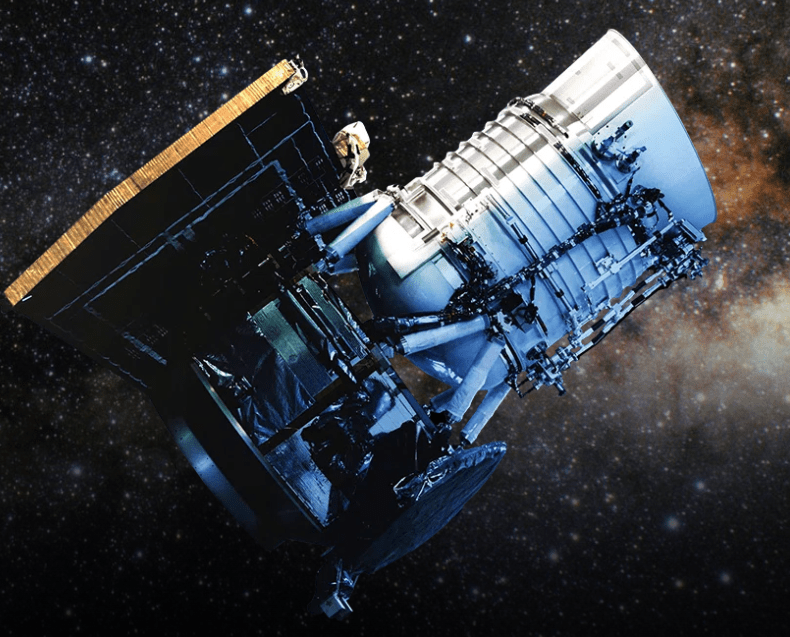
Image (Credit): NEOWISE space telescope. (NASA)

Here are some recent stories of interest.

Flying Magazine: NASA’s Asteroid, Comet Hunting Telescope Set to Retire at End of Month

A NASA space telescope designed to “hunt” asteroids and comets that could pose a threat to life on Earth and orbiting spacecraft will soon burn up in orbit. In late 2024 or early 2025, the agency’s Near-Earth Object (NEO) Wide-field Infrared Survey Explorer—or NEOWISE—is expected to come home in pieces following the conclusion of its second mission later this month…However, NASA has a replacement lined up: the Near Earth Object Surveyor (NEO Surveyor), set for a 2027 launch. The infrared space telescope is the first to be designed specifically for hunting large numbers of NEOs in and around Earth orbit. It has a baseline development cost of $1.2 billion to which NASA committed in 2022.

NPR: Volunteers Who Lived in a NASA-created Mars Replica for Over a Year Have Emerged

Four volunteers who spent more than a year living in a 1,700-square-foot space created by NASA to simulate the environment on Mars have emerged. The members of the Crew Health and Performance Exploration Analog mission — or CHAPEA — walked through the door of their habitat at NASA’s Johnson Space Center in Houston on Saturday to a round of applause…Haston and the other three crew members — Anca Selariu, Ross Brockwell and Nathan Jones — entered the 3D-printed Mars replica on June 25, 2023, as part of a NASA experiment to observe how humans would fare living on the Red Planet.

Reuters: Russia Plans to Create Core of New Space Station by 2030

Russia is aiming to create the four-module core of its planned new orbital space station by 2030, its Roscosmos space agency said on Tuesday. The head of Roscosmos, Yuri Borisov, signed off on the timetable with the directors of 19 enterprises involved in creating the new station. The agency confirmed plans to launch an initial scientific and energy module in 2027. It said three more modules would be added by 2030 and a further two between 2031 and 2033.

More on the Recent Asteroid Flybys

Image (Credit): Asteroid 2024 MK captured by NASA’s Goldstone Solar System Radar. (NASA, JPL-Caltech)

Remember asteroid 2024 MK from last Saturday? Well, NASA has some nice shots (shown above) of the asteroid as it made it close approach to the Earth. It shows the 500 foot-wide asteroid in all of its scary glory. We were lucky to be nothing but observers that day.

Another asteroid that shot by the Earth on June 27th at a distance that was about 17 time the distance between the Earth and the Moon was asteroid UL21. This asteroid was not a surprise, having been spotted back in 2011. However, it had a surprise when viewed up close. The asteroid had its own moon (shown below).

I’m impressed we have these amazing images, but if they price for these images is a risky rendezvous then I can live without them.

Note: Another asteroid is coming our way next week – asteroid 2024 MT1. The asteroid is 260 feet in diameter and will be come much closer than UL21, or about four times the distance between the Earth and the Moon.

Image (Credit): Asteroid UL21 captured by NASA’s Goldstone Solar System Radar. You can see its moon as the small speck at the bottom of the image. (NASA, JPL-Caltech)

A Day in Astronomy: The Tunguska Event

Image (Credit): A current map showing the location of the Tunguska Event in Russia. (Wikipedia)

It was on this day in 1908 that about 800 square miles of forest in Siberia were decimated in what was later attributed to an meteor exploding 3 to 6 miles above the Tunguska River area. As a result of the aerial explosion, no impact crater was created from what was called the Tunguska Event.

The meteor that hit Russia has been estimated top be 160–200 feet wide. The asteroid that passed by the Earth yesterday, 2024 MK, has been estimated to be 400 and 850 feet wide. We are lucky that we did not need to go through this again more than 100 years later.

The Tunguska Event is the largest impact event in recorded history. It was this event that later inspired what we celebrate today – Asteroid Day.

Happy Asteroid Day!