Can Someone Give NASA a Hand with its Asteroid Canister?

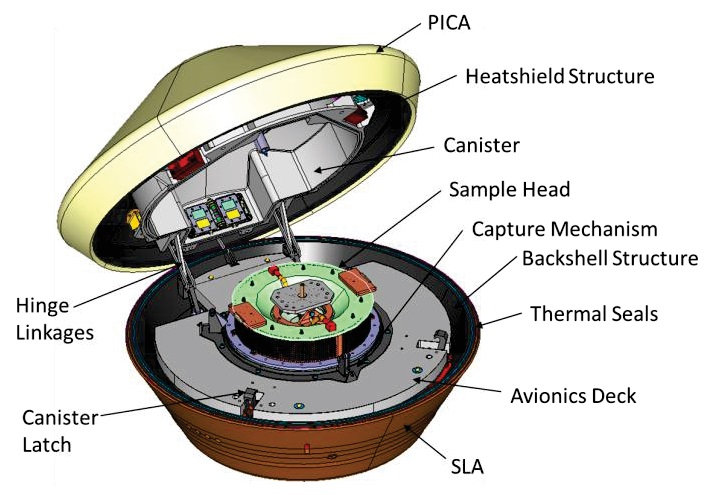
Image (Credit): OSIRIS-REx Sample Return Capsule. (NASA/Lockheed Martin)

Remember when you had to run the pickle jar under the faucet before you could take off the lid? Well, this can even happen to scientists. In fact, it has happened with NASA’s Origins, Spectral Interpretation, Resource Identification, and Security–Regolith Explorer (OSIRIS-REx) sample canister.

NASA has reported that it is still trying to get the lid off of the canister, though it has been able to collect material from outside the container. On Friday, NASA stated:

In the last week, the team at NASA’s Johnson Space Center in Houston changed its approach to opening the TAGSAM head, which contained the bulk of the rocks and dust collected by the spacecraft in 2020. After multiple attempts at removal, the team discovered two of the 35 fasteners on the TAGSAM head could not be removed with the current tools approved for use in the OSIRIS-REx glovebox. The team has been working to develop and implement new approaches to extract the material inside the head, while continuing to keep the sample safe and pristine.

NASA stated it may take a few more weeks to resolve since the scientists need to be careful with the tools they use in the confined space.

The good news is that, even without the additional material, the team has already recovered about 70 grams of material from asteroid Bennu sample, which surpasses the agency’s goal of bringing at least 60 grams to Earth.

It is a pretty odd ending after the sample has gone through a multi-year journey before landing in the Utah desert. At least the sample canister is in a safe place while the scientists play with it.
Space Quote: Rich Bounty from the Asteroid Bennu Sample

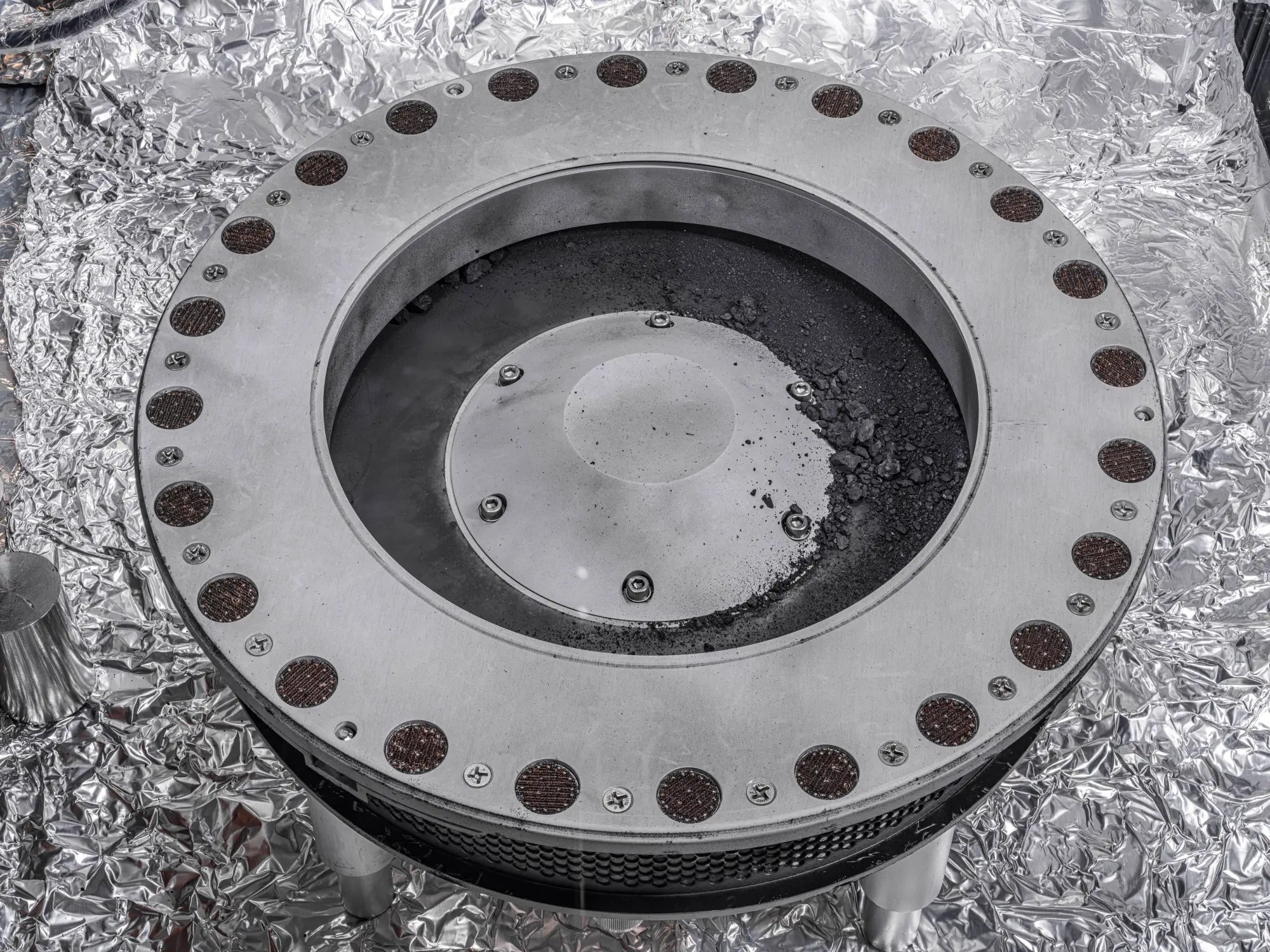
Image (Credit): Outside view of the OSIRIS-REx sample collector. You an see sample material from asteroid Bennu on the middle right. (NASA/Erika Blumenfeld & Joseph Aebersold)

“As we peer into the ancient secrets preserved within the dust and rocks of asteroid Bennu, we are unlocking a time capsule that offers us profound insights into the origins of our solar system…The bounty of carbon-rich material and the abundant presence of water-bearing clay minerals are just the tip of the cosmic iceberg. These discoveries, made possible through years of dedicated collaboration and cutting-edge science, propel us on a journey to understand not only our celestial neighborhood but also the potential for life’s beginnings. With each revelation from Bennu, we draw closer to unraveling the mysteries of our cosmic heritage.”

Statement by Dante Lauretta, OSIRIS-REx principal investigator, regarding the recently-arrived sample collected from asteroid Bennu. NASA and its partners are expected to study the sample for the next two years to learn more about the asteroid and our solar system.

The Psyche Mission Begins

Credit: NASA

It may be Friday the 13th, but the news has been positive about the Psyche spacecraft, which earlier today successfully launched from  NASA’s Kennedy Space Center in Florida.

Here is part of a statement by Arizona State University Professor Lindy Elkins-Tanton, the Principal Investigator (PI) of the Psyche mission, from back in 2017 as she awaited word on whether the Psyche mission had been green-lighted by NASA:

I’ve only been working on this project for five and a half years. Some of my competitors have been through the process before with the same ideas, and are coming up on a decade of trying to fly their concept. Still, five and a half years. About 150 people have worked on this concept with me. We’ve written about 2,000 pages, including the step 1 and step 2 proposals and all the written, edited, revised, formatted, and published answers to questions that came in between. We have art and models and videos and new scientific and engineering results because of all our efforts to understand how to get to the metal world Psyche and what we might find if we did, and how we could measure it and send the information back to Earth and understand it and interpret it for everyone in the world.

To say our hearts are in this project would be too facile, too surficial, too trite. We have lived and breathed this. We know and love each other and we know each other’s families and we have learned when to be quiet and let the other person work through a peak of frustration late at night after no rest for weeks. We have sweated through countless reviews and celebrated with numerous cakes and dinners the many intermediate successes that allowed us to get here, the ultimate intermediate success, the privilege to wait for the phone call.

Here is PI Lindy Elkins-Tanton’s quote from earlier today:

We said ‘goodbye’ to our spacecraft, the center of so many work lives for so many years – thousands of people and a decade…But it’s really not a finish line; it’s a starting line for the next marathon. Our spacecraft is off to meet our asteroid, and we’ll fill another gap in our knowledge – and color in another kind of world in our solar system.

Congratulations to PI Lindy Elkins-Tanton and her team on a job well done (so far, of course).

NASA Gets Ready for a Thursday Launch to Asteroid Psyche

Image (Credit): The Psyche spacecraft sits aboard a SpaceX Falcon Heavy rocket earlier today at Launch Complex 39A. (NASA/Aubrey Gemignani)

After a number of delays, the Psyche mission appears ready to go as the spacecraft sits at Launch Complex 39A at the Kennedy Space Center in Florida. The launch is scheduled for tomorrow at 10:16 a.m. EDT.

The spacecraft will not reach the metal-rich asteroid Psyche until 2029. It will then orbit the asteroid for about two years collecting data to learn more about an object that astronomers believe may contain clues about the formation of the rocky planets closest to the Sun.

The scientific goals of the mission are to:

  • Understand a previously unexplored building block of planet formation: iron cores.
  • Look inside terrestrial planets, including Earth, by directly examining the interior of a differentiated body, which otherwise could not be seen.
  • Explore a new type of world. For the first time, examine a world made not of rock and ice, but metal.

NASA has a good track record this years with asteroid missions, so let’s hope the positive track record continues with tomorrow’s launch.

Update: Bad weather had delayed the launch until Friday, October 13th.

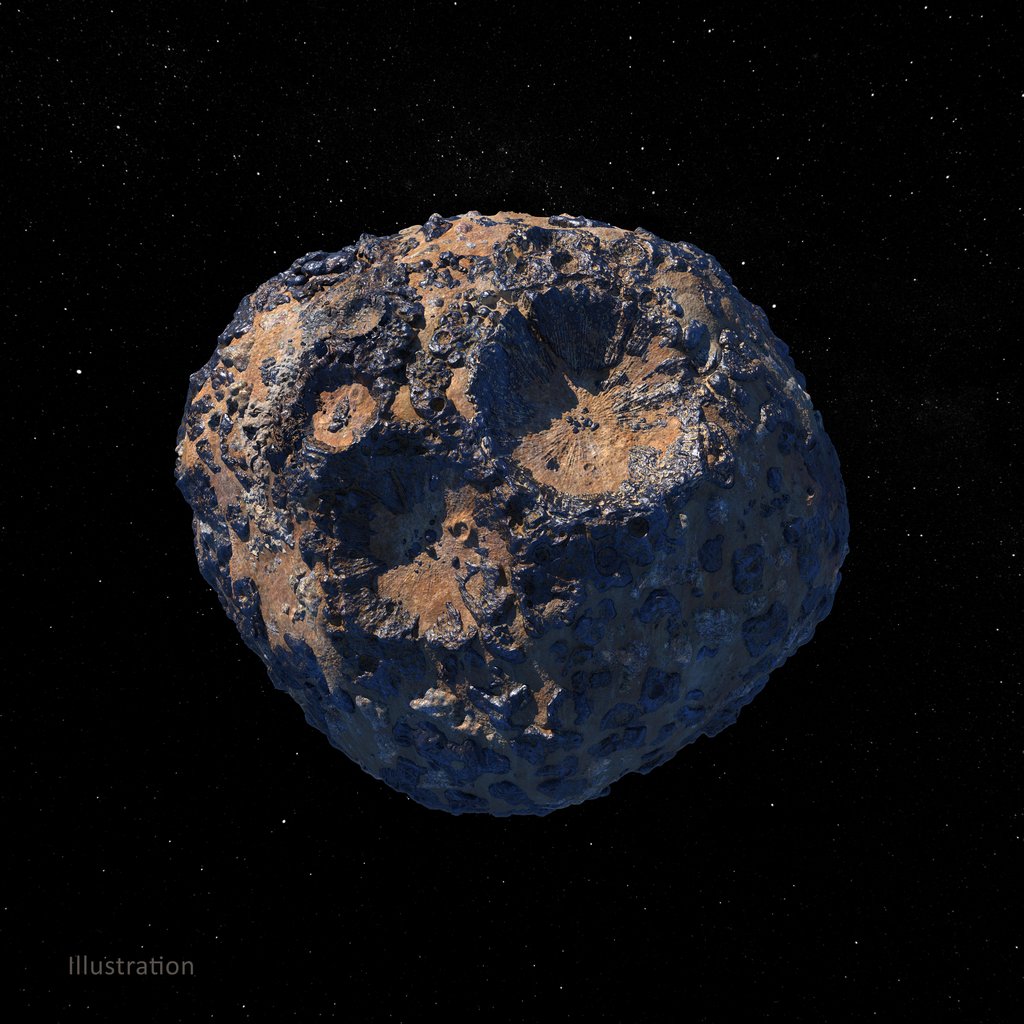
Image (Credit): Artist’s rendering of asteroid Pysche. (NASA)

Space Stories: Psyche Ready to Go, Interesting Exoplanets, and Protecting Astronaut Health

Image (Credit): Artist’s rendering of NASA’s Psyche mission approaching the asteroid Psyche. (NASA)

Here are some recent stories of interest.

Universe.com: “NASA’s Psyche Now Set to Launch October 12

With just under two weeks until its planned launch, NASA’s Psyche mission has been rescheduled. As per a NASA blog post, the agency along with SpaceX are now aiming for liftoff on October 12 at 10:16 A.M. EDT from the Kennedy Space Center in Florida — the first of several NASA science missions that will ride to space on a Falcon Heavy Rocket. The mission was originally set to launch October 5.

Trottier Institute for Research on Exoplanets: “UdeM-Led Study of Exoplanet TRAPPIST-1 b Reveals New Insights into its Atmosphere and Star

A team of astronomers has made an important leap forward in our understanding of the intriguing TRAPPIST-1 exoplanetary system. Not only has their research shed light on the nature of TRAPPIST-1 b, the exoplanet orbiting closest to the system’s star, but it has also shown the importance of parent stars when studying exoplanets. The findings, published today in Astrophysical Journal Letters, shed light on the complex interplay between stellar activity and exoplanet characteristics.

NASA: “NASA Funds Eight Studies to Protect Astronaut Health on Long Missions

NASA is funding eight new studies aimed at better understanding how the human body reacts to spaceflight. These studies will be done on Earth without the need for samples and data from astronauts. Collectively, these studies will help measure physiological and psychological responses to physical and mental challenges that astronauts may encounter during spaceflight. With this information, NASA may be better able to mitigate risks and protect astronaut health and performance during future long-duration missions to the International Space Station, the Moon, Mars, and beyond.