Top Astronomy Stories in 2023

Image (Credit): Chart showing the planned travel of the JUICE spacecraft. (ESA, work performed by ATG under contract to ESA)

I wanted to start out the new year by first remembering all of the great missions from 2023. I also decided to group this work rather than focus on single missions.

Here is what I came up with:

NASA’s Moon Mission: We saw more progress towards the next steps in the Artemis program to put humans on the Moon, including NASA’s announcement of the four astronauts to lead the Artemis II mission, SpaceX’s tests of the Starship rocket, and the design of new spacesuits for the Artemis astronauts.

Other Attempts to Land on the Moon: We saw other nations also reaching for the Moon. While India had great success landing a rover on the lunar South Pole, both Russia and a commercial venture from Japan did not have similar luck. We also saw Japan trying it again late last year.

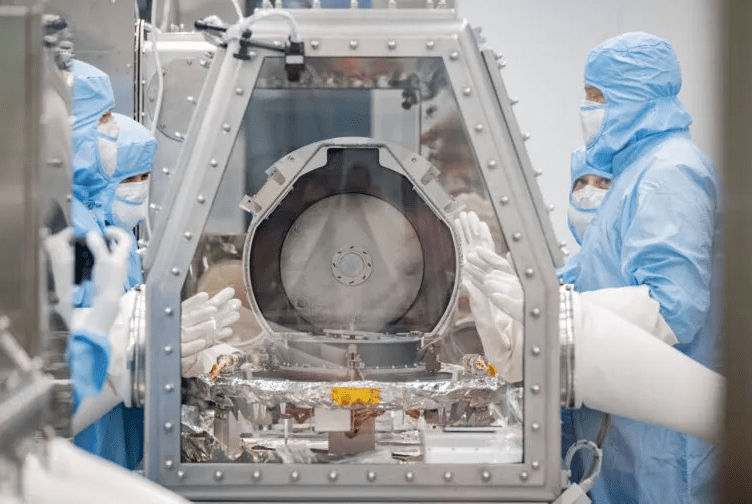
NASA Asteroid Missions: Asteroids were the big news this year, with Lucy encountering a surprise pair of asteroids, OSIRIS-REx bringing back a sample from the asteroid Bennu, and NASA launching the Psyche mission.

JWST Discoveries: This year we celebrated the anniversary of the James Webb Space Telescope (JWST), which has been better than ever imaged. It is helping to change our understanding of the origin of the universe while poking and prodding at exoplanets to review their secrets.

ESA Missions: The European Space Agency (ESA) has also been very busy in 2023. For instance, the launch of the Euclid mission to study dark matter and dark energy, as well as the JUICE mission to study Jupiter and its moons, will assist with our understanding of the big picture as well as our own neighborhood.

That’s an impressive record, and I look forward to even more great news in 2024.

NASA Had a Busy Year

Image (Credit): The introduction of the Artemis II crew, just one of many items highlighted in NASA’s new video summarizing 2023. (NASA)

This is the time of year for lists, so I wanted to highlight one of the more important lists, at least in the opinion of this writer. That’s right, we need to remember the important space milestones from this year.

Fortunately, NASA recently summed up its successes in 2023 with a new video titled NASA 2023: Nothing is Beyond Our Reach. The video highlights many of the Agency’s accomplishments this year, including the launch of the Psyche mission, the announcement of a crew for the Artemis II mission, and the OSIRIS-REx capsule retrieval.

It is quite a list. Luckily, NASA provided a list of links so you can read more about the various efforts:

Time to read up on 2023 before we dive into more activities in 2024.

Note: You can read a more detailed list of accomplishments at this NASA site.

Look What Lucy Found

Image (Credit): A view of the newly discovered second asteroid behind asteroid Dinkinesh. (NASA/Goddard/SwRI/Johns Hopkins APL/NOIRLab)

NASA’s Lucy spacecraft encountered a surprise last Wednesday as it approached the target asteroid Dinkinesh, located in the asteroid belt. Instead of finding a single asteroid, it found a binary pair. Early data indicated that asteroid Dinkinesh is about 0.5 miles wide and its orbiting partner is only 0.15 miles wide.

Lucy did not have time to stick around, but it captured enough images during its fly by to keep astronomers busy for some time. The spacecraft was flying about 10,000 mph as it passed the pair.

Lucy’s primary mission is the Trojan asteroids (that is, asteroids that share Jupiter’s orbit around the Sun). And why are they of interest? NASA mission page tells us:

Planet formation and evolution models suggest that the Trojan asteroids are likely to be remnants of the same primordial material that formed the outer planets (Jupiter, Saturn, Uranus, and Neptune), and thus serve as time capsules from the birth of our solar system over four billion years ago.

We may have many more surprises before Lucy finishes her 12-year mission.

Space Stories: Dinosaur Dust, Missing Stars, and SETI Signals

Image (Credit): The end of the dinosaurs. (NYT, Roger Harris/Science Source)

Here are some recent stories of interest.

Royal Observatory of Belgium: “Dust Played a Major Role in Dinosaur Demise

Fine dust from pulverized rock generated by the Chicxulub impact likely played a dominant role in global climate cooling and the disruption of photosynthesis following the event. This is suggested by a new study published in Nature Geoscience, in which researchers Cem Berk Cenel, Özgür Karatekin and Orkun Temel of the Royal Observatory of Belgium contributed.

Express: “Astronomers Trying to Unravel Mystery of Three Stars that Suddenly Disappeared from Sky

A team of Spanish astronomers is leading the investigation into one of stargazing’s most perplexing mysteries. Three bright stars photographed in the night sky above southern California in 1952 vanished just an hour later. Generations of scientists have sought to explain the rare phenomenon over the past half-century, but nothing has yet convinced the community. Researchers at the Centre for Astrobiology (CAB) in Madrid tried to solve the riddle of the “triple transient” that has “remained absent from telescope exposures for 71 years” in a new paper published online.

Sci.News: “New Study Sets Clearer Bounds on Search for Technosignatures from Extraterrestrial Intelligences

A stable-frequency transmitter with relative radial acceleration to a receiver will show a change in received frequency over time, known as a ‘drift rate.’ For a transmission from an exoplanet, astronomers must account for multiple components of drift rate: the exoplanet’s orbit and rotation, the Earth’s orbit and rotation, and other contributions. Understanding the drift rate distribution produced by exoplanets relative to Earth, can help scientists constrain the range of drift rates to check in a Search for Extraterrestrial Intelligence (SETI) project to detect radio technosignatures, and help them decide validity of signals-of-interest, as they can compare drifting signals with expected drift rates from the target star. In a new study, University of California, Los Angeles astronomer Megan Grace Li and colleagues modeled the drift rate distribution for over 5,300 confirmed exoplanets, using parameters from the NASA Exoplanet Archive.

A Day in Astronomy: Flyby of Asteroid Gaspra

Image (Credit): Asteroid Gaspra as photographed by the Galileo spacecraft. (NASA)

On this day in 1991, NASA’s Galileo spacecraft conducted a flyby of asteroid Gaspra, an asteroid that orbits in the asteroid belt between Mars and Jupiter. The asteroid is about 10.5 miles long. Gaspra was discovered in 1916 by Russian astronomer G. N. Neujmin, who named it after a famous Russian spa retreat in Crimea.

The Galileo spacecraft’s primary mission was to visit Jupiter and its moons, but it also conducted other observations along the way, including flybys of asteroids Gaspra and Ida.

Here are a few facts about the Galileo mission from NASA:

  • Galileo was the first spacecraft to orbit an outer planet.
  • It was the first spacecraft to deploy an entry probe into an outer planet’s atmosphere.
  • It completed the first flyby and imaging of an asteroid (Gaspra, and later, Ida).
  • It made the first, and so far only, direct observation of a comet colliding with a planet’s atmosphere (Shoemaker-Levy 9).
  • It was the first spacecraft to operate in a giant planet magnetosphere long enough to identify its global structure and to investigate its dynamics.