Pic of the Week: The New Glenn Rocket Booster Returns

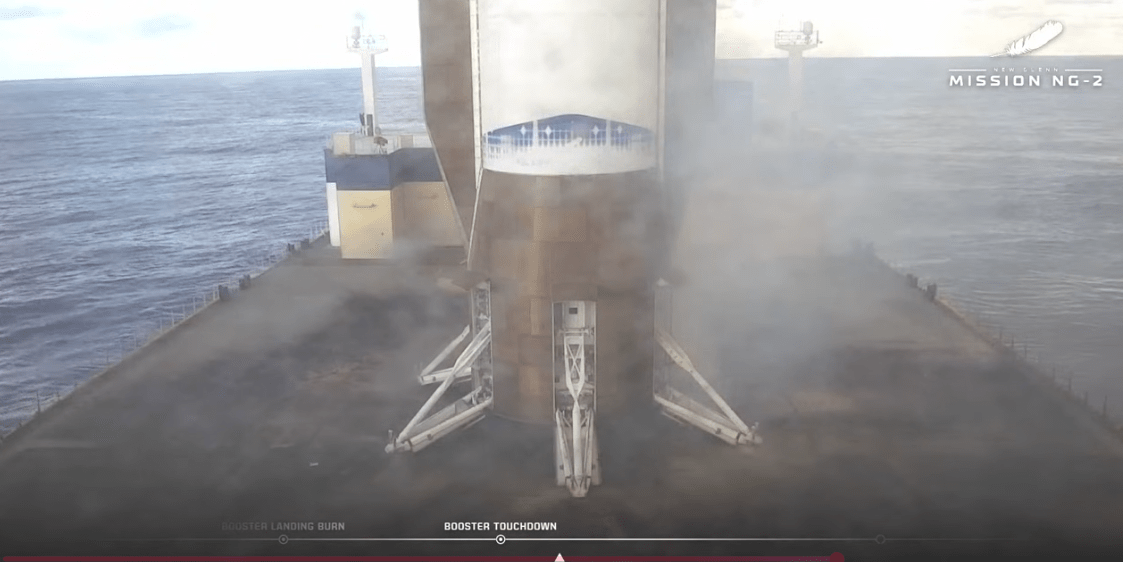
Image (Credit): The New Glenn booster after it landed on a platform in the Atlantic Ocean. (Blue Origin)

Today’s image comes from Blue Origin, which successfully completed it second launch of it New Glenn rockets, sending two NASA Martian probes into orbit. The image shows the reusable rocket booster right after it landed on a platform in the Atlantic Ocean.

Acting NASA Administrator Sean Duffy stated:

Congratulations to Blue Origin, Rocket Lab, UC Berkeley, and all of our partners on the successful launch of ESCAPADE…This heliophysics mission will help reveal how Mars became a desert planet, and how solar eruptions affect the Martian surface. Every launch of New Glenn provides data that will be essential when we launch MK-1 through Artemis. All of this information will be critical to protect future NASA explorers and invaluable as we evaluate how to deliver on President Trump’s vision of planting the Stars and Stripes on Mars.

SpaceX now has another competitor for military and space missions, which is good for everyone (including SpaceX since it will keep them focused).

The New Glenn Launch to Mars Scheduled for Tomorrow

Image (Credit): Artist’s rending of the two EscaPADE probems approaching Mars. (NASA)

Blue Origin’s New Glenn rocket is scheduled to be launched tomorrow afternoon with two Martian probes on board. A lot is riding on tomorrow’s launch. The mission is important for Blue Origin, as it tests its new rocket with its first real mission. It is also important to NASA, which is using the probes to better understand the Martian atmosphere.

Blue Origin’s reusable New Glenn rocket will put it in direct competition with SpaceX for future NASA missions. This redundancy is needed, particularly with SpaceX seeming to struggle with its projects related to the Atemis lunar mission.

The $100 million Martian mission, called Escape and Plasma Acceleration and Dynamics Explorers (EscaPADE), involves a pair of identical spacecraft with a the goal of analyzing:

  1. how Mars’ magnetic field guides particle flows around the planet,
  2. how energy and momentum are transported from the solar wind through the magnetosphere, and
  3. what processes control the flow of energy and matter into and out of the Martian atmosphere.

The two probes will be launched towards Lagrange Point 2, where they will sit for more than a year before making an approach towards Mars. The probes are expected to go into orbit around Mars in September 2027.

Godspeed to Blue Origin and NASA.

Update: The launch has been delayed due to bad weather. The next attempt will be on November 12th.

If at First You Don’t Succeed: Jared Isaacman is Really Back

Image (Credit): Artist’s rendering of Blue Origin’s Blue Moon Mark 1, which is a single-launch, lunar cargo lander. (Blue Origin)

President Trump has had a change of heart on Jared Isaacman, his initial nominee for NASA administrator until he withdrew that nomination earlier this year.

Earlier today, the President posted the following:

Jared’s passion for Space, astronaut experience, and dedication to pushing the boundaries of exploration, unlocking the mysteries of the universe, and advancing the new space economy, make him ideally suited to lead NASA into a bold new era.

So what has changed in the last few months to make Mr. Isaacman “ideally suited” to lead NASA as compared to when he was determine unsuitable? I cannot think of anything other than the end of the President’s feud with Elon Musk. Of course, that was recently replaced with Elon Musk’s feud with acting NASA Administrator Sean Duffy, who proposed reopening competition for the first manned Moon landing this century due to delays with SpaceX’s Starship.

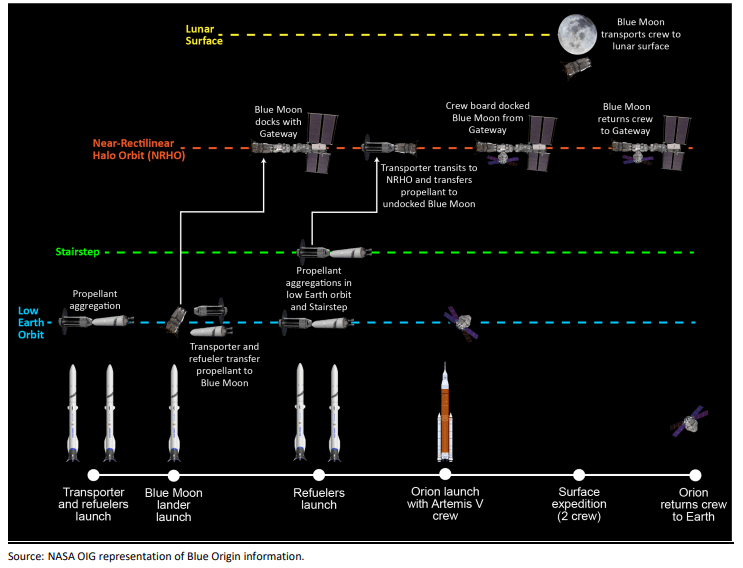
Will Mr. Isaacman save Musk’s Moon mission? He may calm some of the acrimony for the time being, but any new NASA administrator had better have a solid plan to get Americans back on the Moon before China does. Mr. Isaacman may be friends with Mr. Musk, but should he be confirmed he will head a weakened space agency that is struggling with a complex Moon mission that may be much less complex without the Starship refueling plans. In fact, Blue Origin just submitted a new Moon mission plan that drops this refueling altogether.

It is not impossible the winds will shift again, leaving Mr. Isaacman adrift once more. That is how it is in Washington these days. Fickle leadership leads to fickle decision-making and fickle planning.

The Chinese are not having these issues at the moment as they aim to be on the Moon by 2030.

Space Quote: SpaceX May Lose the Moon

Credit: Image by Gordon Johnson from Pixabay.

“If SpaceX is behind, but Blue Origin can do it before them, good on Blue Origin…But … we’re not going to wait for one company. We’re going to push this forward and win the second space race against the Chinese.”

Statement by acting NASA Administrator Sean Duffy regarding ongoing delays with SpaceX’s Starship, which was given a $2.9 billion contract in 2021 for a lunar landing vehicle as part of Artemis III. As a result, NASA may reopen to lunar lander contract. Blue Origin is working on its own lunar lander called Blue Moon. As noted in yesterday’s post, Mr. Musk has been distracted this year, so it may make sense to have a solid back up.

Update: Mr. Musk was not pleased with the news. In reference to acting NASA Administrator Duffy, Mr. Musk commented, “The person responsible for America’s space program can’t have a 2 digit IQ.” The man certainly knows how to make friends.

Space Quote: SpaceX Delays May Sink Efforts to Beat China to the Moon

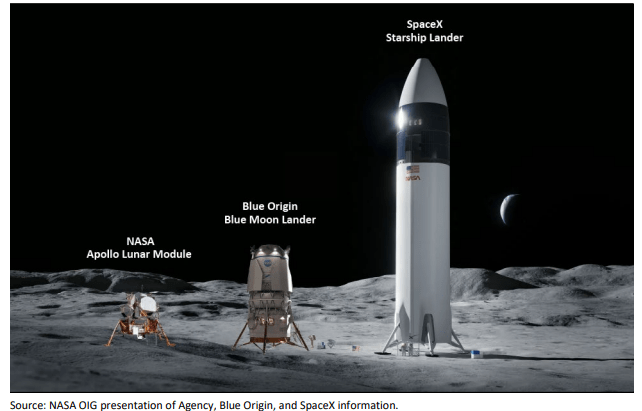
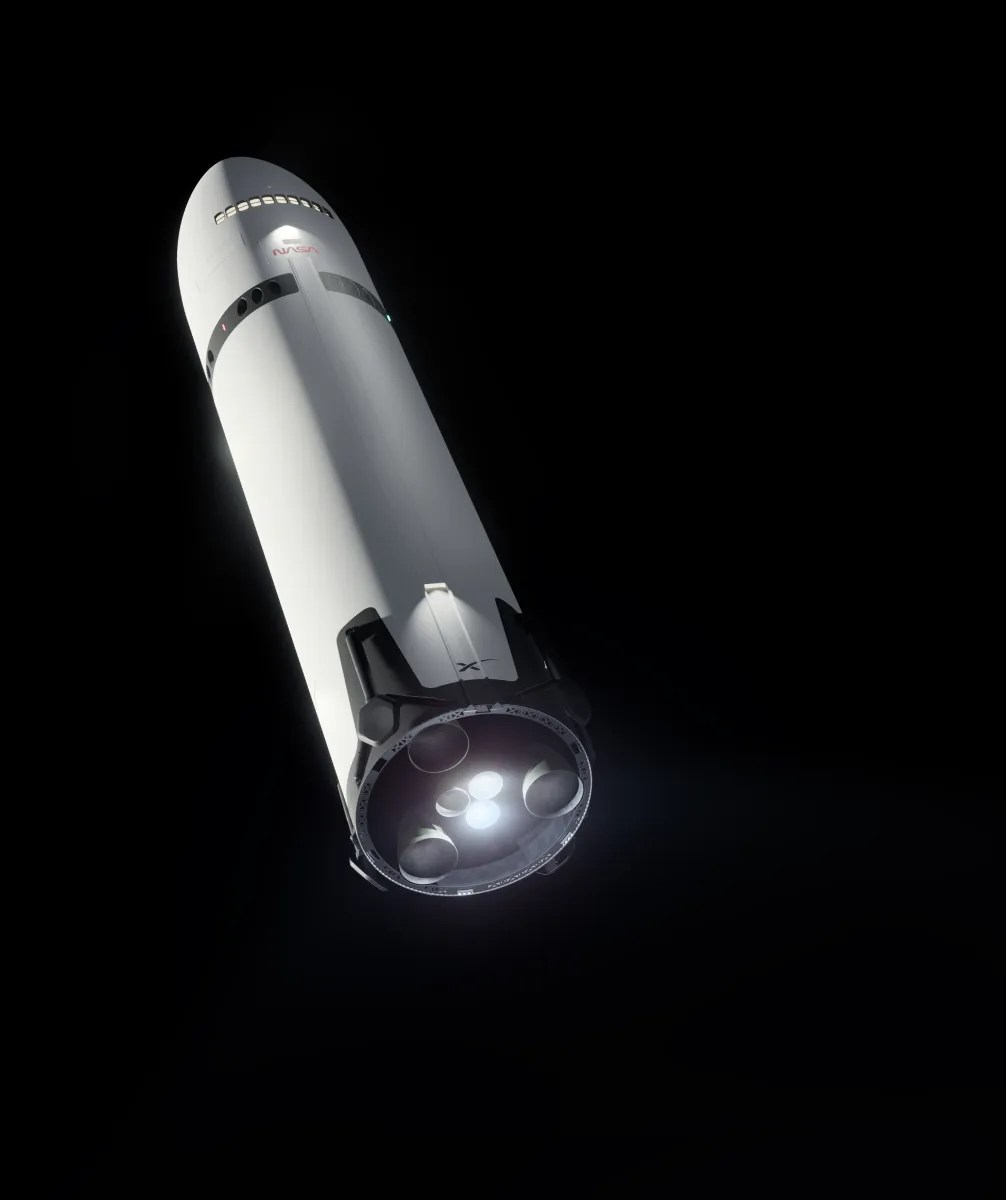
Image (Credit): Artist’s rendering of SpaceX’s Starship HLS on the Moon. (SpaceX)

“The HLS schedule is significantly challenged and, in our estimation, could be years late for a 2027 Artemis 3 moon landing.”

-Statement by Aerospace Safety Advisory Panel (ASAP) member Paul Sean Hill, as quoted by Space News. NASA contracted with SpaceX to develop the Human Landing System (HLS) for the astronauts landing on the Moon as part of Artemis III and later missions. While Blue Origin has also been tapped by NASA to assist with later missions, SpaceX was expected to provide the initial HLS. Maybe NASA should have picked two companies to provide the initial HLS, with the second in place still assisting with later landings. The ASAP’s 2024 Annual Report highlighted the many risks related to Artemis III, including several related to the HLS (shown below). Everyone knew this was going to be difficult, and no one wants to be asked to answer “Who Lost the Moon?” Also, it is good we still have a few advisory panels left after the recent purge.

Image (Credit): Figure 1, “First-time milestones for the Artemis III mission,” contained in the ASAP’s 2024 Annual Report. (ASAP)