A Martian Rover on the Moon?

Image (Credit): The PROMISE rover, as shown at a recent “NASA Moon Base Update” press conference. (NASA)

It seems NASA is looking for some shortcuts to get back on the Moon, including repurposing an earlier rover designed for Mars. The rover in question is called the Polar Rover for Observation, Mapping and In-Situ Exploration, or simply PROMISE. It is the test model for the Perseverance and Curiosity rovers currently exploring Mars.

One of the advantages of the Mars rover is its power source. Instead of relying on solar panels, the rover is powered by a nuclear battery. This will give it greater range on the Moon’s surface without having to wait for lunar daylight. Another advantage is that it is proven technology, as the two Martian rovers have demonstrated for years.

It sounds like a smart way to take something off the shelf, but one can only wonder why this is only being considered now after NASA spent more than $450 million on the Volatiles Investigating Polar Exploration Rover (VIPER) project. Was a nuclear battery ever considered for VIPER? These Martian rovers have been around for quite some time, and a nuclear reactor has been discussed as part of the Moon Base itself, so this is not a new idea.

Given this change in plans, one might expect that the contract with Blue Origin to bring the VIPER to the Moon in 2027 is no longer needed. Maybe VIPER will put on a shelf for years like PROMISE until someone comes up with a new purpose for it.

Stay tuned.

Artemis III Has a Crew

Image (Credit): The Artemis III crew members (from left: Andre Douglas, Luca Parmitano, Randy Bresnik, Frank Rubio). (NASA/Bill Stafford)

Earlier today NASA announced its new four-member crew for the next set of Artemis tests. The two week long Artemis III mission will test spacecraft in low Earth orbit in preparation for Artemis IV, which will entail an actual crewed mission to the surface of the Moon.

The new crew are three NASA astronauts and one European Space Agency (ESA) astronaut from Italy. NASA has a full profile of each crew member, but here are the basics:

NASA may have a crew, but does it have any partners that are really ready for a lunar landing?

To date, the only fully operational spacecraft is the Orion capsule, which will be sent aloft via the Space Launch System. Both SpaceX and Blue Origin plan to send up demonstration lunar landers that will not contain all of the necessary components for humans preparing for a Moon landing. This sounds a little dangerous given that the real reason for Artemis III is a dry-run in space. It sounds more like a dry-run for a dry-run, but NASA may not have time to complete a true test.

In additon to lunar lander delays, SpaceX is busy trying to make a fortune with its IPO, while Blue Origin is still licking its wounds after the recent explosion at Cape Canaveral.

These four astronauts may be the best news out of NASA for some time to come, so it may be best to raise a toast to the four of them and then simply hope for the best.

Space Quote: Not All is Lost at Launch Complex 36

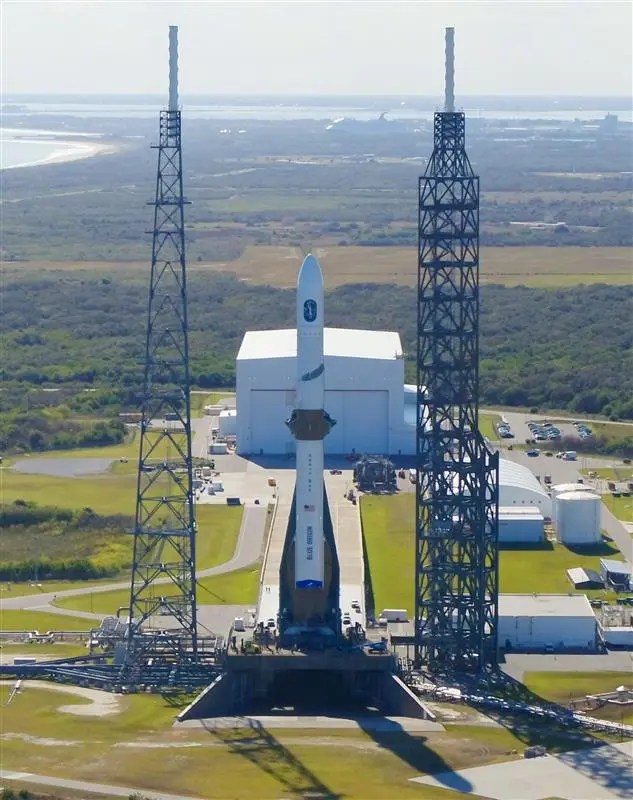
Image (Credit): Photo of Launch Complex 36 (LC-36), located at Cape Canaveral Space Force Station, prior to Thurday’s explosion. Completed in 2021, Blue Origin invested more than $1 billion to rebuild the launch site from the ground up. (Blue Origin)

“We have regained some access to Launch Complex 36 and are actively investigating the hotfire anomaly. We will start clearing the pad soon and have a good rebuild plan in place. The booster and GS2s in the integration facility appear healthy from quick looks.”

-Statement on Twitter/X by Blue Origin CEO Dave Limp regarding the Cape Canaveral Launch Complex 36 facility damaged by the explosion of a New Glenn rocket on Thursday. The “GS2s” refer to the New Glenn second stages housed at Launch Complex 36 with the booster. Eric Berger, senior space editor at Ars Technica, stated:

The company does not have another launch site for New Glenn. It has begun preliminary work on a nearby pad, LC-36B, and has plans to develop another site at Vandenberg Space Force Base in California. But these projects are just getting started...Rebuilding the company’s pad, or finishing a new one, will likely take at least a year.

Space Stories: ESA & China Are Smiling, Blue Origin Beats SpaceX to the Moon, and JWST Analyzes Exoplanet Atmosphere

Here are some recent space-related stories.

European Space Agency: Smile Lifts Off on Quest to Reveal Earth’s Invisible Shield Against the Solar Wind

The Smile spacecraft lifted off on a Vega-C rocket from Europe’s Spaceport in French Guiana at 04:52 BST / 05:52 CEST (00:52 local time) on 19 May 2026. The launch marks the beginning of an ambitious mission to better understand solar storms, geomagnetic storms, and the science of space weather…Smile is a collaboration between the European Space Agency (ESA) and the Chinese Academy of Sciences (CAS). It will reveal how Earth responds to the streams of particles and bursts of radiation from the Sun, using an X-ray camera to make the world’s first X-ray observations of Earth’s magnetic shield, and an ultraviolet camera to watch the resulting northern lights non-stop for 45 hours at a time.

The Guardian: “Nasa Selects Jeff Bezos’s Blue Origin for First of Three Uncrewed Lunar Missions

Nasa announced on Tuesday ambitious plans for three uncrewed lunar missions this year to kickstart construction of a $20bn moon base, and said it had chosen the Amazon founder Jeff Bezos’s Blue Origin, ahead of Elon Musk’s SpaceX, to conduct the first...[NASA’s Administrator] said the three missions planned for 2026 would be followed by “more than a dozen” more in the coming years to test systems and equipment. He said the highly successful Artemis II mission last month that sent four astronauts around the moon for the first time since 1972 had been both a catalyst and incentive to advance the moon base plan.

Astrobiology: Astronomers Observe Exoplanet Atmospheres With New Cloud-detecting Method

Every morning, clouds roll in, and by evening, they have cleared off. This sounds like a weather forecast for a coastal city here on Earth — but it’s for WASP-94A b, a well-studied gas giant orbiting a star located nearly 700 light-years away. A new study published in the journal Science documents the first detection of repeating cloud cycles on a hot Jupiter exoplanet. The first author of the study is Sagnick Mukherjee, a 51 Pegasi b postdoctoral fellow at Arizona State University’s School of Earth and Space Exploration. Mukherjee is part of a research team that analyzed data from the James Webb Space Telescope targeting WASP-94 A b, a gas giant in the constellation Microscopium. The team discovered that the planet’s morning side is blanketed in clouds of magnesium silicate, the same mineral found in common rocks, while its evening side is under clear skies.

Note: Here is the podcast version of this post.

De-orbit is a Polite Word for the End of Bluebird 7

image (Credit): The Bluebird satellites being launch in the news few years. (AST)

Sunday’s failed satellite launch by Blue Origin will have a number of repercussions.

  • Rocket Company Issues: Blue Origin’s New Glenn rocket will be grounded while the Federal Aviation Administration investigates the matter.
  • Satellite Company Issues: AST, the owner of the Bluebird 7 satellite placed in the wrong orbit, will now need to “de-orbit” its satellite. This means the satellite will be burned up in the Earth’s atmosphere. It also means that the roll out of AST SpaceMobile will be delayed, which has impacted the company’s stock.
  • Artemis Issues: The timeline for Artemis III, where NASA tests the lunar landers, may need to be delayed, at least for Blue Origin. Of course, SpaceX is having its own problems getting its Starship ready.
  • Astronomy Issues: The Bluebird satellites have been controversial because of their large size. This will only add to the growing light pollution from orbiting satellites that impact ground-based astronomers. So, in this case, with the loss of Bluebird 7 the astronomers get a reprieve for now.

So, three negative outcomes and one position outcome. A turnaround on all of these issues will take time, including the design of the satellite itself. While it appears each generation of the Bluebird satellite is getting larger, this could be a fixable problem given that AST stated it is willing to work with the National Science Foundation to limit the damage to the night sky.

Plenty of issues arising out of one launch.

Stay tuned.