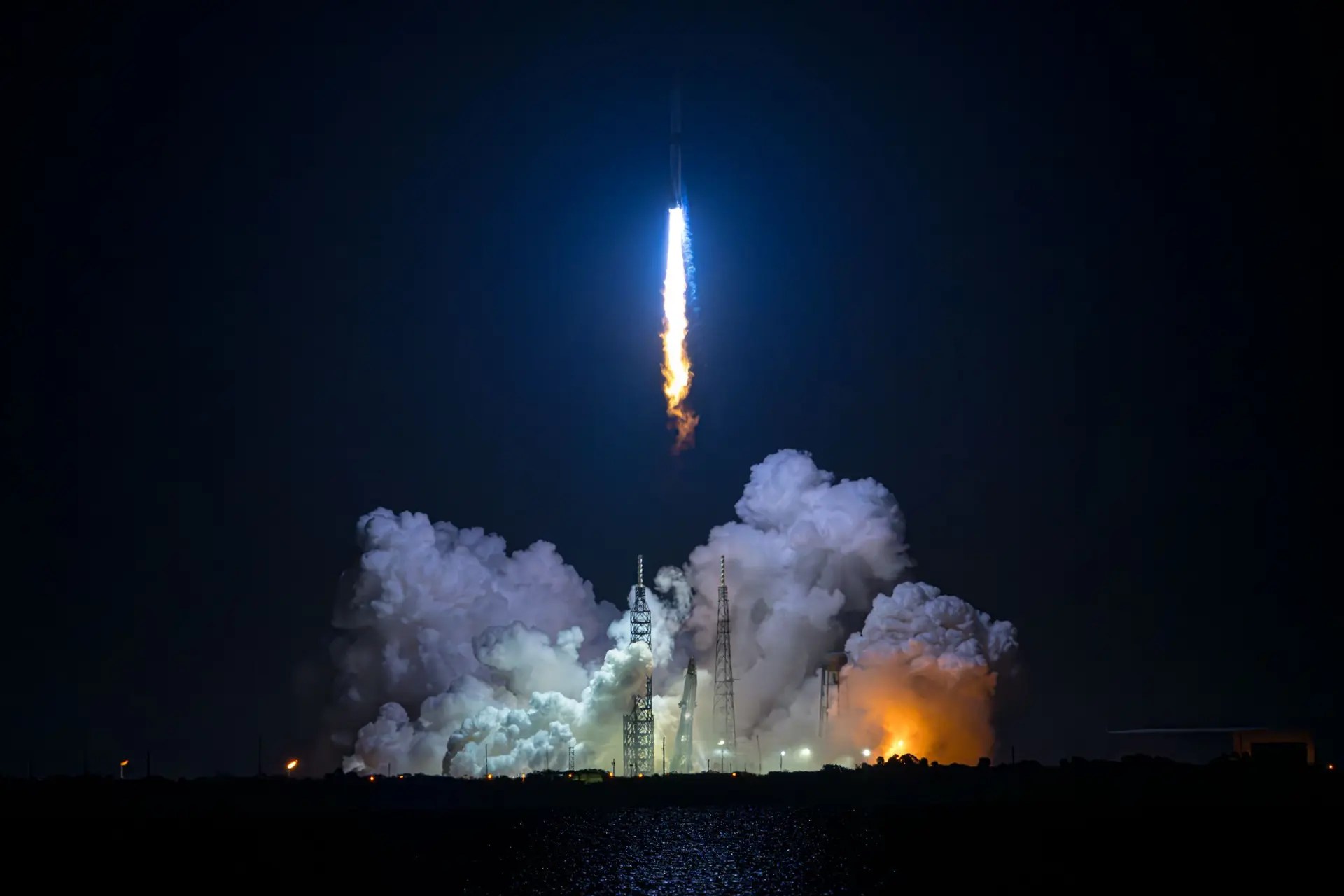
Image (Credit): Blue Origin’s New Glenn rocket lifting off on January 16, 2025. (Blue Origin)
Earlier today, Blue Origin’s New Glenn rocket safely made its way into the Earth’s orbit from its launch pad at the Cape Canaveral Space Force Station in Florida. The only piece of the mission that fell short was the loss of the booster that should have landed on a barge in the Atlantic Ocean.
I’m incredibly proud New Glenn achieved orbit on its first attempt…We knew landing our booster, So You’re Telling Me There’s a Chance, on the first try was an ambitious goal. We’ll learn a lot from today and try again at our next launch this spring. Thank you to all of Team Blue for this incredible milestone.
Even with the lost booster, the rocket launch has proven that the US space industry may soon have another reliable competitor to challenge SpaceX, which is good new for everyone.
Blue Origin’s New Glenn rocket launch was pushed off again earlier today when ice was found building up on one of the lines related to the hydraulic systems.
We’re standing down on today’s launch attempt to troubleshoot a vehicle subsystem issue that will take us beyond our launch window. We’re reviewing opportunities for our next launch attempt.
As a result, the new launch date is set for Thursday, January 16.
In the meantime, watch for the launch on Wednesday of Firefly Aerospace’s Blue Ghost Mission One as part of NASA’s Commercial Lunar Payload Services (CLPS) program. This mission will deliver 10 science and technology payloads to the Moon, including
Blue Ghost will spend approximately 45 days in transit to the Moon, allowing ample time to conduct health checks on each subsystem and begin payload science. Blue Ghost will then land in Mare Crisium and operate payloads for a complete lunar day (about 14 Earth days). Following payload operations, Blue Ghost will capture imagery of the lunar sunset and provide critical data on how lunar regolith reacts to solar influences during lunar dusk conditions. The lander will then operate for several hours into the lunar night.
Image (Credit): Blue Ghost Mission One schedule. (Firefly Aerospace)
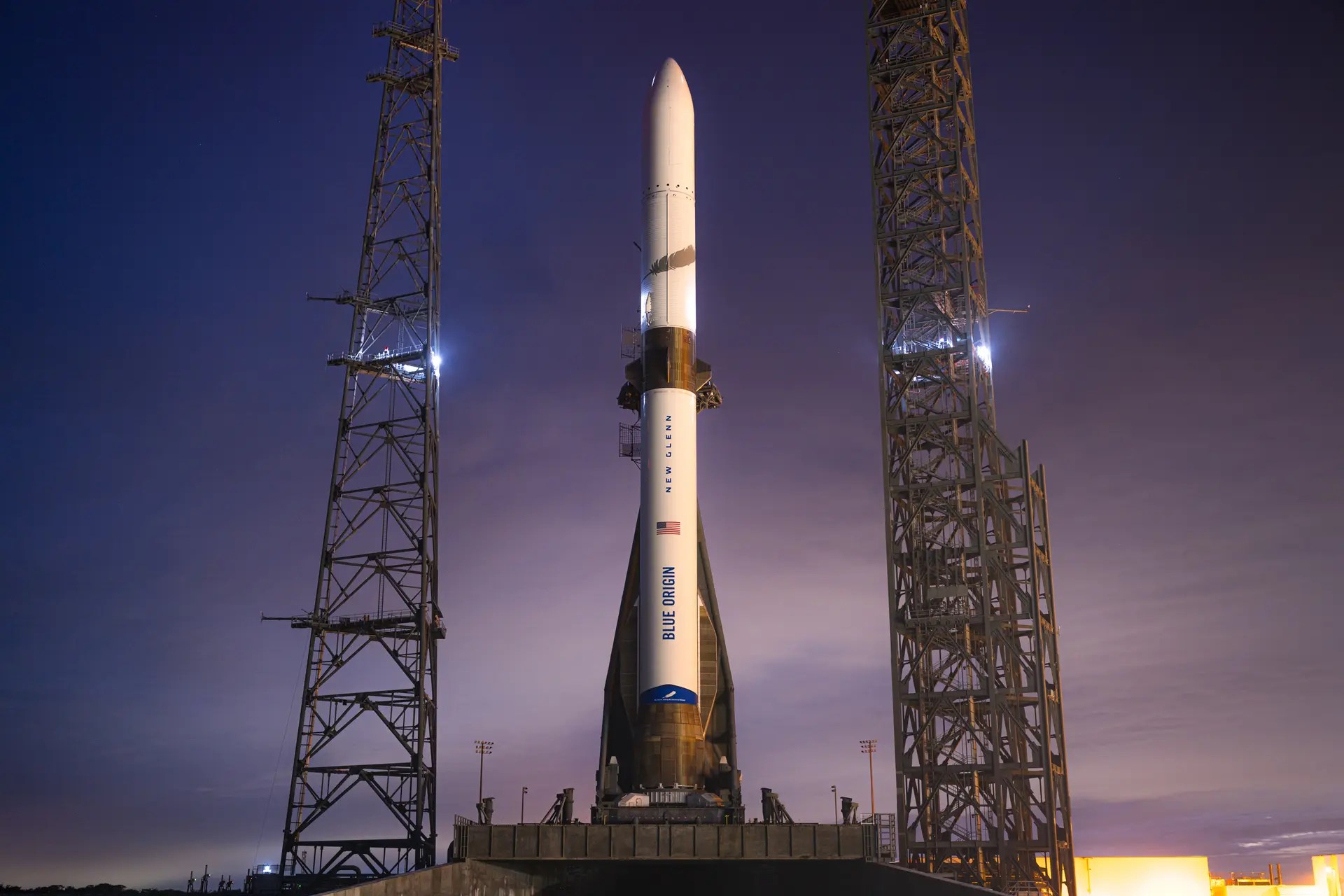
Image (Credit): The New Glenn rocket on the launch pad at Launch Complex 36 in Cape Canaveral. (Blue Origin)
It appears the New Glenn rocket test will take place this Friday, January 10. Blue Origin is using the language “no earlier than,” but this is the best estimate at the moment.
Here is the language from the company’s press release:
New Glenn’s inaugural mission (NG-1) is targeting no earlier than Friday, January 10, from Launch Complex 36 at Cape Canaveral Space Force Station, Florida. The three-hour launch window opens at 1 a.m. EST (0600 UTC). NG-1 is our first National Security Space Launch certification flight.
The payload is our Blue Ring Pathfinder. It will test Blue Ring’s core flight, ground systems, and operational capabilities as part of the Defense Innovation Unit’s (DIU) Orbital Logistics prototype effort.
Our key objective is to reach orbit safely. We know landing the booster on our first try offshore in the Atlantic is ambitious—but we’re going for it.
“This is our first flight and we’ve prepared rigorously for it,” said Jarrett Jones, SVP, New Glenn. “But no amount of ground testing or mission simulations are a replacement for flying this rocket. It’s time to fly. No matter what happens, we’ll learn, refine, and apply that knowledge to our next launch.”
Fingers crossed.
Update: The launch has been moved to Sunday, January 12.
Second Update: The launch has been moved to Monday, January 13.
Image (Credit): Blue Origin’s New Glenn rocket. (Blue Origin)
Sometime next week, Blue Origin is expected to launch its New Glenn rocket, which could put it back in the running as a true challenger to SpaceX for space launches. I know, we already heard this story about Boeing’s Starliner challenging Space’s Dragon capsule, but this may be different.
Per the last posting on Blue Origin’s website on December 27, the rocket is ready to go:
New Glenn successfully completed an integrated launch vehicle hotfire test today, the final major milestone on our road to first flight. NG-1 will carry a Blue Ring Pathfinder as its first manifested payload and will launch from Launch Complex 36 in Cape Canaveral, FL.
The boosters on the 30-story New Glenn rocket are designed to land safely after the launch for future use. Sound familiar? In face, Blue Origin was the first company to successfully test a reusable rocket, so this is nothing new. The New Glenn also has a greater capacity than SpaceX’s Falcon 9.
NASA and the US space industry also have high hopes that the Blue Origin can increase the competition for launches and add some redundancy (you know, in case Mr. Musk really goes off the rails).
If commercial space is the future, then we need more capable players to keep it alive and vibrant. With that in mind, we can only hope for a very successful launch and increased competition down the road.
It was not a good week for the US space industry. One major US space company is looking to exit the business while the head of another US space company is holding secret talks with Putin.
In the first case, Boeing’s bleak finances may be pushing it to consider the sale of its space business, which includes the troubled Starliner capsule most recently stuck at the International Space Station.
Fortune magazine highlighted comments by Boeing’s new CEO, Kelly Ortber, at his first earnings conference call on Wednesday, where he stated:
We’re better off doing less and doing it better than doing more and not doing it well…What do we want this company to look like five and 10 years from now? And do these things add value to the company or distract us?
This follows rumors that Boeing has been talking with Blue Origin about handing off some of its NASA-related portfolio.
It would appear that Boeing, which has been with NASA since the Apollo program, is having some second thoughts about its role in the space program as it deals with Starliner troubles, airplane manufacturing issues, and an ongoing worker strike.
And then we read about Elon Musk having help secret talks with Russia’s Vladimir Putin since at least 2022. You may remember Mr. Musk raised concerns in Washington when it was learned that he turned off his Starlink system when the Ukranians were planning an attack against invading Russian.
Some in Congress are already calling for an investigation into these discussions, given the role of SpaceX in critical Department of Defense contracts. Rep. Adam Smith (D-WA), the House Armed Services Committee’s top Democrat, stated:
We should investigate what Elon Musk is up to to make sure that it is not to the detriment of the national security of the United States.
NASA Administrator Bill Nelson also has some questions, stating:
I don’t know that that story is true. I think it should be investigated…If the story is true that there have been multiple conversations between Elon Musk and the president of Russia, then I think that would be concerning, particularly for NASA, for the Department of Defense, for some of the intelligence agencies.
It has become increasingly apparent that Mr. Musk’s excellence in creating companies will always be trumped by his bone-headed ego. He cannot help but be the center of attention rather than the competent engineer. He should really stay away from social media and social relationships until he can get his ego under control.
As I said, it was not a good week for the US space industry.