Bookshelf: The Giant Leap by Caleb Scharf

Credit: Basic Books

If you are looking for a new book to read, you might want to check out The Giant Leap by Caleb Scharf, who is director of astrobiology at Columbia University and the senior scientist for astrobiology at NASA’s Ames Research Center.

Here is a quick blurb from the publisher:

The story of life has always been one of great transitions, of crossing new frontiers. The dawn of life itself is one; so, too, is the first time two cells stuck together rather than drifting apart. And perhaps most dramatic were the moves from the sea to land, land to air. Each transition has witnessed wild storms of innovation, opportunity, and hazard. It might seem that there are no more realms for life to venture. But there is one: space.

In The Giant Leap, astrobiologist Caleb Scharf argues that our journey into space isn’t simply a giant leap for humankind—it’s life’s next great transition, an evolution of evolution itself. Humans and our technology are catalysts for an interplanetary transformation, marking a disruption in the story of life as fundamental as life’s movement from sea to land, and land to sky.

Inspired by Darwin’s account of his journey on the Beagle, and packed with stories from the past, present, and future of space travel, The Giant Leap thrills at both life’s creativity and the marvels of technology that have propelled us into the cosmos. And it offers an awesome glimpse of the grander vistas that wait in the great beyond.

Scientific American magazine interviewed the author to learn more about his views. One of the questions related to settling on Mars, which the author did not view as a best option for expanding outward into our Solar System:

We definitely need to study Mars and the moon, and maybe some of us should even try to live there. I mean, there’s all sorts of genuine reasons for doing that. But in the long term, it’s far better to engineer what you really need—to create environments that place fewer stressors on life that evolved on Earth over four billion years. Even if you build fabulous habitats on the moon or Mars, you’ll never have Earth-normal gravity in those places, for example.

Whether you make use of a natural object such as an asteroid or just construct an entirely artificial habitat out there, both would give you far more options than a planetary surface. You can spin your habitat to get Earth-like artificial gravity; you can engineer a lovely atmosphere that precisely fits our biological needs. You can set up seasons, choose where to orbit and have robust protection from cosmic radiation.

The interview covers a range of questions that delve into parts of the book. You may want to start with the interview before deciding to go further. It is a great launching point.
Congresswoman Seeks More Data on Interstellar Comet

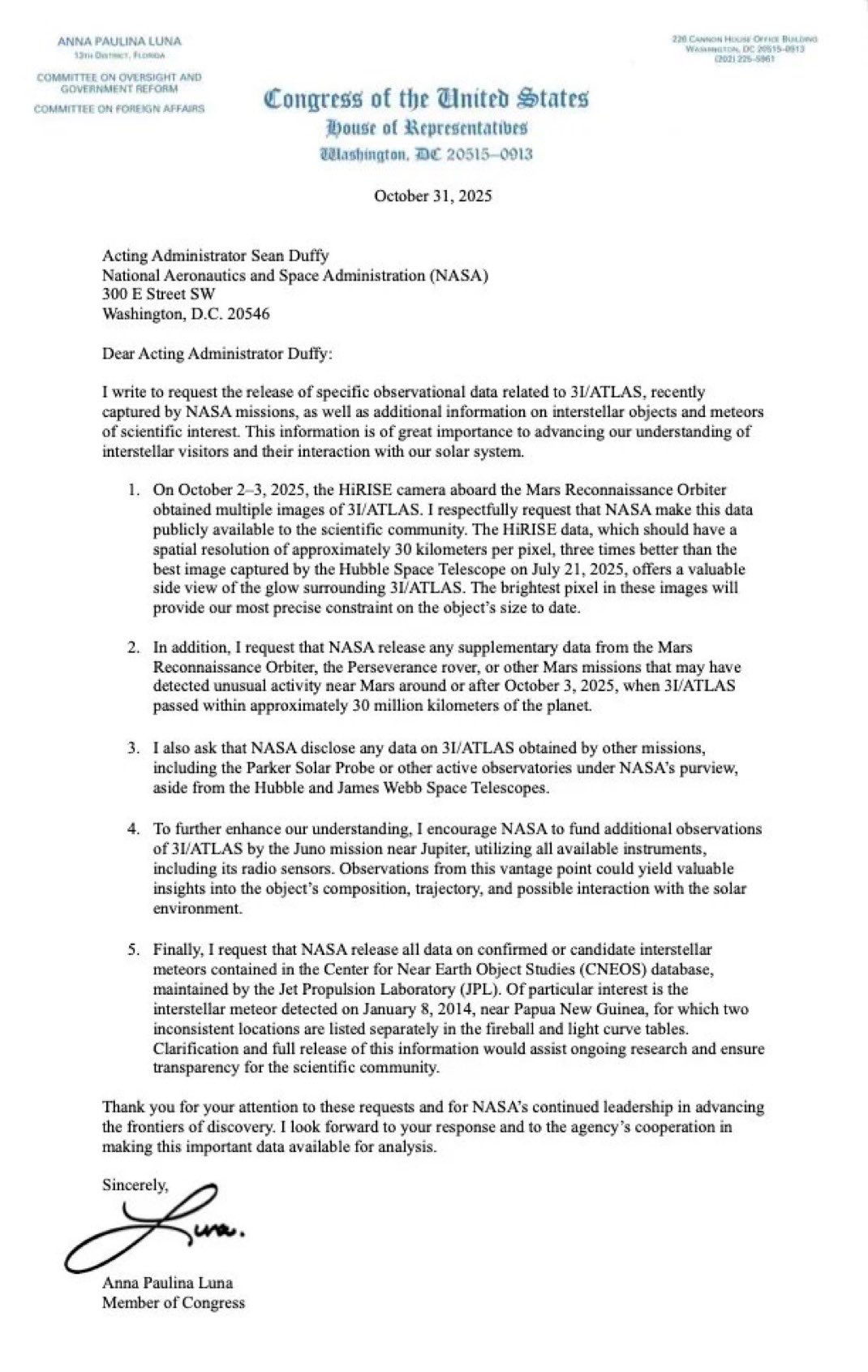
Congresswoman Anna Paulina Luna (R-FL) is very interested in obtaining some additional observational data from NASA regarding the interstellar comet known as 3I/ATLAS. In her letter to NASA (shown below), she said the information is “…of great importance to advancing our understanding of interstellar visitors and their interaction with our solar system.”

It appears this interest follows comments from Harvard scientist Avi Loeb about the object possibly being an alien spaceship.

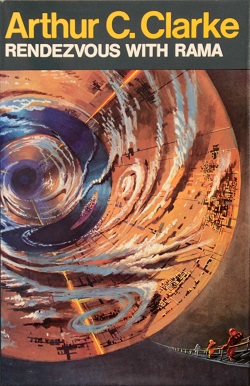
All of this is starting to sound the plot in Arthur C. Clark’s book Rendezvous with Rama.

Space Stories: Dragon Docks with ISS, a Braille Astronomy Book, and an Exoplanet with No Atmosphere

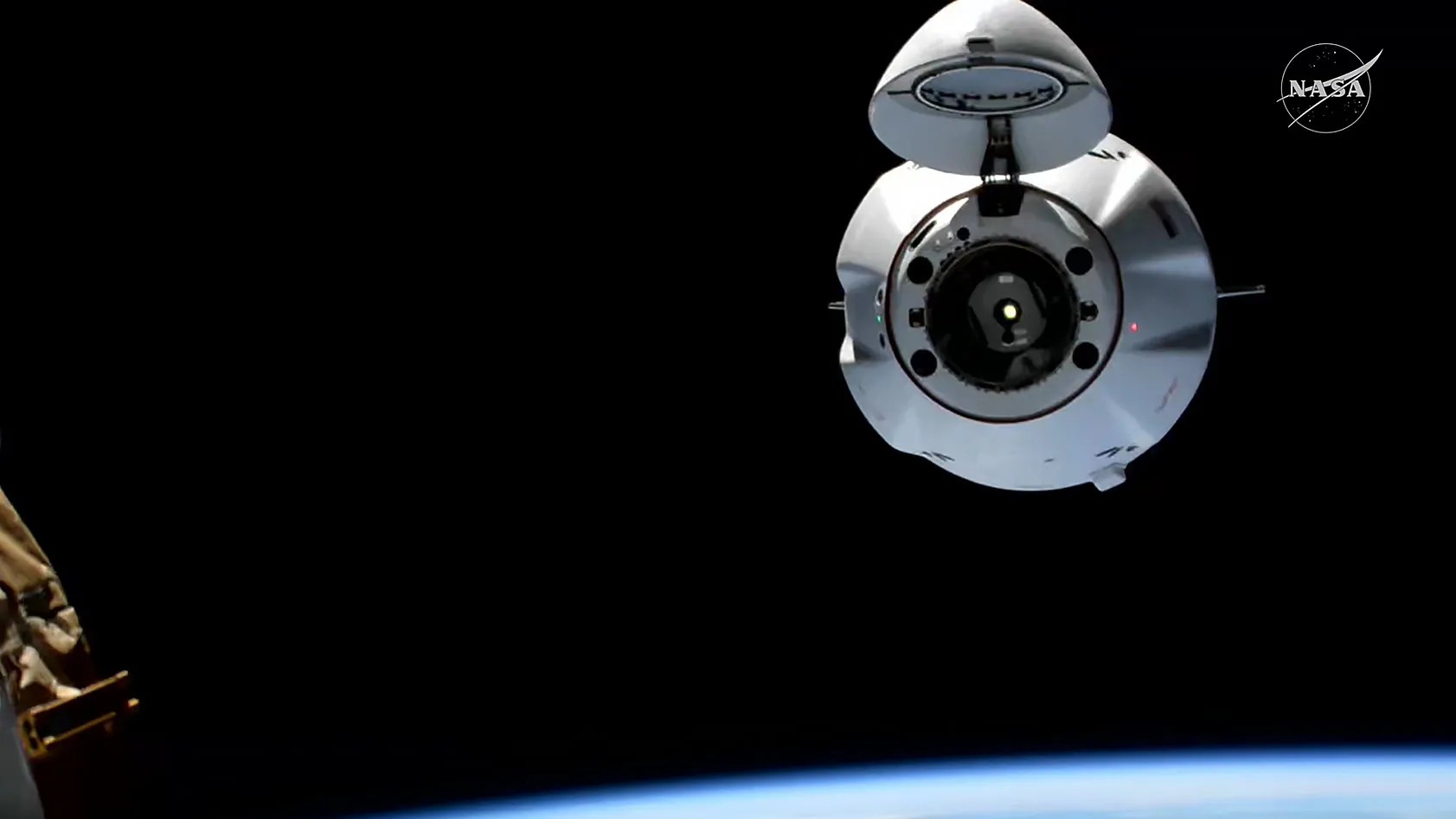
Image (Credit): The Dragon cargo capsule approaching the ISS. (NASA)

Here are some recent space-related stories of interest.

NASA: SpaceX Dragon Docks to Station Delivering New Science, Supplies

At 7:05 a.m. EDT, the SpaceX Dragon spacecraft docked to the forward port of the International Space Station’s Harmony module.  The spacecraft carried over 5,000 pounds of scientific investigations and cargo to the orbiting laboratory on SpaceX’s 33rd commercial resupply services mission for NASA. The mission launched at 2:45 a.m. on Aug. 24 atop a SpaceX Falcon 9 rocket from Space Launch Complex 40 at Cape Canaveral Space Force Station in Florida. 

Cincinnati Enquirer: New Braille Book from Cincinnati Astronomer Lets You See Constellations Without Your Eyes

Longtime readers will recognize the name Dean Regas, astronomy contributor to The Enquirer and former cohost of the PBS series “Star Gazers,” but they may not know that Regas is also the author of seven books about astronomy. His latest foray into the world of writing, “All About Orion,” is a children’s book focused on its namesake, Orion, with a twist: the book features braille writing and textile constellations as well as large print for blind and visually impaired children.

Universe Today: “Another Earth-like Exoplanet Crossed Off the List: JWST Shows that GJ 3929b Has No Atmosphere

The JWST’s latest exoplanet atmosphere target is GJ 3929 b. Astronomers discovered it in TESS data in 2022. “Our analysis confirms the planetary nature of the transiting planet GJ 3929 b,” the authors of the 2022 paper wrote. “Its mass and radius (~ 0.43 Earth masses and ~1.15 Earth radii) put it into the regime of small Earth-sized planets.” Earth-like planets attract attention for obvious reasons. Now the JWST’s results are in, and the once-promising planet appears to be barren.

Ed Helms and Lunar Nukes

Credit: Grand Central Publishing.

Actor Ed Helms is making his rounds to sell his book Snafu: The Definitive Guide to History’s Greatest Screwups.

One of the stories he tells is about the US “planting nukes on the moon.” Is this true?

Yes, it was a top secret effort called Project A119, with the goal of exploding a hydrogen bomb on the Moon. And believe it or not, Carl Sagan was involved in the calculations related to this zany idea.

This was in the late 1950s during the Cold War when the US and Soviet Union were doing everything they could to trump one another. It also was right after Sputnik, when the US felt it was losing the space race. In this case, the US would make a clear demonstration of its power through this distant explosion.

Fortunately, the US decided to take a better route by going into orbit and eventually to the Moon. If we had blown up the Moon, Carl Sagan would have been remembered in a very different way today – less as the educator, and more as Dr. Strangelove.

Just never underestimate the ability of the government to go down some dark roads. We needed guardrails then like we need them now.

You can read more about it in this History.com story.

Books for NASA Foodies

Credit: Ballast Books

If you are a foodie and still looking for a holiday gift or just a fun gift, you might want to check out these two space-related books.

The first book by Vickie Kloeris, Space Bites: Reflections of a NASA Food Scientist, discusses the thinking that goes into the food prepared for NASA’s astronauts. In this case, Ms. Kloeris worked with the food eaten by astronauts on the space shuttles and the International Space Station.

Former NASA Astronaut Mike Massimino stated:

During her decades-long career at NASA, my friend and colleague Vickie Kloeris made sure my fellow astronauts and I were well-fed and healthy while in space. Space Bites is not only a compilation of stories of her amazing career but also a behind-the-scenes look at the evolution of human space travel. Read this book to be inspired and to learn, and don’t be surprised if it also leaves you hungry for some space food.

It might be the perfect book after holidays if you want some insight into the space program.

However, if you want to sample the astronaut food, you might want to check out this older book by Charles T. Borland and Gregory L. Vogt, The Astronaut’s Cookbook: Tales, Recipes, and More. It contains recipes allowing you to create astronaut-worthy meals without the freeze drying.

The book covers a lot of territory: Appetizers, Beverages, Bread and Tortillas, Cookies, Sandwiches, Desserts, Main Dishes, Soups and Salads, Vegetables, and Future Space Foods.

David W. Hughes from Astronomy Now noted:

Charles Bourland has just retired from his job as NASA’s ‘director of space foods’, and Gregory Vogt was an astronaut trainer. They have provided us with a fascinating insight into the job of the space dietician and nutritionist, as well as a wondrous collection of recipes for the meals that were served on Skylab, Apollo, thespace shuttle and the International Space Station. … This an intriguing book, well written, and colourfully reproduced with a host of appetising pictures.

It may not be fantastic food, yet you can eat like an astronaut (and maybe suffer like an astronaut). When you sit down to dine on this strange fare, you can be pretty certain that no one else in your neighborhood will have such a dinner that evening.

Credit: Springer