Book Review: Starry Messenger Starring Neil deGrasse Tyson

Credit: Henry Holt and Co.

Neil deGrasse Tyson has put out quite a few popular astronomy books over the years, including:

  • One Universe: At Home in the Cosmos (2000);
  • The Sky Is Not the Limit: Adventures of an Urban Astrophysicist (2004);
  • Death by Black Hole: And Other Cosmic Quandaries (2007);
  • The Pluto Files: The Rise and Fall of America’s Favorite Planet (2009); and
  • Astrophysics for People in a Hurry (2017). 

And while he often runs into the thick of current politics in his interviews, his books tended to stick to science. His latest book, Starry Messenger: Cosmic Perspectives on Civilization, is one of the exceptions and at least one reviewer is taking him to the woodshed.

Mr. Tyson says this in the book’s preface:

Starry Messenger is a wake-up call to civilization. People no longer know who or what to trust. We sow hatred of others fueled by what we think is true, or what we want to be true, without regard to what is true. Cultural and political factions battle for the souls of communities and of nations. We’ve lost all sight of what distinguishes facts from opinions. We’re quick with acts of aggression and slow with acts of kindness.

To The Washington Post’s Mark Whitaker, in his review titled “Neil deGrasse Tyson Tries Punditry, with Less-than-stellar Results,” Mr. Tyson may be going a little too boldly into the political realm. Mr. Whitaker writes:

When Tyson sticks to his orbit of expertise, he remains as engaging as ever, like the professor of a popular college survey course that students might take to satisfy their science requirement… Yet while Tyson extols the virtue of a skeptical mind-set in scientific inquiry, he often comes off as none-too-skeptical in his discussion of how that mind-set can be applied to human and political affairs.

Just as Mr. Tyson followed and updated Carl Sagan’s work, such as the remake of the television series Cosmos, he may be trying to update Dr. Sagan’s 1995 book The Demon-Haunted World: Science as a Candle in the Dark. Dr. Sagan was concerned about the future of mankind and its silly prejudices, which he also illustrated in his fictional book Contact. In The Demon-Haunted World, Dr. Sagan wrote:

I have a foreboding of an America in my children’s or grandchildren’s time – when the United States is a service and information economy; when nearly all the key manufacturing industries have slipped away to other countries when awesome technological powers are in the hands of a very few, and no one representing the public interest can even grasp the issues; when the people have lost the ability to set their own agendas or knowledgeably question those in authority when, clutching our crystals and nervously consulting our horoscopes, our critical faculties in decline, unable to distinguish between what feels good and what’s true, we slide, almost without noticing, back into superstition and darkness.

He wrote that almost 27 years ago and we are now living in the time of his children and grandchildren. His predictions seem true enough in a time of Facebook and “fake news,” as well as various denials throughout the world, from elections to climate change.

Maybe Mr. Tyson’s book is far from perfect, but if he can really continue Dr. Sagan’s work of chipping away at opinions masquerading as facts, then he is pursuing the same noble path even if it he hits a few bumps along the way. We may not be able to save what we have if we continue with our games for another 27 years.

Podcast/Book Review: The Mission: A True Story

Credit: NASA

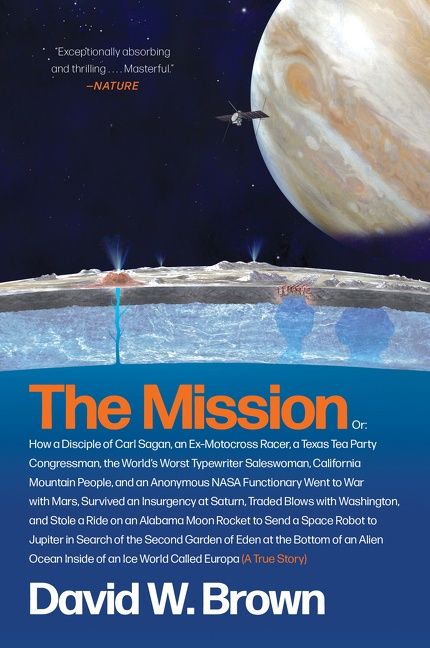
A recent episode of the Astronomy Cast podcast recommended a number of books to read this summer, including David W. Brown’s book The Mission: A True Story. It highlights all the efforts to make the soon-to-be-launched Europa Clipper mission a reality. Below is the book blurb by Harper Collins:

In the spirit of Tom Wolfe and John McPhee, The Mission is an exuberant master class of creative nonfiction that reveals how a motley, determined few expanded the horizon of human achievement.

When scientists discovered the first ocean beyond Earth, they had two big questions: “Is it habitable?” and “How do we get there?” To answer the first, they had to solve the second, and so began a vivacious team’s twenty-year odyssey to mount a mission to Europa, the ocean moon of Jupiter.

Standing in their way: NASA, fanatically consumed with landing robots on Mars; the White House, which never saw a science budget it couldn’t cut; Congress, fixated on going to the moon or Mars—anywhere, really, to give astronauts something to do; rivals in academia, who wanted instead to go to Saturn; and even Jupiter itself, which guards Europa in a pulsing, rippling radi­ation belt—a halo of death whose conditions are like those that follow a detonated thermonuclear bomb.

The Mission is the Homeric, never-before-told story of modern space exploration, and a magnificent portrait of the inner lives of scientists who study the solar system’s mysterious outer planets. David W. Brown chronicles the remarkable saga of how Europa was won, and what it takes to get things done—both down here, and up there.

I think it is safe to say that every space mission goes through a gauntlet these days and is lucky to remain intact at the other end. The James Webb Space Telescope started in the 1990s and only saw the light of day (on a distant exoplanet) earlier this year. Not everyone may have the stomach for the sausage-making behind these missions, but you may want to read this tale if you are looking for modern-day drama in the halls of government and academia that can lead to something meaningful.

Credit: Harper Collins

Podcast: Lori Garver on NASA and Commercial Space

Credit: Amazon

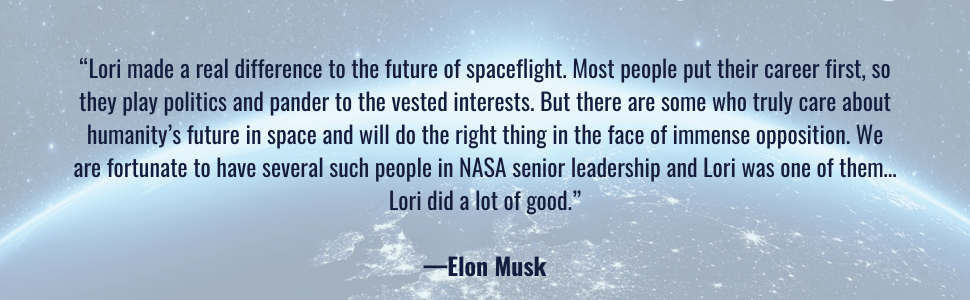
This week’s StarTalk podcast with Neil deGrasse Tyson included an interview with former Deputy Administrator of NASA, Lori Garver. She is author of a new book, Escaping Gravity: My Quest to Transform NASA and Launch a New Space Age, which has a number of reviewer quotes, including the one from Elon Musk below.

In addition to the dialog about her time with NASA and the growing role of commercial space providers, the dialogue also gets into specific projects, including potential plans to mine asteroids. One asteroid in particular, Psyche (located in the asteroid belt), was cited as an asteroid of special interest because it contains what some believe to be the core of a failed planet, which means plenty of expensive metals.

NASA currently has plans to launch a spacecraft later this year to visit Psyche. The objectives are to:

  • Determine whether Psyche is a core, or if it is unmelted material.
  • Determine the relative ages of regions of Psyche’s surface.
  • Determine whether small metal bodies incorporate the same light elements as are expected in the Earth’s high-pressure core.
  • Determine whether Psyche was formed under conditions more oxidizing or more reducing than Earth’s core.
  • Characterize Psyche’s topography.

I recommend you listen to the full podcast story and also stayed tuned for the upcoming asteroid adventure.

Image (Credit): Quote regarding Ms. Garver’s latest book. (Amazon)

Update: The Psyche mission has been delayed. NASA noted:

Due to the late delivery of the spacecraft’s flight software and testing equipment, NASA does not have sufficient time to complete the testing needed ahead of its remaining launch period this year, which ends on Oct. 11.

A launch is possible as early as next year, but NASA is now going over all the options.

Space Quote: The End of Astronauts?

Credit: Belknap Press/Harvard University Press

“We should not have publicly funded programmes to send people to the moon, still less to Mars…It’s hugely risky, hugely expensive, and there’s no practical or scientific benefit to sending humans. It’s a pretty bad bargain for the taxpayer.”

-Statement by Lord Martin Rees, co-author of the book The End of Astronauts, speaking to the The Guardian. He argues that private sector humans and government robots are the future of space exploration. In other words, let billionaires die space, while the government avoids this risk. Harvard University Press states:

In The End of Astronauts, Goldsmith and Rees weigh the benefits and risks of human exploration across the solar system. In space humans require air, food, and water, along with protection from potentially deadly radiation and high-energy particles, at a cost of more than ten times that of robotic exploration. Meanwhile, automated explorers have demonstrated the ability to investigate planetary surfaces efficiently and effectively, operating autonomously or under direction from Earth. Although Goldsmith and Rees are alert to the limits of artificial intelligence, they know that our robots steadily improve, while our bodies do not. Today a robot cannot equal a geologist’s expertise, but by the time we land a geologist on Mars, this advantage will diminish significantly.

You can read an excerpt from the book at Slate.

Similar Sentiments About Our Place in the Universe

Image (Credit): Book cover of Olaf Staledon’s Star Maker. (Wesleyan University Press)

I was reading the 1937 science fiction classic Star Maker by British writer Olaf Stapledon when I came across this statement:

I perceived that I was on a little round grain or rock and metal, filmed with water and with air, whirling in sunlight and darkness. And on the skin of that little grain all the swarms of men, generation by generation, had lived in labor and blindness, with intermittent joy and intermittent lucidity of spirit. And all their history, with its folk-wanderings, its empires, its philosophies, its proud sciences, its social revolutions, its increasing hunger for community, was but a flicker in one day of the lives of stars.

It reminded me of Carl Sagan’s famous statement from his book Pale Blue Dot:

From this distant vantage point, the Earth might not seem of any particular interest. But for us, it’s different. Consider again that dot. That’s here. That’s home. That’s us. On it everyone you love, everyone you know, everyone you ever heard of, every human being who ever was, lived out their lives. The aggregate of our joy and suffering, thousands of confident religions, ideologies, and economic doctrines, every hunter and forager, every hero and coward, every creator and destroyer of civilization, every king and peasant, every young couple in love, every mother and father, hopeful child, inventor and explorer, every teacher of morals, every corrupt politician, every “superstar,” every “supreme leader,” every saint and sinner in the history of our species lived there–on a mote of dust suspended in a sunbeam.

Mr. Stapledon had only his imagination at hand when he pondered the role of humans. His book has been praised by numerous science fiction writers, including H. G. Wells, Stanisław Lem, and Arthur C. Clarke.

Mr. Sagan was fortunate to have an image from Voyager I that clearly made this same point. We need the combined powers of dreamers and scientists as we face this awesome universe.

Image (Credit): This narrow-angle color image of the Earth, dubbed ‘Pale Blue Dot’, is a part of the first ever ‘portrait’ of the solar system taken by Voyager 1. (NASA JP)

Extra: For more background on the image above, visit NASA’s site 10 Things You Might Not Know About Voyager’s Famous ‘Pale Blue Dot’ Photo.