If you are looking for another gift idea for the holidays, maybe you should consider one of the many popular astronomy books. Here are the 10 most popular from Goodreads:
It’s great to see that Carl Sagan is still educating the public so many years after his death. As with the Voyager spacecraft, his words and contributions are traveling far and wide.
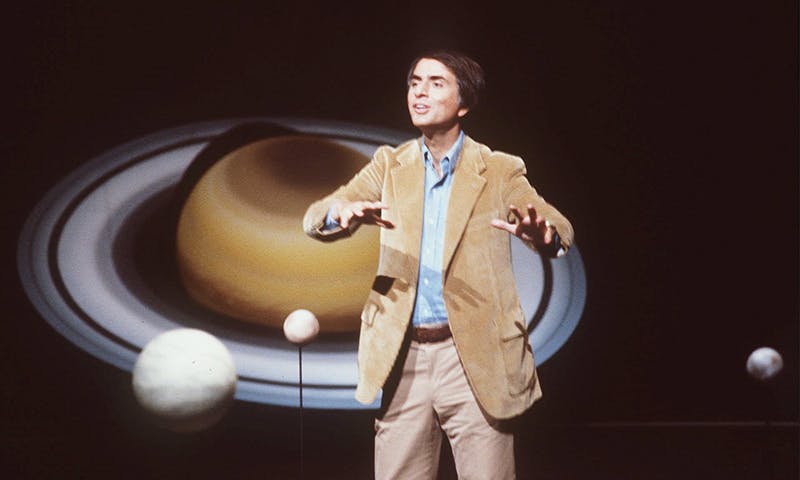
Image (Credit): Astrobiologist Carl Sagan. (Nautilus.us)
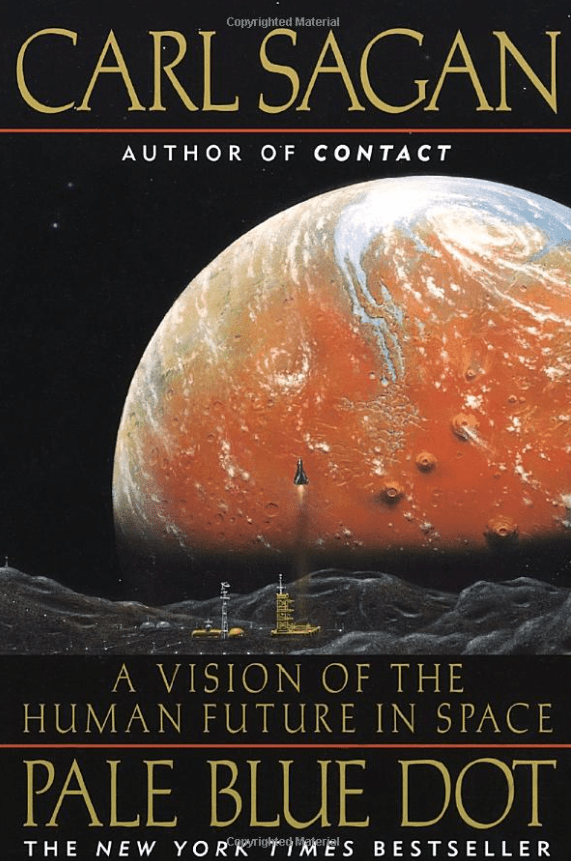
On this day in 1934, scientist and communicator Carl Edward Sagan was born in Brooklyn, NY. He was to become a great communicator of all things related to astronomy. He has played a key role over the years introducing millions to our place in the universe through his books, television series, speeches, and scientific work. His television series Cosmos was a milestone in educational television, bringing the stars and planets into everyone’s living room, while his books (Contact, Pale Blue Dot, The Dragons of Eden) continue to encourage the next generation of astronomers.
Dr. Sagan has a long resume, but I am most fascinated with his work to communicate with extraterrestrial life. He was a strong supporter of the Search for Extra-Terrestrial Intelligence (SETI) and worked with NASA to ensure our spacecraft were equipped with a record of human activity to educate other planetary civilizations, including the gold records placed on the Pioneer 10 and 11 space probes as well as the two Voyager space probes.
Years ago, the Smithsonian magazine had a good summary of Dr. Sagan’s life in the article “Why Carl Sagan is Truly Irreplaceable.” I recommend the article as a good way to get to know the man, though delving into his books is even better.
Credit: Ballantine Books
Extra: Carl Sagan was also the founder and first president of the Planetary Society. Visit this Planetary Society site, Ann Druyan wishes you a happy Sagan Day, for more on Dr. Sagan’s work.
Neil deGrasse Tyson has put out quite a few popular astronomy books over the years, including:
One Universe: At Home in the Cosmos (2000);
The Sky Is Not the Limit: Adventures of an Urban Astrophysicist (2004);
Death by Black Hole: And Other Cosmic Quandaries (2007);
The Pluto Files: The Rise and Fall of America’s Favorite Planet (2009); and
Astrophysics for People in a Hurry (2017).
And while he often runs into the thick of current politics in his interviews, his books tended to stick to science. His latest book, Starry Messenger: Cosmic Perspectives on Civilization, is one of the exceptions and at least one reviewer is taking him to the woodshed.
Mr. Tyson says this in the book’s preface:
Starry Messenger is a wake-up call to civilization. People no longer know who or what to trust. We sow hatred of others fueled by what we think is true, or what we want to be true, without regard to what is true. Cultural and political factions battle for the souls of communities and of nations. We’ve lost all sight of what distinguishes facts from opinions. We’re quick with acts of aggression and slow with acts of kindness.
When Tyson sticks to his orbit of expertise, he remains as engaging as ever, like the professor of a popular college survey course that students might take to satisfy their science requirement… Yet while Tyson extols the virtue of a skeptical mind-set in scientific inquiry, he often comes off as none-too-skeptical in his discussion of how that mind-set can be applied to human and political affairs.
Just as Mr. Tyson followed and updated Carl Sagan’s work, such as the remake of the television series Cosmos, he may be trying to update Dr. Sagan’s 1995 book The Demon-Haunted World: Science as a Candle in the Dark. Dr. Sagan was concerned about the future of mankind and its silly prejudices, which he also illustrated in his fictional book Contact. In The Demon-Haunted World, Dr. Sagan wrote:
I have a foreboding of an America in my children’s or grandchildren’s time – when the United States is a service and information economy; when nearly all the key manufacturing industries have slipped away to other countries when awesome technological powers are in the hands of a very few, and no one representing the public interest can even grasp the issues; when the people have lost the ability to set their own agendas or knowledgeably question those in authority when, clutching our crystals and nervously consulting our horoscopes, our critical faculties in decline, unable to distinguish between what feels good and what’s true, we slide, almost without noticing, back into superstition and darkness.
He wrote that almost 27 years ago and we are now living in the time of his children and grandchildren. His predictions seem true enough in a time of Facebook and “fake news,” as well as various denials throughout the world, from elections to climate change.
Maybe Mr. Tyson’s book is far from perfect, but if he can really continue Dr. Sagan’s work of chipping away at opinions masquerading as facts, then he is pursuing the same noble path even if it he hits a few bumps along the way. We may not be able to save what we have if we continue with our games for another 27 years.
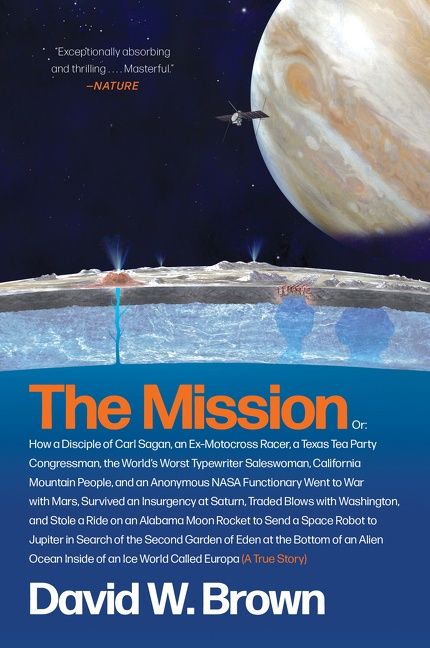
A recent episode of the Astronomy Cast podcast recommended a number of books to read this summer, including David W. Brown’s book The Mission: A True Story. It highlights all the efforts to make the soon-to-be-launched Europa Clipper mission a reality. Below is the book blurb by Harper Collins:
In the spirit of Tom Wolfe and John McPhee, The Mission is an exuberant master class of creative nonfiction that reveals how a motley, determined few expanded the horizon of human achievement.
When scientists discovered the first ocean beyond Earth, they had two big questions: “Is it habitable?” and “How do we get there?” To answer the first, they had to solve the second, and so began a vivacious team’s twenty-year odyssey to mount a mission to Europa, the ocean moon of Jupiter.
Standing in their way: NASA, fanatically consumed with landing robots on Mars; the White House, which never saw a science budget it couldn’t cut; Congress, fixated on going to the moon or Mars—anywhere, really, to give astronauts something to do; rivals in academia, who wanted instead to go to Saturn; and even Jupiter itself, which guards Europa in a pulsing, rippling radiation belt—a halo of death whose conditions are like those that follow a detonated thermonuclear bomb.
The Mission is the Homeric, never-before-told story of modern space exploration, and a magnificent portrait of the inner lives of scientists who study the solar system’s mysterious outer planets. David W. Brown chronicles the remarkable saga of how Europa was won, and what it takes to get things done—both down here, and up there.
I think it is safe to say that every space mission goes through a gauntlet these days and is lucky to remain intact at the other end. The James Webb Space Telescope started in the 1990s and only saw the light of day (on a distant exoplanet) earlier this year. Not everyone may have the stomach for the sausage-making behind these missions, but you may want to read this tale if you are looking for modern-day drama in the halls of government and academia that can lead to something meaningful.
In addition to the dialog about her time with NASA and the growing role of commercial space providers, the dialogue also gets into specific projects, including potential plans to mine asteroids. One asteroid in particular, Psyche (located in the asteroid belt), was cited as an asteroid of special interest because it contains what some believe to be the core of a failed planet, which means plenty of expensive metals.
NASA currently has plans to launch a spacecraft later this year to visit Psyche. The objectives are to:
Determine whether Psyche is a core, or if it is unmelted material.
Determine the relative ages of regions of Psyche’s surface.
Determine whether small metal bodies incorporate the same light elements as are expected in the Earth’s high-pressure core.
Determine whether Psyche was formed under conditions more oxidizing or more reducing than Earth’s core.
Characterize Psyche’s topography.
I recommend you listen to the full podcast story and also stayed tuned for the upcoming asteroid adventure.
Update: The Psyche mission has been delayed. NASA noted:
Due to the late delivery of the spacecraft’s flight software and testing equipment, NASA does not have sufficient time to complete the testing needed ahead of its remaining launch period this year, which ends on Oct. 11.
A launch is possible as early as next year, but NASA is now going over all the options.