Space Stories: Chinese Space Partnerships, Approaching Comet, and European Rocket Shortage

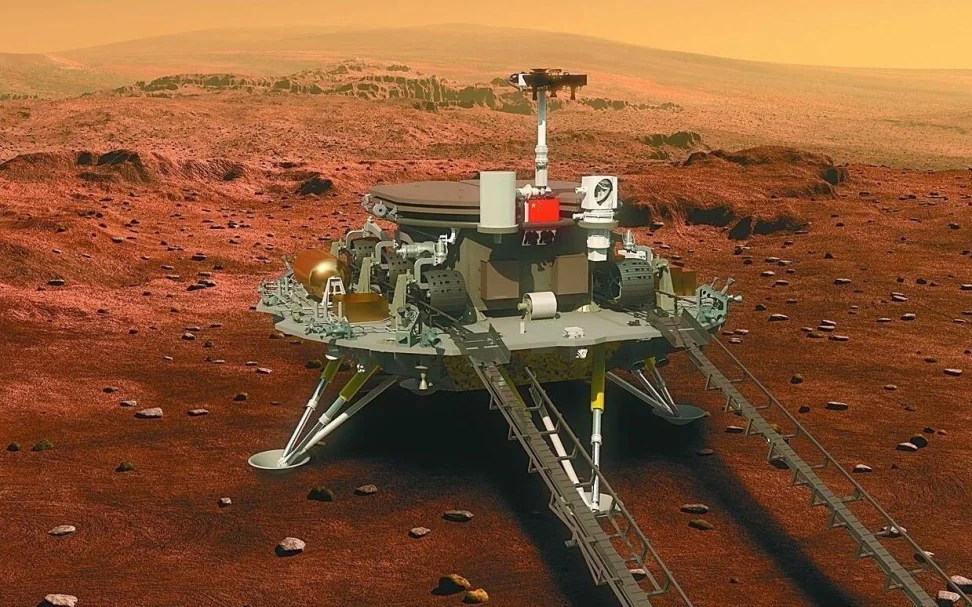
Image (Credit): Chinese space program poster. (Asia Times)

Here are some recent stories of interest.

SpaceNews.com: “China Looks to Build Space Partnerships with Gulf Nations

China is aiming to grow cooperation with emerging space nations including Saudi Arabia and the United Arab Emirates. Space was named as one of a number of priority areas for the next three to five years during the first China-Gulf Cooperation Council (GCC) Summit held in Riyadh earlier this month. “China stands ready to work with GCC countries on remote sensing and communications satellite, space utilization, aerospace infrastructure, and the selection and training of astronauts,” according to the text of the keynote speech made by Chinese President Xi Jinping at the summit, Dec. 9. The GCC intergovernmental group comprises Saudi Arabia, the United Arab Emirates, Bahrain, Kuwait, Oman and Qatar.

Newsweek: “Once-in-a-Lifetime Cosmic Event Could Be Visible to the Naked Eye

A comet zooming through the solar system could soon be visible to the naked eye from Earth in what will be a once-in-a-lifetime event. And some astronomical predictions indicate that the object may never return to our cosmic neighborhood. C/2022 E3 (ZTF) is currently located around 100 million miles away from Earth and will make a close approach to our planet in early February 2023.

Atalayar.com: Europe Runs out of Rockets for Autonomous Access to Space

Overnight, the European Space Agency (ESA) headed by Austrian Josef Aschbacher has been left without any capacity to position its own satellites in outer space. Neither Aschbacher nor his director of space transport, the Swiss Daniel Neuenschwander, have any space vector model to fulfil their commitments to the European Union to renew the Copernicus constellation and place their Sentinel environmental monitoring satellites in orbit. Much less is ESA in a position to meet the growing global demand for launch services that is knocking on its doors, those of the United States, China and India.

A Day in Astronomy: The Last Lunar Footprint

Image (Credit): Official emblem of the Apollo 17 lunar landing mission. (NASA)

On this day in 1972, Apollo 17 commander Eugene Cernan was the last human to be on the Moon. He was the eleventh human to ever step on the Moon.

Here is the full crew of Apollo 17:

  • Eugene A. Cernan, Commander
  • Harrison H. Schmitt, Lunar Module Pilot
  • Ronald E. Evans, Command Module Pilot

Mr. Cernan, who passed away in 2017, was also part of the Apollo 10 mission that orbited the moon without landing (similar to the upcoming Artemis II mission).

With the successful orbit of the Orion spacecraft around the Moon this month, let’s hope the 50 year dryspell is finally over and the United States can again be the nation putting humans back on the lunar surface. Of course, we will be followed by others, including the Chinese. Yet it’s important the first space-faring nation get back in the game and restart the human exploration of the Moon, and then Mars soon thereafter.

In Case You Missed It: Poop for the Ages

Image (Credit): A trasch bag lying beneath the Apollo Lunar Module in 1969. (NASA)

Back in July 2019, Vox had a great article about the waste astronauts left behind on the Moon. In the article, “Apollo Astronauts Left Their Poop on the Moon. We Gotta Go Back for That Shit.,” we learn about approximately 96 bags of human waste left behind on the moon. The topic is relevant today because (1) we are talking about returning to the Moon under the Artemis mission and (2) we probably want to learn more about the lifespan of this waste before we continue to deposit it on the Moon, Mars, and elsewhere. So maybe it is time to revisit the poop.

Earlier, The Atlantic had another article that listed much more human debris on the Moon than just the 96 bags (of urine, feces, and vomit, mind you). Here is the incomplete list:

  • more than 70 spacecraft, including rovers, modules, and crashed orbiters;
  • 5 American flags;
  • 2 golf balls;
  • 12 pairs of boots;
  • TV cameras;
  • film magazines;
  • 96 bags of urine, feces, and vomit;
  • numerous Hasselbad cameras and accessories;
  • several improvised javelins;
  • various hammers, tongs, rakes, and shovels;
  • backpacks;
  • insulating blankets;
  • utility towels;
  • used wet wipes;
  • personal hygiene kits;
  • empty packages of space food;
  • a photograph of Apollo 16 astronaut Charles Duke’s family;
  • a feather from Baggin, the Air Force Academy’s mascot falcon, used to conduct Apollo 15’s famous “hammer-feather drop” experiment;
  • a small aluminum sculpture, a tribute to the American and Soviet “fallen astronauts” who died in the space race—left by the crew of Apollo 15;
  • a patch from the never-launched Apollo 1 mission, which ended prematurely when flames engulfed the command module during a 1967 training exercise, killing three U.S. astronauts;
  • a small silicon disk bearing goodwill messages from 73 world leaders, and left on the moon by the crew of Apollo 11;
  • a silver pin, left by Apollo 12 astronaut Alan Bean;
  • a medal honoring Soviet cosmonauts Vladimir Komarov and Yuri Gagarin; and
  • a cast golden olive branch left by the crew of Apollo 11.

In the 2022 movie Moonshot, we sent Martian trash back to Earth. But that was not the case with the Moon. And now China and Russia are clamoring to do the same in the near future. Will the Moon someday be marked with more trash heaps than craters?

One might argue that explorers throughout time have had to leave something behind. Think of the piles of trash as well as corpses left on the top of Mount Everest. The great sea explorers also left plenty of men, material, and ships at the bottom of the sea where they would remain unclaimed.

But the interesting part of the Vox story is the potential of life remaining in that trash and even producing new life. If such biological material can seed new life, then who can say whether the Earth was simply a rest stop for aliens on their way somewhere else, and we are the product of their poop.

One more thing. If we do manage to let the Earth slip away from us and flip into another Venusian nightmare, the Moon poop may be the only human biology for a future alien to analyze. We sent the Voyager and other spacecraft out into the void with recordings and data, but no one thought about adding a biological component. Well, now we have that surviving piece on the Moon should it be needed. If we can figure out what a Tyrannosaurus was eating millions of years ago, maybe future visitors can figure out what the astronauts were eating in 20th century Texas.

Intense stuff, and worth reading about when you have a moment.

Space Stories: Hungarians in Space, A Constantly Manned Chinese Space Station, and Lunar Water

Here are some recent stories of interest.

SpaceNews.com: “Hungary to spend $100 million on private astronaut mission to ISS

The Hungarian government plans to spend $100 million to send an astronaut to the International Space Station in two years through a deal with Axiom Space. In a presentation at the European Space Agency’s ministerial council meeting Nov. 22, Péter Szijjártó, Hungarian foreign minister, said the country was in the middle of a process to select an astronaut to fly on a month-long mission to the ISS in late 2024 or early 2025. Axiom Space announced in July it signed a memorandum of understanding with the government of Hungary regarding that country’s Hungarian to Orbit (HUNOR) program, which would fly a Hungarian astronaut to space on a future Axiom Space mission. That announcement, though, provided few details about when that person would fly.

Associated Press: “Chinese Spaceship with 3 Aboard Docks with Space Station

Three Chinese astronauts docked early Wednesday with their country’s space station, where they will overlap for several days with the three-member crew already onboard and expand the facility to its maximum size. Docking with the Tiangong station came at 5:42 a.m. Wednesday, about 6 1/2 hours after the Shenzhou-15 spaceship blasted off atop a Long March-2F carrier rocket from the Jiuquan Satellite Launch Center...The station’s third and final module docked earlier this month, one of the last steps in China’s effort to maintain a constant crewed presence in orbit.

UniverseToday.com: “Tiny Cubesat Will Shine an Infrared ‘Flashlight’ Into the Moon’s Shadowed Craters, Searching for Water Ice

A tiny spacecraft is ready to head out for a big job: shining a light on water ice at the Moon’s south pole. Lunar Flashlight is a cubesat about the size of a briefcase, set to launch on December 1 on a SpaceX Falcon 9 rocket, sharing a ride with the Hakuto-R Mission to the Moon. The tiny 14 kg (30 lb) spacecraft will use near-infrared lasers and an onboard spectrometer to map the permanently shadowed regions near the Moon’s south pole, where there could be reservoirs of water ice.

Space Stories: Chinese Lunar Nuclear Station, Helium Exoplanets, and the UAE Lunar Rover

Image (Credit): Artist’s rendering of a lunar exploration base. (NASA/Dennis Davidson)

Here are some recent stories of interest.

Republic World: “China Plans Development Of New Nuclear System To Power Its Bases On Moon By 2028

China is developing a nuclear system that will be used to power its lunar station planned to be developed on the Moon’s South Pole. Wu Weiren, chief designer of the Chinese lunar exploration programme, told Chinese broadcaster CCTV that this new system will fulfill the ‘high-power energy demands’ of the station, the South China Morning Post (SCMP) reported. Notably, the station is being developed by the China National Space Administration (CNSA) and the Russian space agency Roscosmos and is expected to complete by 2028.

University of Chicago: “Many Planets Could Have Atmospheres Rich in Helium, Study Finds

For centuries, no one knew if we were alone in the universe—or if there were even other planets like ours. But thanks to new telescopes and methods in the past decades, we now know there are thousands and thousands of planets out there circling faraway stars, and they come in all sorts of shapes and sizes—large and small, rocky and gaseous, cloudy or icy or wet. A study by scientists with the University of Chicago, the University of Michigan and the University of Maryland suggests another for the list: planets with helium atmospheres. Moreover, the discovery may suggest a new step in our understanding of planet evolution. Their simulations found that it’s likely that helium would build up in the atmospheres of certain types of exoplanets over time. If confirmed, this would explain a decades-long puzzle about the sizes of these exoplanets.

Astronomy.com: “China and United Arab Emirates Plan Lunar Rover Mission

The United Arab Emirates’ fledgling space program took another step forward last month, securing an agreement to collaborate on China’s planned Chang’e 7 lunar mission, set to land near the Moon’s south pole in 2026. The Mohammed bin Rashid Space Center (MBRSC) in Dubai will build a small robotic rover, which will hitch a ride on the Chang’e 7 lander, according to the agreement signed Sept. 16 between MBRSC and the China National Space Administration (CNSA).