Image (Credit): Image from the earlier Space Race between the US and Soviet Union. (The Independent)
“Space will be the next great commons, a shared global resource like the oceans or cyberspace. History shows that these great commons are inevitably a source of competition and conflict, not voluntary cooperation. Whoever dominates space will determine the future of nations. We have to abandon the globalist fantasy that the U.S., China, and Russia will work together to keep space rules-based, free and open.”
Image (Credit): USAF’s X-37B Orbital Test Vehicle at Vandenberg AFB, California in June 2009. (USAF)
You may have heard of the U.S. Air Force’s (USAF) X-37B unmanned mini-space shuttle that has been sent into orbit many times in the past. It performed secretive missions for the USAF, yet it now falls under the U.S. Space Force. The X-37B is currently orbiting the Earth and has been doing so since May 2020. While it has been said to carry various NASA experiments, this is probably cover for its other work (given that the International Space Station is more than able to carry out these experiments).
So while we are still trying to figure out the real mission of the X-37B, China is experimenting with its own secret space plane and saying even less. On August 4th, China launched its space plane aboard a Long March 2F rocket for a spin around the globe. This is part of continuing experimental flights.
And just in case you might think Russia is falling behind, it already has spacecraft in orbit that seem to be tracking some U.S. satellites.
What are these nations up to? The role of the U.S. Space Force relates to:
…organizing, training, and equipping Guardians to conduct global space operations that enhance the way our joint and coalition forces fight, while also offering decision makers military options to achieve national objectives.
That does not sound like a scientific mission, which is why the USAF and not NASA owned the spacecraft years back.
More likely than not, while these spacecraft will be able to repair and protect the parent nation’s satellites, they will also be able to block, disable, and destroy the satellites of other nations. Yes, this is the militarization of space and all that means in a time or war – potentially endless debris threatening the missions of the other satellites orbiting the planet.
Like it or not, the space race continues on in many forms.
Note: The U.S. Air Force still has a page on the X-37B that highlights its mission. The page states:
The X-37B Orbital Test Vehicle, or OTV, is an experimental test program to demonstrate technologies for a reliable, reusable, unmanned space test platform for the U.S. Air Force. The primary objectives of the X-37B are twofold; reusable spacecraft technologies for America’s future in space and operating experiments which can be returned to, and examined, on Earth.
Here are the specs for the X-37B:
Primary Mission: Experimental test vehicle
Prime Contractor: Boeing
Height: 9 feet, 6 inches (2.9 meters)
Length: 29 feet, 3 inches (8.9 meters)
Wingspan: 14 feet, 11 inches (4.5 meters)
Launch Weight: 11,000 pounds (4,990 kilograms)
Power: Gallium Arsenide Solar Cells with lithium-Ion batteries
Launch Vehicles: United Launch Alliance Atlas V (501) and SpaceX Falcon 9
Image (Credit): The July 24th launch of a Long March 5B rocket transporting China’s second module for its Tiangong space station. (CNS/AFP/Getty Images)
A few days ago debris from China’s Long March 5B rocket landed in the waters off the Philippine island of Palawan. The 1.8 million pounds of rocket brought a module to the Chinese space station. Such problems with Chinese rocket debris is a clear example that China needs to follow both SpaceX and Blue Origin and start using resusable rockets in the future.
The People’s Republic of China did not share specific trajectory information as their Long March 5B rocket fell back to Earth.
All spacefaring nations should follow established best practices, and do their part to share this type of information in advance to allow reliable predictions of potential debris impact risk, especially for heavy-lift vehicles, like the Long March 5B, which carry a significant risk of loss of life and property.
Doing so is critical to the responsible use of space and to ensure the safety of people here on Earth.
China has plans to develop reusable rockets for future heavy-lift missions to its space station and the Moon. This would certainly reduce the risk to parties below and hopefully add some efficiencies to the launch process.
Of course, China is not alone when it comes to falling space debris. SpaceX appears to be responsible for debris that landed in Australia last month (see below). While confirmation is still needed, the material appears to be from a SpaceX Dragon capsule.
Image (Credit): One of the panels of the debris found in Australia. (The Guardian/Brad Tucker)
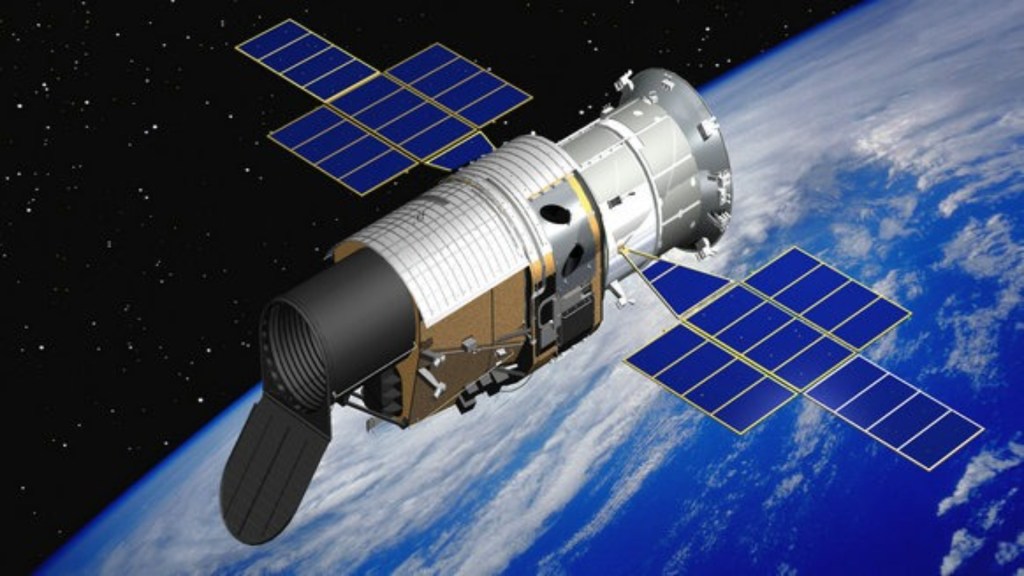
Image: Artist’s impression of the Xuntian Survey Space Telescope.
Next year China plans to launch the Xuntian (Chinese for “survey to heavens”) Survey Space Telescope that will orbit near China’s space station. Like the Hubble Space Telescope, it will be easier to service from this location. Unlike the Hubble, it will have a greater field of view – about 300-350 times greater. This field of view will allow the telescope to observe about 40 percent of the sky within its 10 year lifespan. If it last 30+ years like the Hubble, it will capture even more of the sky.
In terms of the space telescope’s planned mission, a Chinese news story stated:
It will observe well over one billion galaxies and measure their positions, shapes and brightness which may help explain how those galaxies evolve…
The telescope will also be able to help determine the upper limit of neutrino mass and shed light on the mysterious dark matter and dark energy. They’re believed to account for the majority of mass-energy content of the universe.
The versatile telescope can undertake many more intriguing studies such as drawing galactic dust map of the Milky Way, observing how super-massive blackholes are gobbling up surrounding materials, exploring exoplanets and discovering new peculiar celestial bodies.
The Xuntian should be launched later next year and be fully operational in 2024.
As long as scientists around the world can share in these observations, this type of space race benefits everyone. The more eyes on the sky, the better.
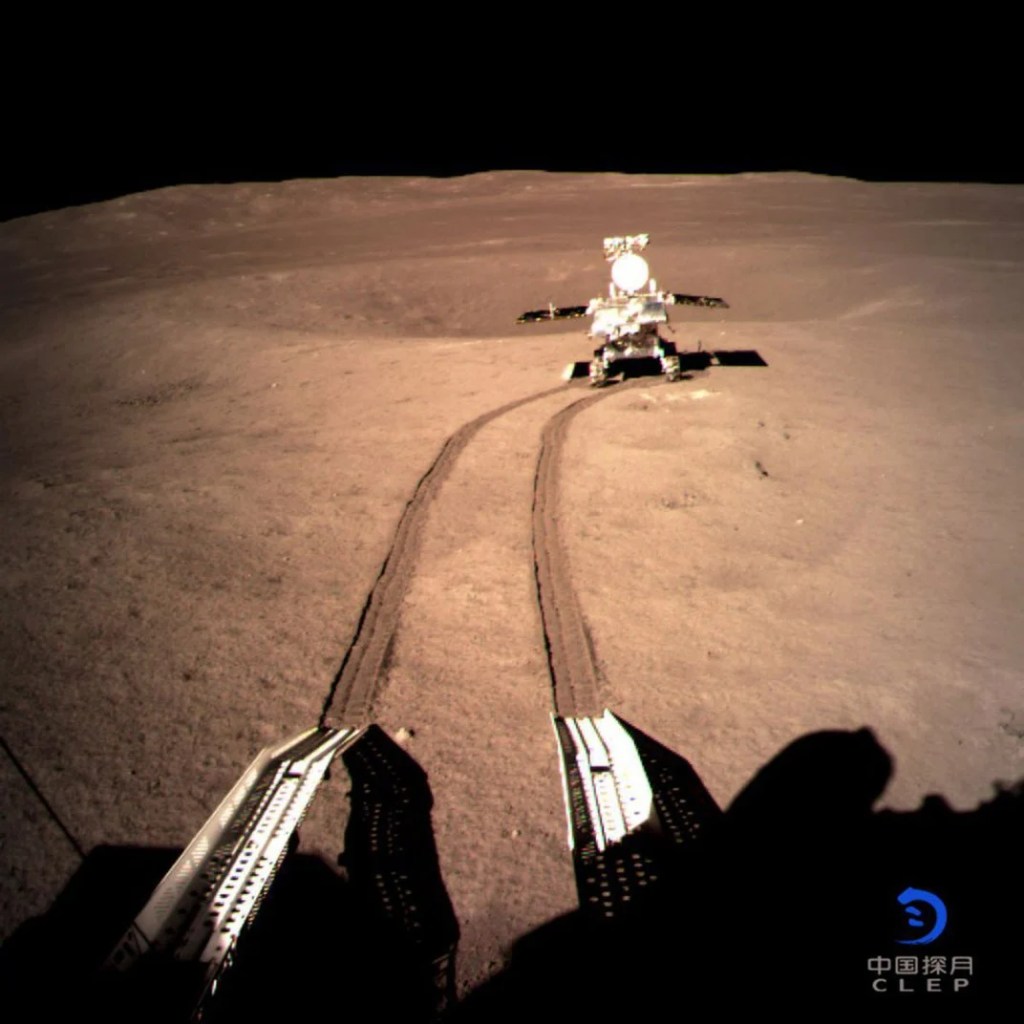
Image (Credit): China’s Yutu 2 rover explores the far side of the moon shortly after its Jan. 2, 2019, touchdown. (China National Space Administration)
“As two scholars who study space security and China’s space program, we believe that neither China nor any other nation is likely to take over the Moon in the near future. It is not only illegal, it is also technologically daunting – the costs of such an endeavor would be extremely high, while the potential payoffs would be uncertain.”
-Statement by Svetla Ben-Itzhak, Assistant Professor of Space and International Relations, Air University and R. Lincoln Hines, Assistant Professor, West Space Seminar, Air University in the Astronomy magazine article “Why China is unlikely to claim the Moon anytime soon.” It follows an earlier statement by NASA Administrator Bill Nelson, who said, “We must be very concerned that China is landing on the Moon and saying: ‘It’s ours now and you stay out.‘”


 Our Awesome Universe